


 一键配货
一键配货
化合物详情
CAS98319-26-7
分子式C23H36N2O2
分子量372.55 g/mol g/mol
危化品
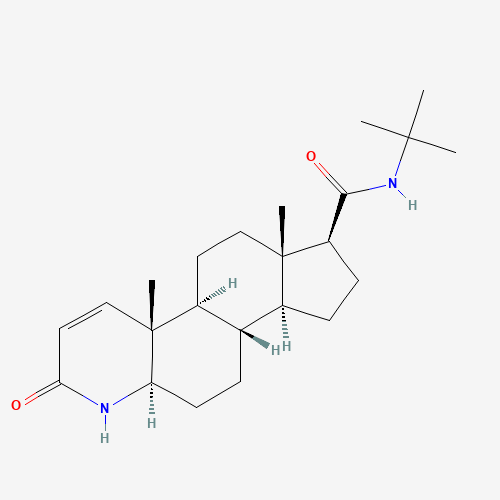
Finasteride is an aza-steroid that is a synthetic drug for the treatment of benign prostatic hyperplasia. It has a role as an androgen antagonist, an EC 1.3.1.22 [3-oxo-5alpha-steroid 4-dehydrogenase (NADP(+))] inhibitor and an antihyperplasia drug. It is an aza-steroid, a 3-oxo steroid and a delta-lactam. It derives from a hydride of a 5alpha-androstane.
科学粮草官-词典编辑部,修订于:2026-07-06
Toxicity
ToxicityHepatotoxicity
Likelihood score: E (unlikely cause of clinically apparent liver injury).
Adverse Effects
Additionally, finasteride may cause dizziness, weakness, dyspnea, rhinitis, and skin rash. Research suggests that 5-alpha reductase inhibitors (including finasteride) can increase the risk of insulin resistance, non-alcoholic fatty liver diseases, and dry eye disease. No clinically significant drug-drug interactions of finasteride are identified in studies.
Toxicity Summary
The mechanism of action of Finasteride is based on its preferential inhibition of Type II 5a-reductase through the formation of a stable complex with the enzyme. Inhibition of Type II 5a-reductase blocks the peripheral conversion of testosterone to DHT, resulting in significant decreases in serum and tissue DHT concentrations, minimal to moderate increase in serum testosterone concentrations, and substantial increases in prostatic testosterone concetrations. As DHT appears to be the principal androgen responsible for stimulation of prostatic growth, a decrease in DHT concentrations will result in a decrease in prostatic volume (approximately 20-30% after 6-24 months of continued therapy). In men with androgenic alopecia, the mechanism of action has not been fully determined, but finaste...
Human Toxicity Excerpts
Finasteride (Proscar, an orally active 5 alpha-reductase enzyme inhibitor) blocks the conversion of testosterone to dihydrotestosterone. The effects of finasteride in patients with benign prostatic hyperplasia were investigated in 2 double blind, placebo controlled studies. In study 1, 86 patients were treated with placebo or finasteride (5 to 80 mg/day) for 12 wk, followed by a 12 wk drug free period. After 12 wk of treatment all doses of finasteride showed significant decreases in prostate volume. However, 12 wk after discontinuation of finasteride prostate volume returned to near baseline values. In study 2, 104 patients were treated with placebo or finasteride (0.2 to 40 mg/day) for 24 wk. After 24 wk of finasteride treatment prostate volume showed a mean decrease of 24% and 28% (p...
Carcinogen Classification
No indication of carcinogenicity to humans (not listed by IARC).
Drug Induced Liver Injury
References: DOI:10.1016/j.drudis.2019.09.022
Non-Human Toxicity Excerpts
The endocrine control of descent of the testis in mammalian species is poorly understood. The androgen dependency of testicular descent was studied in the rat using an antiandrogen (flutamide) and an inhibitor of the enzyme 5 alpha-reductase (finasteride). Androgen receptor blockade inhibited testicular descent more effectively than inhibition of 5 alpha-reductase activity. Moreover, its inhibitory effect was limited to the outgrowth phase of the gubernaculum testis, particularly the earliest stages of outgrowth. Gubernacular size was also significantly reduced in fetuses exposed to flutamide during the outgrowth period. In contrast, androgen receptor blockade or 5 alpha-reductase inhibition applied after the initiation of gubernacular outgrowth or during the regression phase did not af...
Effects During Pregnancy and Lactation
Problems with sexual function have been reported in males taking finasteride. Some small differences have been seen in the semen of males who take finasteride, such as low sperm counts. Sperm levels improved when the medication was stopped.A study in rats did not show an increased chance for birth defects in the offspring of female rats who had mated with male rats given finasteride.There has been concerns about an increased chance of birth defects involving the sex organs of male babies if a male and female had unprotected sex during the critical time in pregnancy when the sex organs are developing (8 to 12 weeks of pregnancy). However, the amount of finasteride found in semen is small. If fetal exposure to the drug is only through semen with vaginal sex, the amount of finasteride in s...









