


 一键配货
一键配货
化合物详情
CAS98967-40-9
分子式C12H9F2N5O2S
分子量325.29 g/mol
非危品
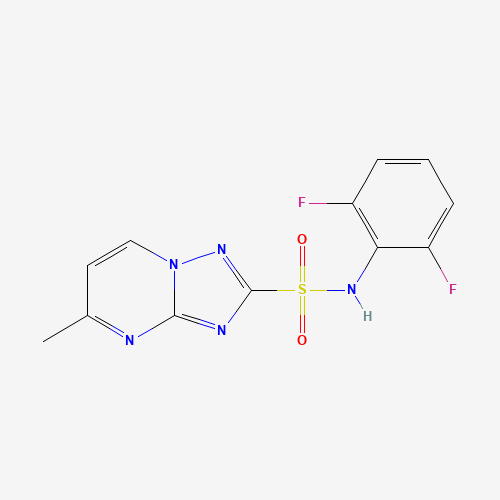
Flumetsulam is a sulfonamide.
科学粮草官-词典编辑部,修订于:2026-07-06
Toxicity
ToxicityEPA Ecotoxicity
Pesticide Ecotoxicity Data from EPA: 39
Ecotoxicity Values
LD50; Species: Apis mellifera (Honey Bee) age <8 days; topical, general >100 ug/bee /99.8% purity/
Fate Summary
ATMOSPHERIC FATE: According to a model of gas/particle partitioning of semivolatile organic compounds in the atmosphere(1), flumetsulam, which has a vapor pressure of 2.78X10⁻¹² mm Hg at 25 °C(2), is expected to exist solely in the particulate phase in the ambient atmosphere. Particulate-phase flumetsulam may be removed from the air by wet or dry deposition(SRC). Flumetsulam contains chromophores that absorb at wavelengths >290 nm(3) and, therefore, may be susceptible to direct photolysis by sunlight(SRC).
Soil Adsorption / Mobility
[Table#8514]: InBIIiwiJSBvcmdhbmljIG1hdHRlciIsIiUgc2FuZHkvc2lsdC9jbGF5IiwiS29jIgoiNS45IiwiMS4yIiwiNDMvMzcvMjEiLCIxMSIKIjYuMCIsIjEuNyIsIjM0LzYwLzUiLCIzMSIKIjUuMyIsIjQuMiIsIjEyLzU2LzMyIiwiNDQiCiI2LjQiLCI0LjEiLCI3LzU5LzM0IiwiMTYiCiI3LjIiLCIzLjYiLCI4LzYzLzI5IiwiNC4zIgoiNy43IiwiMi41IiwiMTIvNTgvMzEiLCI2LjkiCiI3LjgiLCIwLjciLCIxNC81MC8zNiIsIjcuNCIK
Environmental Biodegradation
ANAEROBIC: The biodegradation half-life of flumetsulam measured under anaerobic conditions in a water/sediment matrix incubated for 360 days at 25 °C was 183 days(1).
Environmental Bioconcentration
An estimated BCF of 3 was calculated in fish for flumetsulam(SRC), using a log Kow of 0.21(1) and a regression-derived equation(2). According to a classification scheme(3), this BCF suggests the potential for bioconcentration in aquatic organisms is low.
Volatilization from Water / Soil
A pKa of 4.6(1) indicates flumetsulam will exist partially in the anion form at pH values of 5 to 9 and, therefore, volatilization of the anion from water surfaces is not expected(SRC). The Henry's Law constant for flumetsulam is estimated as 2.1X10⁻¹⁵ atm-cu m/mole(SRC) derived from its vapor pressure, 2.78X10⁻¹² mm Hg(1), and water solubility, 565 mg/L(2). This Henry's Law constant indicates that neutral flumetsulam is expected to be essentially nonvolatile from water and moist soil surfaces(3). Flumetsulam is not expected to volatilize from dry soil surfaces(SRC) based upon its vapor pressure(1).
Environmental Abiotic Degradation
Flumetsulam did not hydrolyze after 2 months in aqueous solutions buffered to pH 5, 7 and 9(1). Flumetsulam contains chromophores that absorb at wavelengths >290 nm(2) and, therefore, may be susceptible to direct photolysis by sunlight(SRC).
Environmental Water Concentrations
RAIN: Water quality data compiled from the Retrieval (STORET) Data Warehouse reports flumetsulam was not detected (detected limit 50 ng/L) in 44 rain water samples collected 2000-2018(1).
Artificial Pollution Sources
Flumetsulam's production may result in its release to the environment through various waste streams; its use as an herbicide(1) will result in its direct release to the environment(SRC).
Probable Routes of Human Exposure
Occupational exposure to flumetsulam may occur through inhalation and dermal contact with this compound at workplaces where flumetsulam is produced or used. Monitoring data indicate that the general population is not expected to be exposed to flumetsulam. (SRC)
Environmental Fate / Exposure Summary
Flumetsulam's production may result in its release to the environment through various waste streams; its use as an herbicide will result in its direct release to the environment. If released to air, a vapor pressure of 2.78X10⁻¹² mm Hg at 25 °C indicates flumetsulam will exist solely in the particulate phase in the atmosphere. Particulate-phase flumetsulam will be removed from the atmosphere by wet or dry deposition. Flumetsulam contains chromophores that absorb at wavelengths >290 nm and, therefore, may be susceptible to direct photolysis by sunlight. If released to soil, flumetsulam is expected to have very high to moderate mobility based upon Koc values of 4.3-182. The pKa of flumetsulam is 4.6, indicating that this compound will exist partially in the anion form in the environment a...
Effect Level
collection=toxvaldb&kind=^EL$
Lethal Dose
collection=toxvaldb&kind=^LD$
Toxicity Summary
IDENTIFICATION AND USE: Flumetsulam is a broad-spectrum, season-long herbicide used in the control of broadleaf weeds in soybeans, corn, and other major crops. HUMAN STUDIES: There are no data available. ANIMAL STUDIES: Flumetsulam did not induce sensitization following dermal exposure in mice. Beagle dogs were fed flumetsulam at nominal dosages of 100-1000 mg/kg/day (males) or 1500 or 2500 mg/kg/day (females) for 2 weeks. In females, degeneration and regeneration of the renal tubular epithelial cells, and lymphocytic infiltration of hepatic sinusoids were reported. In mice fed flumetsulam for 2 weeks, decreased kidney weights were reported in males at dietary concentrations of 1.5 and 3.0% and in females given 3.0%, which corresponded to dosages >3500 mg/kg/day. In rats, dietary exposu...
RAIS Toxicity Values
Oral Chronic Reference Dose Reference: OPP
Carcinogen Classification
No indication of carcinogenicity to humans (not listed by IARC).
Non-Human Toxicity Values
LD50 Rat oral >5000 mg/kg
Reference and Risk Values
collection=toxvaldb&kind=^RRV$
Non-Human Toxicity Excerpts
/LABORATORY ANIMALS: Subchronic or Prechronic Exposure/ In rats, dietary exposure to concentrations of up to 5% (approximately 6000 mg/kg/day) for 2-4 weeks identified the kidney as the primary target organ. Effects in the kidneys consisted of focal necrosis and inflammation of the papilla(e), and tubular epithelial cell degeneration and regeneration, with secondary effects on urinalysis parameters at the highest dosage. The only effect reported at 1000 mg/kg/day was cecal enlargement in males. However, the ceca were normal histologically, and 1000 mg/kg/day was considered the NOAEL following 2-4 weeks of exposure.
Antidote and Emergency Treatment
/SRP:/ Advanced treatment: Consider orotracheal or nasotracheal intubation for airway control in the patient who is unconscious, has severe pulmonary edema, or is in severe respiratory distress. Positive-pressure ventilation techniques with a bag valve mask device may be beneficial. Consider drug therapy for pulmonary edema ... . Consider administering a beta agonist such as albuterol for severe bronchospasm ... . Monitor cardiac rhythm and treat arrhythmias as necessary ... . Start IV administration of D5W TKO /SRP: "To keep open", minimal flow rate/. Use 0.9% saline (NS) or lactated Ringer's (LR) if signs of hypovolemia are present. For hypotension with signs of hypovolemia, administer fluid cautiously. Watch for signs of fluid overload ... . Treat seizures with diazepam (Valium) or l...
USGS Health-Based Screening Levels for Evaluating Water-Quality
Reference: Smith, C.D. and Nowell, L.H., 2024. Health-Based Screening Levels for evaluating water-quality data (3rd ed.). DOI:10.5066/F71C1TWP









