


 一键配货
一键配货
化合物详情
CAS99011-02-6
分子式C14H16N4
分子量240.31 g/mol g/mol
危化品
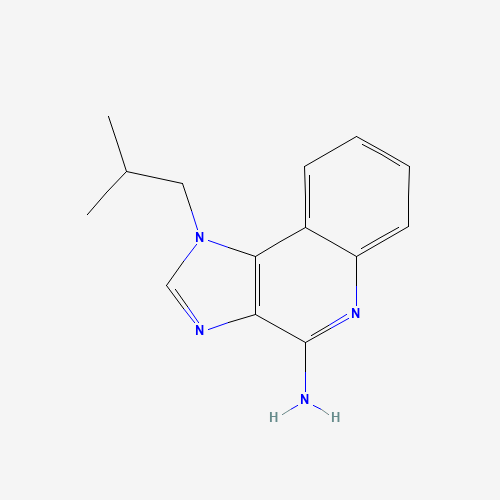
Imiquimod is an imidazoquinoline fused [4,5-c] carrying isobutyl and amino substituents at N-1 and C-4 respectively. A prescription medication, it acts as an immune response modifier and is used to treat genital warts, superficial basal cell carcinoma, and actinic keratosis. It has a role as an antineoplastic agent and an interferon inducer.
科学粮草官-词典编辑部,修订于:2026-07-06
Toxicity
ToxicityFate Summary
ATMOSPHERIC FATE: According to a model of gas/particle partitioning of semivolatile organic compounds in the atmosphere(1), imiquimod, which has an estimated vapor pressure of 7.8X10⁻⁹ mm Hg at 25 °C(SRC), determined from a fragment constant method(2), is expected to exist solely in the particulate phase in the ambient atmosphere. Particulate-phase imiquimod may be removed from the air by wet and dry deposition(SRC). Imiquimod contains chromophores that absorb at wavelengths >290 nm(3) and, therefore, may be susceptible to direct photolysis by sunlight(SRC).
Soil Adsorption / Mobility
Using a structure estimation method based on molecular connectivity indices(1), the Koc of imiquimod can be estimated to be 1000(SRC). According to a classification scheme(2), this estimated Koc value suggests that imiguimod is expected to have low mobility in soil. Aromatic amines are expected to bind strongly to humus or organic matter in soils due to the high reactivity of the aromatic amino group(3,4), suggesting that mobility may be much lower in some soils(SRC).
Environmental Biodegradation
Biodegradation data in soil or water were not available. (SRC, 2013)
Environmental Bioconcentration
An estimated BCF of 50 was calculated in fish for imiquimod(SRC), using an estimated log Kow of 3.06(1) and a regression-derived equation(2). According to a classification scheme(3), this BCF suggests the potential for bioconcentration in aquatic organisms is moderate(SRC).
Volatilization from Water / Soil
The Henry's Law constant for imiquimod is estimated as 8.3X10⁻¹³ atm-cu m/mole(SRC) using a fragment constant estimation method(1). This Henry's Law constant indicates that imiquimod is expected to be essentially nonvolatile from water and moist soil surfaces(2). Imiquimod is not expected to volatilize from dry soil surfaces(SRC) based upon an estimated vapor pressure of 7.8X10⁻⁹ mm Hg(SRC), determined from a fragment constant method(3).
Environmental Abiotic Degradation
Imiquimod is not expected to undergo hydrolysis in the environment due to the lack of functional groups that hydrolyze under environmental conditions(1). Imiquimod contains chromophores that absorb at wavelengths >290 nm(1) and, therefore, may be susceptible to direct photolysis by sunlight(SRC).
Artificial Pollution Sources
Imiquimod's production and use as an immunologic adjuvant and antineoplastic agent(1) may result in its release to the environment through various waste streams(SRC).
Probable Routes of Human Exposure
Occupational exposure to imiquimod may occur through inhalation and dermal contact with this compound at workplaces where imiquimod is produced or used. Exposure to imiquimod among the general population may be limited to those administered this drug. (SRC)
Environmental Fate / Exposure Summary
Imiquimod's production and administration as an immunologic adjuvant and antineoplastic agent may result in its release to the environment through various waste streams. If released to air, an estimated vapor pressure of 7.8X10⁻⁹ mm Hg at 25 °C indicates imiquimod will exist solely in the particulate phase in the atmosphere. Particulate-phase imiquimod will be removed from the atmosphere by wet and dry deposition. Imiquimod contains chromophores that absorb at wavelengths >290 nm and, therefore, may be susceptible to direct photolysis by sunlight. If released to soil, imiquimod is expected to have moderate mobility based upon an estimated Koc of 1000. Aromatic amines are expected to bind strongly to humus or organic matter in soils due to the high reactivity of the aromatic amino group,...
Adverse Effects
Reported side effects of 5% imiquimod cream, when used to treat external anogenital warts, are often mild and include erythema, edema, erosion, excoriation, induration, or scabbing. Patients have also reported pain, pruritus, and irritation at the site of application or local cutaneous edema or erythema with the use of topical 2.5% or 3.75% imiquimod creams to treat external anogenital warts. When used to treat actinic keratoses, reported local adverse effects of imiquimod cream include erythema, flaking, scabbing, edema, weeping, and erosion, but the presence of these reactions correlates with improved lesion clearance. Less common systemic adverse effects when 5% imiquimod cream was applied to the scalp, face, or upper extremity to treat actinic keratosis included flu-like symptoms, h...
Toxicity Summary
While most side effects of topical imiquimod use are mild, there are reports of severe local or systemic adverse effects associated with topical imiquimod use, in which case the prescriber may need to halt treatment. For patients with autoimmune conditions, the application of imiquimod over large areas of the body should prompt caution, given the potential for a systemic immune response.
Human Toxicity Excerpts
/CASE REPORTS/ A 44-year-old man who was previously diagnosed with actinic cheilitis was prescribed imiquimod cream 5%, which resulted in thick hemorrhagic crusting of the lower lip after 4 applications. He subsequently noted the development of lichen planus lesions on his arms and legs for the first time in 15 years following imiquimod use. On follow-up he also was noted to have characteristic Wickham striae on his lower lip. Lichen planus is an autoimmune inflammatory condition in which autoreactive T lymphocytes attack keratinocytes. The mechanism of action for imiquimod is upregulation of IFN-alpha and IFN-beta. Treatment with clobetasol cream 0.05% led to resolution of his lichen planus lesions.
Non-Human Toxicity Excerpts
/LABORATORY ANIMALS: Chronic Exposure or Carcinogenicity/ /The researchers/ have provided evidence for a multifaceted antitumor-function of the Toll-like receptor 7 (TLR7) agonist imiquimod, which rapidly recruits plasmacytoid dendritic cells and possibly other immune cells into tumors by inducing the secretion of CCL2 by dermal cells. Imiquimod induces pDC maturation and their conversion into cytolytic killer cells, which are capable of eliminating tumors independently from the adaptive immune system.
Populations at Special Risk
Imiquimod cream should be used with caution in patients with autoimmune conditions. Consideration should be given to balancing the benefit of imiquimod treatment for these patients with the risk associated with a possible worsening of their autoimmune conditions.
Antidote and Emergency Treatment
/SRP:/ Advanced treatment: Consider orotracheal or nasotracheal intubation for airway control in the patient who is unconscious, has severe pulmonary edema, or is in severe respiratory distress. Positive-pressure ventilation techniques with a bag valve mask device may be beneficial. Consider drug therapy for pulmonary edema ... . Consider administering a beta agonist such as albuterol for severe bronchospasm ... . Monitor cardiac rhythm and treat arrhythmias as necessary ... . Start IV administration of D5W /SRP: "To keep open", minimal flow rate/. Use 0.9% saline (NS) or lactated Ringer's if signs of hypovolemia are present. For hypotension with signs of hypovolemia, administer fluid cautiously. Watch for signs of fluid overload ... . Treat seizures with diazepam or lorazepam ... . Use...
Effects During Pregnancy and Lactation
◉ Effects on Lactation and Breastmilk









