

 一键配货
一键配货
化合物详情
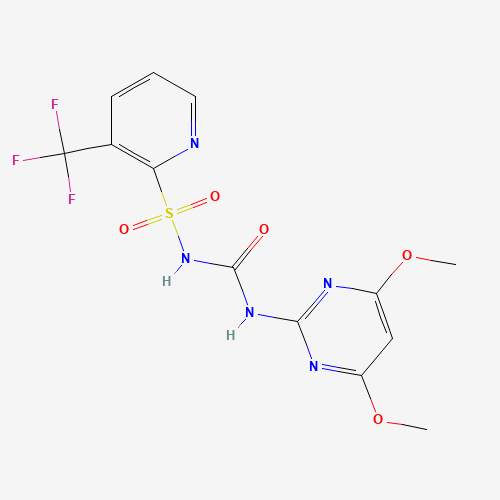
CAS104040-78-0
分子式C13H12F3N5O5S
分子量407.33 g/mol
非危品
Flazasulfuron is a member of pyridines and a sulfonamide.
科学粮草官-词典编辑部,修订于:2026-07-06
Toxicity
ToxicityEPA Ecotoxicity
Pesticide Ecotoxicity Data from EPA: 51
Ecotoxicity Values
LC50; Species: Oncorhynchus mykiss (Rainbow Trout); Concentration: 22 mg/L for 96 hr /Conditions of bioassay not specified in source examined/
Fate Summary
ATMOSPHERIC FATE: According to a model of gas/particle partitioning of semivolatile organic compounds in the atmosphere(1), flazasulfuron, which has an estimated vapor pressure of 1.81X10⁻¹⁰ mm Hg at 25 °C(SRC), determined from a fragment constant method(2), is expected to exist solely in the particulate phase in the ambient atmosphere. Particulate-phase flazasulfuron may be removed from the air by wet or dry deposition(SRC). Flazasulfuron does not contain chromophores that absorb at wavelengths >290 nm(4), and therefore is not expected to be susceptible to direct photolysis by sunlight(SRC).
Soil Adsorption / Mobility
The Koc of flazasulfuron is estimated as 290(SRC), using a log Kow of 1.30(1) and a regression-derived equation(2). According to a classification scheme(3), this estimated Koc value suggests that flazasulfuron is expected to have moderate mobility in soil(SRC) and has the potential to leach to ground water and/or reach surface water during runoff events(5). Sulfonylurea herbicides, such as flazasulfuron(6), are more mobile in alkaline soils and in soils with lower organic matter content. The pKa of flazasulfuron is 4.37(1), indicating that this compound will partially exist in the anion form in the environment and anions generally do not adsorb more strongly to soils containing organic carbon and clay than their neutral counterparts(4). The mobility of flazasulfuron is expected to incre...
Environmental Bioconcentration
An estimated BCF of 2 was calculated in fish for flazasulfuron(SRC), using an estimated log Kow of 1.30(1) and a regression-derived equation(2). According to a classification scheme(3), this BCF suggests the potential for bioconcentration in aquatic organisms is low(SRC). Flazasulfuron has low potential to bioaccumulate(4).
Volatilization from Water / Soil
The Henry's Law constant for flazasulfuron is estimated as 6.1X10⁻¹² atm-cu m/mole(SRC) using a fragment constant estimation method(1). This Henry's Law constant indicates that flazasulfuron is expected to be essentially nonvolatile from water and moist soil surfaces(2,3). Flazasulfuron is not expected to volatilize from dry soil surfaces(SRC) based upon an estimated vapor pressure of 1.8X10⁻¹⁰ mm Hg(SRC), determined from a fragment constant method(4).
Environmental Abiotic Degradation
The half-life of flazasulfuron in water has been reported as 17.4 hrs (pH 4); 16.6 days (pH 7); and 13.1 days (pH 9)(1). Flazasulfuron has been reported to undergo base-catalyzed contraction rearrangement of the sulfonylurea bridge and its hydrolysis rate is faster in alkaline conditions than acidic conditions. Flazasulfuron degrades 10 to 100 times faster than some other sulfonylureas via an intermolecular nucleophilic addition and elimination reaction. Under alkaline conditions, this product can be further hydrolyzed to a pyridinyl-pyrimidinylamine(2). Chemical and enzyme-mediated hydrolysis is a major route of transformation of flazasulfuron in water, soil, and water-sediment systems. Both the half-life and mechanism of hydrolysis are pH dependent. There are four major hydrolytic and...
Ecotoxicity Excerpts
/AQUATIC SPECIES/ ...The effects of the sulfonylurea herbicide, flazasulfuron (formulated as Katana) /were/ investigated on the unicellular green alga Scenedesmus obliquus. The pigment content of the algal suspensions was followed as a biomarker of exposure to the herbicide. The results demonstrate that flazasulfuron induced a reduction in chlorophyll content at concentrations of 10 ug/L, while the increase of pigment content in the culture was reduced with the lowest concentration tested (0.1 ug/L). Among the three pigments tested, chlorophyll a appeared to be the most sensitive biomarker. In the algal medium, flazasulfuron was slowly degraded (DT(50) approximately 8 days) to a compound that was tentatively identified. The toxicity of this herbicide for the algae was comparable to that...
Artificial Pollution Sources
Flazasulfuron's production may result in its release to the environment through various waste streams; its use as a herbicide(1) will result in its direct release to the environment(SRC).
Probable Routes of Human Exposure
Occupational exposure to flazasulfuron may occur through inhalation and dermal contact with this compound at workplaces where flazasulfuron is produced or used. (SRC)
Environmental Fate / Exposure Summary
Flazasulfuron's production may result in its release to the environment through various waste streams; its use as a herbicide will result in its direct release to the environment. If released to air, an estimated vapor pressure of 1.8X10⁻¹⁰ mm Hg at 25 °C indicates flazasulfuron will exist solely in the particulate phase in the atmosphere. Particulate-phase flazasulfuron will be removed from the atmosphere by wet or dry deposition. Flazasulfuron does not contain chromophores that absorb at wavelengths >290 nm, and therefore is not expected to be susceptible to direct photolysis by sunlight. If released to soil, flazasulfuron is expected to have moderate mobility based upon an estimated Koc of 290. Sulfonylurea herbicides, such as flazasulfuron, are more mobile in alkaline soils and in s...
Effect Level
collection=toxvaldb&kind=^EL$
Lethal Dose
collection=toxvaldb&kind=^LD$
Effect Concentration
collection=toxvaldb&kind=^EC$
RAIS Toxicity Values
Oral Chronic Reference Dose Reference: OPP
Non-Human Toxicity Values
LD50 Rat oral >5 g/kg
Reference and Risk Values
collection=toxvaldb&kind=^RRV$
Non-Human Toxicity Excerpts
/LABORATORY ANIMALS: Subchronic or Prechronic Exposure/ In a 21-day dermal toxicity study, SL-160 (/flazasulfuron/ 96.3% ai) was applied to the shaved skin of five New Zealand white rabbits/sex/dose at dose levels of 0 (water), 250, 500, or 1000 mg/kg bw/day, 6 hours/day for 21 (males) or 22 (females) consecutive days. There were no treatment-related deaths, clinical observations, dermal reactions, or effects on body weight, food consumption, hematology, clinical chemistry, organ weight, or gross or histopathology. Based on the results of this study, the systemic and dermal LOAELs for Flazasufulron in male and female rabbits are not identified, and the systemic and dermal NOAELs are the limit dose of 1000 mglkglday.
Antidote and Emergency Treatment
/SRP:/ Advanced treatment: Consider orotracheal or nasotracheal intubation for airway control in the patient who is unconscious, has severe pulmonary edema, or is in severe respiratory distress. Positive-pressure ventilation techniques with a bag valve mask device may be beneficial. Consider drug therapy for pulmonary edema ... . Consider administering a beta agonist such as albuterol for severe bronchospasm ... . Monitor cardiac rhythm and treat arrhythmias as necessary ... . Start IV administration of D5W /SRP: "To keep open", minimal flow rate/. Use 0.9% saline (NS) or lactated Ringer's if signs of hypovolemia are present. For hypotension with signs of hypovolemia, administer fluid cautiously. Watch for signs of fluid overload ... . Treat seizures with diazepam or lorazepam ... . Use...