


 一键配货
一键配货
化合物详情
CAS104098-48-8
分子式C14H17N3O3
分子量275.3 g/mol g/mol
危化品
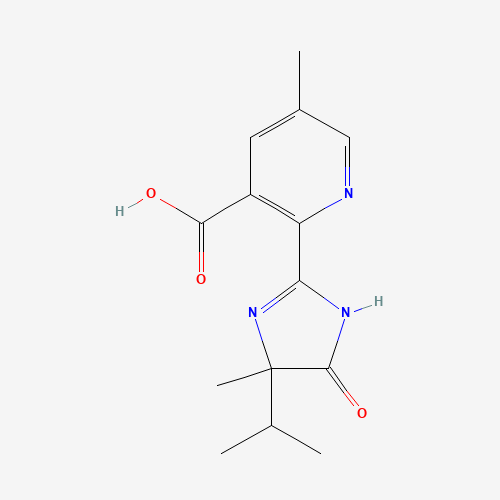
5-methyl-2-[4-methyl-5-oxo-4-(propan-2-yl)-4,5-dihydro-1H-imidazol-2-yl]pyridine-3-carboxylic acid is a pyridinemonocarboxylic acid that is 5-methylpyridine-3-carboxylic acid which is substituted at position 2 by a 4,5-dihydro-imidazol-2-yl group, which in turn is substituted at positions 4, 4, and 5 by isopropyl, methyl, and oxo groups, respectively. It is an imidazolone, a member of methylpyridines, a pyridinemonocarboxylic acid and a member of imidazolines.
科学粮草官-词典编辑部,修订于:2026-07-06
Toxicity
ToxicityEPA Ecotoxicity
Pesticide Ecotoxicity Data from EPA: 7
Ecotoxicity Values
LD50; Species: Colinus virginianus (Northern Bobwhite Quail) >2150 mg/kg /Conditions of bioassay not specified in source examined/
Fate Summary
ATMOSPHERIC FATE: According to a model of gas/particle partitioning of semivolatile organic compounds in the atmosphere(1), imazapic, which has an estimated vapor pressure of 7.7X10⁻¹² mm Hg at 25 °C(SRC), determined from a fragment constant method(2), is expected to exist solely in the particulate phase in the ambient atmosphere. Particulate-phase imazapic may be removed from the air by wet or dry deposition(SRC). Imazapic absorbs light at wavelengths >290 nm(4), and therefore may be susceptible to direct photolysis by sunlight(SRC).
Soil Adsorption / Mobility
The Koc of imazapic is estimated as 3(SRC), using a log Kow of 0.393(1) and a regression-derived equation(2). According to a classification scheme(3), this estimated Koc value suggests that imazapic is expected to have very high mobility in soil. The pKa values of imazapic are 2.0, 3.3, and 11.1(1), indicating that this compound will almost entirely exist in the anion form in the environment and anions generally do not adsorb more strongly to soils containing organic carbon and clay than their neutral counterparts(4).
Environmental Biodegradation
AEROBIC: Microbial degradation is the main loss process of imazapic in soil with half-lives ranging from 31 to 410 days. This range indicates biodegradation may be dependent on soil conditions(1).
Environmental Bioconcentration
This research was aimed at understanding the dynamics of the herbicides ... imazapic [2-(4-isopropyl-4-methyl-5-oxo-2-imidazolin-2-yl)-5-methylnicotinic acid] ... in two soils of different physicochemical properties. To accomplish such intent, several greenhouse experiments were run. The bioavailability of imazapic (0; 98 and 122.5 g ha-1) was measured in samples from a sandy loam soil and a clay soil, by sowing a bioindicator (Brachiaria decumbens /signal grass/), at 0, 25, 50, 75 and 100 days after herbicides application (DAA). ... Imazapic provided a short bioavailability in relation to B. decumbens, independent of rates applied.
Volatilization from Water / Soil
The pKa values of 2.0, 3.6, and 11.1(1) indicate imazapic will exist almost entirely in anion form at pH values of 5 to 9 and therefore volatilization from water and moist soil surfaces is not expected to be an important fate process. Imazapic is not expected to volatilize from dry soil surfaces(SRC) based upon an estimated vapor pressure of 7.7X10⁻¹² mm Hg(SRC), determined from a fragment constant method(2).
Environmental Abiotic Degradation
Imazapic is not expected to undergo hydrolysis in the environment due to the lack of functional groups that hydrolyze under environmental conditions(1). Imazapic absorbs at wavelengths >290 nm(2), and therefore it may be susceptible to direct photolysis by sunlight(SRC). When irradiated at lambda >290, imazapic (10 ppm in aqueous solution) was slowly degraded. After 2 hours, 98% of imazapic still remained; after 24 hours, imazapic decreased to 22% of original solution concentration(2).
Ecotoxicity Excerpts
/AQUATIC SPECIES/ Cyprinus carpio was exposed to imazethapyr and imazapic at laboratory and at field conditions. The laboratory experiment was carried out for 7 days and at rice field for 7, 30 and 90 days. Oxidative stress parameters and antioxidant profile were studied as well as metabolic parameters. After 7 days, brain AChE activity increases in laboratory and field, but in muscle, reduction was observed only in laboratory. At the same period, brain and muscle thiobarbituric acid reactive substances (TBARS) and liver catalase cationic amino transporters (CAT) increase in the laboratory. Metabolic parameters showed changes in both conditions and exposure periods. After 30 days in rice field, brain AChE activity decreases and in muscle it was enhanced. After 90 days in field, only mus...
Artificial Pollution Sources
Imazapic's production may result in its release to the environment through various waste streams; its use as a herbicide(1) will result in its direct release to the environment(SRC).
Probable Routes of Human Exposure
Occupational exposure to imazapic may occur through inhalation and dermal contact with this compound at workplaces where imazapic is produced or used. (SRC)
Environmental Fate / Exposure Summary
Imazapic's production may result in its release to the environment through various waste streams; its use as a herbicide will result in its direct release to the environment. If released to air, an estimated vapor pressure of 7.7X10⁻¹² mm Hg at 25 °C indicates imazapic will exist solely in the particulate phase in the atmosphere. Particulate-phase imazapic will be removed from the atmosphere by wet or dry deposition. Imazapic absorbs light at wavelengths >290 nm, and therefore may be susceptible to direct photolysis by sunlight. If released to soil, imazapic is expected to have very high mobility based upon an estimated Koc of 3. The pKa values of imazapic are 2.0, 3.6, and 11.1, indicating that this compound will exist almost entirely in the anion form in the environment and anions gen...
Effect Level
collection=toxvaldb&kind=^EL$
Lethal Dose
collection=toxvaldb&kind=^LD$
RAIS Toxicity Values
Oral Chronic Reference Dose Reference: OPP
Carcinogen Classification
No indication of carcinogenicity to humans (not listed by IARC).
Non-Human Toxicity Values
LD50 Rat oral >5000 mg/kg
Reference and Risk Values
collection=toxvaldb&kind=^RRV$
Non-Human Toxicity Excerpts
/LABORATORY ANIMALS: Chronic Exposure or Carcinogenicity/ Six Beagle dogs /sex/group received imazapic (AC 263,222, purity: 96.9%) in the diet at 0 (basal diet), 5,000, 20,000, and 40,000 ppm for 1 year. Average compound consumption during the study was 137.4, 500.7, and 1140.8 mg/kg/day for males and 180.2, 533.8, and 1092.1 mg/kg/day for females at 5,000; 20,000; and 40,000 ppm respectively. One male died from bronchopneumonia at 40,000 ppm on day 233. An increase in salivation was noted at 20,000ppm and at 40,000 ppm. Emesis (incidence per animal) was increased for both sexes at 40,000 ppm. Food consumption was decreased at some intervals at 20,000 (females) and 40,000 ppm (both sexes). Overall bodyweight gain was decreased at 40,000 ppm in both sexes. At 5,000 ppm, clinical signs, f...
Antidote and Emergency Treatment
/SRP:/ Advanced treatment: Consider orotracheal or nasotracheal intubation for airway control in the patient who is unconscious, has severe pulmonary edema, or is in severe respiratory distress. Positive-pressure ventilation techniques with a bag valve mask device may be beneficial. Consider drug therapy for pulmonary edema ... . Consider administering a beta agonist such as albuterol for severe bronchospasm ... . Monitor cardiac rhythm and treat arrhythmias as necessary ... . Start IV administration of D5W /SRP: "To keep open", minimal flow rate/. Use 0.9% saline (NS) or lactated Ringer's if signs of hypovolemia are present. For hypotension with signs of hypovolemia, administer fluid cautiously. Watch for signs of fluid overload ... . Treat seizures with diazepam or lorazepam ... . Use...









