


 一键配货
一键配货
化合物详情
CAS105512-06-9
分子式C17H13ClFNO4
分子量349.74 g/mol g/mol
危化品
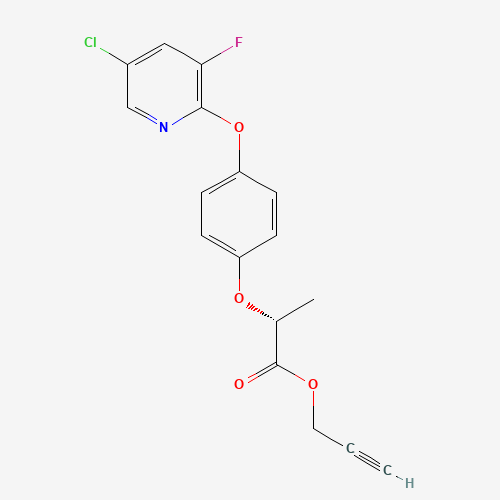
Clodinafop-propargyl is a carboxylic ester resulting from the formal condensation of the carboxy group of clodinafop with the hydroxy group of prop-2-yn-1-ol. It is widely used as a herbicide for the control of annual grass weeds in cereal crops. It has a role as a herbicide, an agrochemical and an EC 6.4.1.2 (acetyl-CoA carboxylase) inhibitor. It is a member of pyridines, a carboxylic ester, a propyzamide, an aromatic ether, an organochlorine compound and an organofluorine compound. It is functionally related to a clodinafop and a prop-2-yn-1-ol.
科学粮草官-词典编辑部,修订于:2026-07-06
Toxicity
ToxicityEPA Ecotoxicity
Pesticide Ecotoxicity Data from EPA: 68
Ecotoxicity Values
LD50; Species: Colinus virginianus (Northern Bobwhite Quail, age 16 weeks) oral via capsule 1455 mg/kg (95% confidence interval: 1205-1908 mg/kg)
Fate Summary
ATMOSPHERIC FATE: According to a model of gas/particle partitioning of semivolatile organic compounds in the atmosphere(1), clodinafop-propargyl, which has a vapor pressure of 2.40X10⁻⁸ mm Hg at 25 °C(2), will exist in both the vapor and particulate phases in the ambient atmosphere. Vapor-phase clodinafop-propargyl is degraded in the atmosphere by reaction with photochemically-produced hydroxyl radicals(SRC); the half-life for this reaction in air is estimated to be 5 hours(SRC), calculated from its rate constant of 2.7X10⁻¹¹ cu cm/molecule-sec at 25 °C(SRC) that was derived using a structure estimation method(3). Particulate-phase clodinafop-propargyl may be removed from the air by wet or dry deposition(SRC). Clodinafop-propargyl does not contain chromophores that absorb at wavelengths...
Soil Adsorption / Mobility
The Koc of clodinafop-propargyl is estimated as 2,000(SRC), using a log Kow of 3.90(1) and a regression-derived equation(2). According to a classification scheme(3), this estimated Koc value suggests that clodinafop-propargyl is expected to have slight mobility in soil. Clodinafop-propargyl is mobile in low organic soil to immobile in high organic soil(4).
Environmental Biodegradation
ANAEROBIC: The anaerobic aquatic metabolism half-life of clodinafop-propargyl is reported as 513 days(1).
Environmental Bioconcentration
An estimated BCF of 170 was calculated in fish for clodinafop-propargyl(SRC), using a log Kow of 3.90(1) and a regression-derived equation(2). According to a classification scheme(3), this BCF suggests the potential for bioconcentration in aquatic organisms is high(SRC), provided the compound is not metabolized by the organism(SRC).
Volatilization from Water / Soil
The Henry's Law constant for clodinafop-propargyl is estimated as 2.8X10⁻⁹ atm-cu m/mole(SRC) derived from its vapor pressure, 2.4X10⁻⁸ mm Hg(1), and water solubility, 4.0 mg/L(1). This Henry's Law constant indicates that clodinafop-propargyl is expected to be essentially nonvolatile from water and moist soil surfaces(2). Clodinafop-propargyl is not expected to volatilize from dry soil surfaces(SRC) based upon its vapor pressure(1).
Environmental Abiotic Degradation
The rate constant for the vapor-phase reaction of clodinafop-propargyl with photochemically-produced hydroxyl radicals has been estimated as 2.7X10⁻¹¹ cu cm/molecule-sec at 25 °C(SRC) using a structure estimation method(1). This corresponds to an atmospheric half-life of about 5 hours at an atmospheric concentration of 5X10+5 hydroxyl radicals per cu cm(1). The rate constant for the vapor-phase reaction of clodinafop-propargyl with ozone has been estimated as 3.0X10⁻¹⁹ cu cm/molecule-sec at 25 °C(SRC) that was derived using a structure estimation method(1). This corresponds to an atmospheric half-life of about 380 days at an atmospheric concentration of 7X10+11 ozone molecules per cu cm(2). The aqueous chemical hydrolysis half-life of clodinafop-propargyl is 184 days at pH 5, 2.7 days a...
Ecotoxicity Excerpts
/OTHER TERRESTRIAL SPECIES/ In the present study, DNA damage caused by clodinafop-propargyl was evaluated in silkworm, Bombyx mori, by the alkaline single-cell gel electrophoresis (SCGE). The second, fourth and fifth instar larvae of silkworm were exposed to clodinafop-propargyl by oral feeding with mulberry leaves treated using the different concentration of 30, 60, 120, 240, 480 mg/L, respectively. The results showed that comet percentage, the head DNA percentage, tail DNA percentage, tail length, tail moment and olive moment of the five tested groups were significantly different from the controlled group (P<0.01). A statistically significant (olive tail moment, P<0.01) dose-dependent increase in DNA damage was observed in silkworm. In addition, the significant dose-dependent reduce i...
Artificial Pollution Sources
Clodinafop-propargyl's production may result in its release to the environment through various waste streams; its use as a herbicide(1) will result in its direct release to the environment(SRC).
Probable Routes of Human Exposure
Occupational exposure to clodinafop-propargyl may occur through inhalation and dermal contact with this compound at workplaces where clodinafop-propargyl is produced or used. (SRC)
Environmental Fate / Exposure Summary
Clodinafop-propargyl's production may result in its release to the environment through various waste streams; its use as a herbicide will result in its direct release to the environment. If released to air, a vapor pressure of 2.4X10⁻⁸ mm Hg at 25 °C indicates clodinafop-propargyl will exist in both the vapor and particulate phases in the atmosphere. Vapor-phase clodinafop-propargyl will be degraded in the atmosphere by reaction with photochemically-produced hydroxyl radicals; the half-life for this reaction in air is estimated to be 5 hours. Particulate-phase clodinafop-propargyl will be removed from the atmosphere by wet or dry deposition. Clodinafop-propargyl does not contain chromophores that absorb at wavelengths >290 nm, and therefore is not expected to be susceptible to direct ph...
Effect Level
collection=toxvaldb&kind=^EL$
Lethal Dose
collection=toxvaldb&kind=^LD$
Toxicity Data
LC50 (rat) > 2,325 mg/m3/4h
Adverse Effects
Skin Sensitizer - An agent that can induce an allergic reaction in the skin.
Effect Concentration
collection=toxvaldb&kind=^EC$
Lethal Concentration
collection=toxvaldb&kind=^LC$
RAIS Toxicity Values
Oral Chronic Reference Dose Reference: OPP
Human Toxicity Excerpts
/CASE REPORTS/ In one plant accidental exposure to clodinafop-propargyl was reported. The injury was described as chemical burn on the skin.
Carcinogen Classification
No indication of carcinogenicity to humans (not listed by IARC).
Non-Human Toxicity Values
LD50 Rat (female) oral 2271 mg/kg /Clodinafop-propargyl technical/
Reference and Risk Values
collection=toxvaldb&kind=^RRV$
Non-Human Toxicity Excerpts
/LABORATORY ANIMALS: Subchronic or Prechronic Exposure/ In a 13 week oral toxicity study, the NOAEL for male mice was 0.9 mg/kg/day and 1.1 mg/kg/day for female mice. The LOAEL was 7.3 mg/kg/day for male mice and 8.6 mg/kg/day for female mice based on clinical chemistry; glucose, sodium, and chloride increases and hepatocellular hypertrophy in males and females. /From table/
Antidote and Emergency Treatment
/SRP:/ Advanced treatment: Consider orotracheal or nasotracheal intubation for airway control in the patient who is unconscious, has severe pulmonary edema, or is in severe respiratory distress. Positive-pressure ventilation techniques with a bag valve mask device may be beneficial. Consider drug therapy for pulmonary edema ... . Consider administering a beta agonist such as albuterol for severe bronchospasm ... . Monitor cardiac rhythm and treat arrhythmias as necessary ... . Start IV administration of D5W /SRP: "To keep open", minimal flow rate/. Use 0.9% saline (NS) or lactated Ringer's if signs of hypovolemia are present. For hypotension with signs of hypovolemia, administer fluid cautiously. Watch for signs of fluid overload ... . Treat seizures with diazepam or lorazepam ... . Use...









