


 一键配货
一键配货
化合物详情
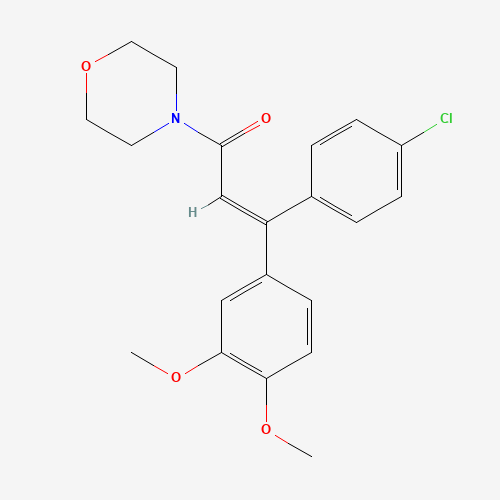
CAS110488-70-5
分子式C21H22ClNO4
分子量387.86 g/mol g/mol
危化品
Dimethomorph is a fungicide effective against Oomycetes in vines, tomatoes and other crops with an systemic affect and good protective activity. It is also a lipid synthesis inhibitor.
科学粮草官-词典编辑部,修订于:2026-07-06
Toxicity
ToxicityEPA Ecotoxicity
Pesticide Ecotoxicity Data from EPA: 30
Ecotoxicity Values
LD50; Species: Anas platyrhynchos (Mallard Duck) oral via capsule >2000 mg/kg
Fate Summary
ATMOSPHERIC FATE: According to a model of gas/particle partitioning of semivolatile organic compounds in the atmosphere(1), dimethomorph, which has a vapor pressure of 7.39X10⁻⁹ mm Hg at 25 °C(2), is expected to exist solely in the particulate phase in the ambient atmosphere. Particulate-phase dimethomorph may be removed from the air by wet or dry deposition(SRC). Dimethomorph contains chromophores that absorb at wavelengths >290 nm(3) and, therefore, may be susceptible to direct photolysis by sunlight(SRC).
Soil Adsorption / Mobility
Using a structure estimation method based on molecular connectivity indices(1), the Koc of dimethomorph can be estimated to be 5690(SRC). According to a classification scheme(2), this estimated Koc value suggests that dimethomorph is expected to be immobile in soil.
Environmental Bioconcentration
An estimated BCF of 27 was calculated in fish for dimethomorph(SRC), using a log Kow of 2.68(1) and a regression-derived equation(2). According to a classification scheme(3), this BCF suggests the potential for bioconcentration in aquatic organisms is low(SRC).
Volatilization from Water / Soil
The Henry's Law constant for dimethomorph is estimated as 1.0X10⁻¹⁵ atm-cu m/mole(SRC) using a fragment constant estimation method(1). This Henry's Law constant indicates that dimethomorph is expected to be essentially nonvolatile from water and moist soil surfaces(2). Dimethomorph is not expected to volatilize from dry soil surfaces(SRC) based upon a vapor pressure of 7.39X10⁻⁹ mm Hg(3).
Environmental Abiotic Degradation
Dimethomorph is not expected to undergo hydrolysis in the environment due to the lack of functional groups that hydrolyze under environmental conditions(1). Dimethomorph contains chromophores that absorb at wavelengths >290 nm(2) and, therefore, may be susceptible to direct photolysis by sunlight(SRC).
Food Survey Values
Dimethomorph residues were not detected in open field potato samples, in greenhouse or open field tomato samples or in greenhouse cucumber samples(1). Detection limits were 0.002, 0.015 and 0.011 mg/kg, respectively(1).
Artificial Pollution Sources
Dimethomorph's production may result in its release to the environment through various waste streams; its use as a fungicide(1) will result in its direct release to the environment(SRC).
Probable Routes of Human Exposure
Occupational exposure to dimethomorph may occur through inhalation and dermal contact with this compound at workplaces where dimethomorph is produced or used. (SRC)
Environmental Fate / Exposure Summary
Dimethomorph's production may result in its release to the environment through various waste streams; its use as a fungicide will result in its direct release to the environment. If released to air, a vapor pressure of 7.39X10⁻⁹ mm Hg at 25 °C indicates dimethomorph will exist solely in the particulate phase in the atmosphere. Particulate-phase dimethomorph will be removed from the atmosphere by wet or dry deposition. Dimethomorph contains chromophores that absorb at wavelengths >290 nm and, therefore, may be susceptible to direct photolysis by sunlight. If released to soil, dimethomorph is expected to have no mobility based upon an estimated Koc of 5690. Volatilization from moist soil surfaces is not expected to be an important fate process based upon an estimated Henry's Law constant...
Effect Level
collection=toxvaldb&kind=^EL$
Interactions
... /It was reported/ that a mixture of widely used pesticides can produce combined AR antagonist effects that exceed the responses elicited by the most potent component alone in a predictable manner.
Lethal Dose
collection=toxvaldb&kind=^LD$
RAIS Toxicity Values
Oral Chronic Reference Dose Reference: OPP
Human Toxicity Excerpts
/GENOTOXICITY/ Peripheral human lymphocytes in whole blood from a healthy male volunteer were cultured for 48 hr (0.4 mL blood in 5 mL medium) prior to exposure to test article (98.6% dimethomorph), -/+ S9, for 2 hr followed by incubation for 21-23 hr or for 45-47 hr. Cell division was arrested during the last 3 hr by 0.5 mg/mL colchicine and chromosome spreads were produced for analysis. Doses, based on 2 cytotoxicity screens for inhibition of mitotic index (with the total # of cells with aberrations (-gaps) per 200 metaphases expressed in parentheses) were 0 (0), 10 (1), 100 (2) and 333 (2) ug/mL (24-hr fixation) and 0 (6), 333 (2) and 422 (17) ug/mL (48-hr fixation) in the absence of S9, and 0 (2), 1 (3), 10 (3), 333 (0) and 422 (48; p<0.001) ug/mL (24-hr fixation) and 0 (1) and 422...
Carcinogen Classification
No indication of carcinogenicity to humans (not listed by IARC).
Non-Human Toxicity Values
LD50 Rat ip 312 mg/kg
Reference and Risk Values
collection=toxvaldb&kind=^RRV$
Non-Human Toxicity Excerpts
/LABORATORY ANIMALS: Acute Exposure/ Dermal toxicity was investigated in a study /with/ Fischer 344 rats. Groups of five males and five females exposed dermally to dimethomorph (purity, 98.5%; E:Z, 46:54) at a dose of 2000 mg/kg bw for 24 hr and then observed for 14 days. ... No signs of toxicity and no mortalities were observed. Therefore, the LD50 was greater than 2000 mg/kg bw in males and females.
Evidence for Carcinogenicity
Cancer Classification: Not Likely to be Carcinogenic to Humans
Antidote and Emergency Treatment
/SRP:/ Advanced treatment: Consider orotracheal or nasotracheal intubation for airway control in the patient who is unconscious, has severe pulmonary edema, or is in severe respiratory distress. Positive-pressure ventilation techniques with a bag valve mask device may be beneficial. Consider drug therapy for pulmonary edema ... . Consider administering a beta agonist such as albuterol for severe bronchospasm ... . Monitor cardiac rhythm and treat arrhythmias as necessary ... . Start IV administration of D5W /SRP: "To keep open", minimal flow rate/. Use 0.9% saline (NS) or lactated Ringer's if signs of hypovolemia are present. For hypotension with signs of hypovolemia, administer fluid cautiously. Watch for signs of fluid overload ... . Treat seizures with diazepam or lorazepam ... . Use...
USGS Health-Based Screening Levels for Evaluating Water-Quality
Reference: Smith, C.D. and Nowell, L.H., 2024. Health-Based Screening Levels for evaluating water-quality data (3rd ed.). DOI:10.5066/F71C1TWP









