


 一键配货
一键配货
化合物详情
CAS111991-09-4
分子式C15H18N6O6S
分子量410.41 g/mol g/mol
危化品
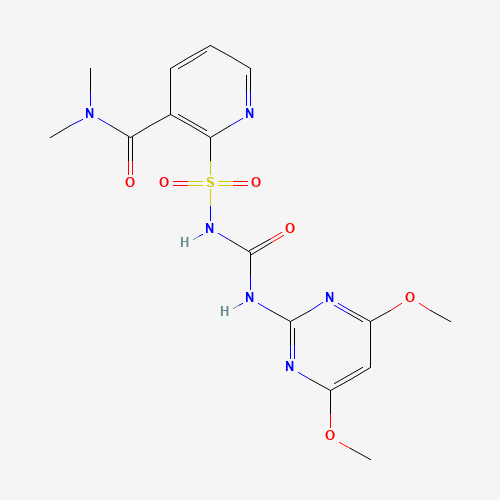
Nicosulfuron is a N-sulfonylurea that is 2-(carbamoylsulfamoyl)-N,N-dimethylpyridine-3-carboxamide substituted by a 4,6-dimethoxypyrimidin-2-yl group at the amino nitrogen. It has a role as a herbicide, a xenobiotic and an environmental contaminant. It is a member of pyridines, a member of pyrimidines and a N-sulfonylurea.
科学粮草官-词典编辑部,修订于:2026-07-06
Toxicity
ToxicityEPA Ecotoxicity
Pesticide Ecotoxicity Data from EPA: 66
Ecotoxicity Values
LD50; Species: Apis mellifera (Honey Bee, adult) topical >20 ug/bee for 48 hr
Fate Summary
ATMOSPHERIC FATE: According to a model of gas/particle partitioning of semivolatile organic compounds in the atmosphere(1), nicosulfuron, which has a vapor pressure of <6X10-12 mm Hg at 25 °C(2), is expected to exist solely in the particulate phase in the ambient atmosphere. Particulate-phase nicosulfuron may be removed from the air by wet or dry deposition(SRC). Photolysis half-lives in soil were 60-67 days and in water, 200-250 days at pH 7(2) suggesting that nicosulfuron may be susceptible to direct photolysis by sunlight(SRC).
Soil Adsorption / Mobility
Average Koc is 39 mL/g at pH 6.5 ... Koc 38.4 and Kd for a soil with 1.1% organic matter and pH 6.6; Koc 28.8 and Kd 0.26 for a soil with 2.1% organic matter and pH 6.5; Koc 78,8 and Kd 1.73 for a soil with 4.3% organic matter an dpH 5.4
Environmental Biodegradation
ANAEROBIC: Nicosulfuron, present at 10 ug/mL sediment, exhibited degradation rate constants of 1.84X10⁻²/day and 0.37X10⁻²/day using a sediment from a stagnant, slow-moving stream near Athens, GA (Beaver Dam) and from a eutrophic pond (Cherokee Park), respectively, incubated at 25 °C(1). The corresponding half-lives are 38 and 182 days, respectively(SRC). Half-lives in the respective sterile controls were 55 days (1.25X10⁻²/day) and 65 days (1.06X10⁻²/day)(1).
Environmental Bioconcentration
An estimated BCF of three was calculated in fish for nicosulfuron(SRC), using a log Kow of -1.8(1) and a regression-derived equation(2). According to a classification scheme(3), this BCF suggests the potential for bioconcentration in aquatic organisms is low(SRC).
Volatilization from Water / Soil
The Henry's Law constant for nicosulfuron is estimated as 4.1X10⁻¹⁸ atm-cu m/mole(1). This Henry's Law constant indicates that nicosulfuron is expected to be essentially nonvolatile from water and moist soil surfaces(2). Nicosulfuron is not expected to volatilize from dry soil surfaces(SRC) based upon a vapor pressure of 6.0X10⁻¹² mm Hg(3).
Environmental Abiotic Degradation
The main degradation pathway for nicosulfuron is hydrolysis of the sulfonylurea bridge(1). Nicosulfuron at a concentration of 10 ug/mL exhibited hydrolysis rate constants of 12.40X10⁻²/day (pH 4, 22 °C), 128.16X10⁻²/day (pH 4, 40 °C), 2.13X10⁻²/day (pH 7, 40 °C), and 1.34X10⁻²/day (pH 10, 40 °C)(2); the corresponding half-lives were 5.6, 0.54, 33, and 53 days, respectively(SRC). A hydrolysis half-life of 15 days at pH 5 has been reported; however, nicosulfuron has also been reported as stable to hydrolysis at pH 7 and pH 9(3). Photolysis half-lives in soil were 60-67 days and in water, 14-19 days at pH 5, 200-250 days at pH 7, and 180-200 days at pH 9. Other values reported in soil were 24-43 days at 20 °C, 80-143 days at 20 °C, and in water 15 days at pH 5 and 20 °C(3). Therefore nicos...
Environmental Water Concentrations
SURFACE WATER: Nicosulfuron was detected in 6 of 22 surface water samples collected in the midwestern US during the summer of 1997 at concentrations of 0.3, 0.18, 0.05, 0.65, 0.05, and 0.04 ug/L in the Tensas River, Tendal, LA, Iowa River, Rowan IA, Mississippi River, Clinton, IA, Wabash River, Harmony, IN, Illinois River (site 1), and Illinois River (site 2), respectively. The limit of detection = 0.08 ug/L(1). Nicosulfuron was detected in 53% of 212 water samples (73 surface sites and 25 groundwater sites) from rivers, reservoirs and ground water in the Midwestern United States, 1998. Sixty-seven of 130 stream and river samples were above the method reporting limit of 0.01 ug/L; the maximum concentration encountered was 0.266 ug/L(2).
Milk Concentrations
EXPERIMENTAL: Two female goats weighing 43 kg (#1) and 34 kg (#2) (1.4 and 1.8 mg/kg body weight respectively), were dosed daily for 3 consecutive days in feed rations treated with (pyrimidine2-(14)C)nicosulfuron, sp. act., 62.2 uCi/mg, radiochemical purity, >95%, isotopic purity, 97%, and (pyridine-2-(14)C)nicosulfuron, sp. act., 62.9 uCi/mg, radiochemical purity, >95%, isotopic purity, >99%, respectively. Dosing capsules were prepared with the (14)C-labeled materials, 13C-enriched isomers (C2 position of each respective ring), and nonradioactive nicosulfuron. The capsules were analyzed prior to dosing by LSC for total (14)C-activity and by HPLC for chemical analysis. These capsules were imbedded in a larger gelatin capsule containing 6 g of goat chow. Goat #1 was housed for a 9-day ac...
Ecotoxicity Excerpts
/AQUATIC SPECIES/ Analytically impure (approximately 85-88%) and purified (99.5%) preparations of two sulfonylurea herbicides, sulfometuron methyl and nicosulfuron, were evaluated for short- and long-term developmental effects on organogenesis (0-4 days) and limb development (0-30 days), and impact on metamorphosis (tail resorption (50-64 days)). Overall, the analytically impure sulfonylurea herbicides were more developmentally toxic than the purified preparations. Purified preparations did not induce early embryo-larval developmental effects or effects on hind limb development, although the rate of tail resorption was slowed at relatively high concentrations. Tail resorption rates were slowed significantly and abnormal limb development was induced by the analytically impure sulfonylure...
Artificial Pollution Sources
Nicosulfuron's production may result in its release to the environment through various waste streams; its use as a herbicide(1) will result in its direct release to the environment(SRC).
Probable Routes of Human Exposure
Occupational exposure to nicosulfuron may occur through inhalation and dermal contact with this compound at workplaces where nicosulfuron is produced or used. Limited monitoring data indicate that the general population may be exposed to nicosulfuron via ingestion of and dermal contact with contaminated water. (SRC)
Other Environmental Concentrations
[Table#7857]: IkZhcm1pbmcgU3lzdGVtIChZZWFyKSIsIkFtb3VudCBhcHBsaWVkIChnL2hhKSIsIkF2ZSBjb25jbiBpbiBydW5vZmYgKHVnL0wpIiwiUGVzdGljaWRlIGxvc3MgKGcvaGEpIiwiUGFzc2l2ZSBseXNpbWV0ZXIgbWF4IGNvbmNuIChwcGIpIgoiQ29udGludW91cyBuby10aWxsIGNvcm4gd2l0aCByeWUgY292ZXIgY3JvcCIsIjI5LjQiLCIyLjAzIiwiMi4zNyIsIjEzLzMzIHBvczsgNC4zOCIKIkNvbnRpbnVvdXMgbm8tdGlsbCBjb3JuIHdpdGhvdXQgcnllIGNvdmVyIGNyb3A6IiwiMTIuOSIsIjAuMTgiLCIwLjQzIiwiOS8xOCBwb3M7IDEuNjUiCiJUd28teWVhciBjb3JuIGFuZCBzb3liZWFuIHJvdGF0aW9uIHdpdGggZGVlcC10aWxsYWdlIHByaW9yIHRvIGNvcm4gKDE5OTQpIiwiNC4yIiwiMi4wMyIsIjAuMDEiLCIxLzE4IHBvczsgMC4xOSIKIlR3by15ZWFyIGNvcm4gYW5kIHNveWJlYW4gcm90YXRpb24gd2l0aCBkZWVwLXRpbGxhZ2UgcHJpb3IgdG8gY29ybiAoMTk5NSkiLCI2LjMiLCIwLjA3IiwiMC4xMSIsIiIKIlR3by15ZWFyIGNvcm4sIHdoZWF0LCBhbmQgc295YmVhbiByb3RhdGlvbiB3aXRoIG5vLXRpbGwgY29ybiwgY29...
Environmental Fate / Exposure Summary
Nicosulfuron's production may result in its release to the environment through various waste streams; its use as a herbicide will result in its direct release to the environment. If released to air, a vapor pressure of <6X10-12 mm Hg at 25 °C indicates nicosulfuron will exist solely in the particulate phase in the atmosphere. Particulate-phase nicosulfuron will be removed from the atmosphere by wet or dry deposition. Photolysis half-lives in soil were 60-67 days and in water, 200-250 days at pH 7 suggesting that nicosulfuron may be susceptible to direct photolysis by sunlight. If released to soil, nicosulfuron is expected to have high to moderate mobility based upon a Koc range of 63.0 to 567.1. Sulfonylurea herbicides, such as nicosulfruon, are more mobile in alkaline soils and in soil...
Effect Level
collection=toxvaldb&kind=^EL$
Lethal Dose
collection=toxvaldb&kind=^LD$
Effect Concentration
collection=toxvaldb&kind=^EC$
RAIS Toxicity Values
Oral Chronic Reference Dose Reference: OPP
Human Toxicity Excerpts
/GENOTOXICITY/ ... /Nicosulfuron/ (IN V9360-27) (90.6% a.i.) induced no significant damage to chromosomal structure of cultured human lymphocytes in the presence and absence of metabolic activation at 40, 200, 400 or 470 micrograms/mL concentrations. Cells were examined for chromosomal abnormalities. Nicosulfuron was not clastogenic under the conditions of this test. The maximum concentration tested 470 micrograms was the limit of the test compound solubility in the test system satisfies the guideline requirement even in the absence of cytotoxicity.
Non-Human Toxicity Values
LD50 Rat oral >5000 mg/kg
Reference and Risk Values
collection=toxvaldb&kind=^RRV$
Non-Human Toxicity Excerpts
/LABORATORY ANIMALS: Chronic Exposure or Carcinogenicity/ In an... 18-month oncogenicity study ..., nicosulfuron technical (90.6% a.i.) was administered to groups of CRL:CD-1(CR)BR mice (80/sex/dose/group) in the diet at concentrations of 0, 25, 250, 2500 or 7500 ppm (3.2, 31.4, 314, 953/ 4.2, 43.0, 420, 1260 mg/kg/day for males/females, based on 90.6% purity). The dose levels were based on a 90-day subchronic study and on the expected application rates and low residue levels. There was no treatment-related effect on survival. Clinical observations were comparable among groups of both sexes. There were no compound-related effect on body weight or body weight gain, although there were statistically significant decreases (not more than 6% below control values) noted at various time points...
Antidote and Emergency Treatment
/SRP:/ Advanced treatment: Consider orotracheal or nasotracheal intubation for airway control in the patient who is unconscious, has severe pulmonary edema, or is in severe respiratory distress. Positive-pressure ventilation techniques with a bag valve mask device may be beneficial. Consider drug therapy for pulmonary edema ... . Consider administering a beta agonist such as albuterol for severe bronchospasm ... . Monitor cardiac rhythm and treat arrhythmias as necessary ... . Start IV administration of D5W /SRP: "To keep open", minimal flow rate/. Use 0.9% saline (NS) or lactated Ringer's if signs of hypovolemia are present. For hypotension with signs of hypovolemia, administer fluid cautiously. Watch for signs of fluid overload ... . Treat seizures with diazepam or lorazepam ... . Use...
USGS Health-Based Screening Levels for Evaluating Water-Quality
Reference: Smith, C.D. and Nowell, L.H., 2024. Health-Based Screening Levels for evaluating water-quality data (3rd ed.). DOI:10.5066/F71C1TWP









