


 一键配货
一键配货
化合物详情
CAS112410-23-8
分子式C22H28N2O2
分子量352.47 g/mol g/mol
危化品
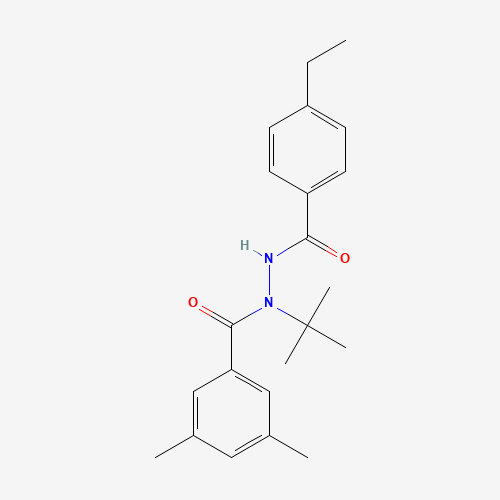
Tebufenozide is a carbohydrazide that is hydrazine in which the amino hydrogens have been replaced by tert-butyl, 3,5-dimethylbenzoyl and 4-ethylbenzoyl groups respectively. It is an insecticide used widely against caterpillars. It has a role as a xenobiotic, an ecdysone agonist and an environmental contaminant. It is functionally related to a N'-benzoyl-N-(tert-butyl)benzohydrazide.
科学粮草官-词典编辑部,修订于:2026-07-06
Toxicity
ToxicityEPA Ecotoxicity
Pesticide Ecotoxicity Data from EPA: 58
Ecotoxicity Values
LC50 Bluegill sunfish 3.0 mg/l (96 hr) /Conditions of bioassay not specified/.
Fate Summary
ATMOSPHERIC FATE: According to a model of gas/particle partitioning of semivolatile organic compounds in the atmosphere(1), tebufenozide, which has a vapor pressure of 2.25X10⁻⁸ mm Hg at 25 °C(2), is expected to exist solely in the particulate phase in the ambient atmosphere. Particulate-phase tebufenozide may be removed from the air by wet and dry deposition(SRC).
Soil Adsorption / Mobility
Using a structure estimation method based on molecular connectivity indices(1), the Koc for tebufenozide can be estimated to be 35,000(SRC). According to a classification scheme(2), this estimated Koc value suggests that tebufenozide is expected to have no mobility in soil. Downward movement in soil using a field microcosm study occurred only in trace amounts, suggesting strong adsorption(3). IN this study, tebufenozide was applied as a spray at 35, 70, and 140 g AI /ha to sandy forest soil and samples were collected at intervals up to 408 days after spraying and analyzed for tebufenozide residues. No tebufenozide was detected (LOD, 0.02 ug/g) in soil samples collected from 2.5 - 5.0 cm depth during zero to 85 days post-spray irrespective of the dosage rate. Samples from the plot spraye...
Environmental Biodegradation
ANAEROBIC: A metabolic half-life of 179 days was reported using an aquatic silt loam soil incubated at 25 °C(1).
Environmental Bioconcentration
An estimated BCF of 370 was calculated for tebufenozide(SRC), using a log Kow of 4.25(1) and a regression-derived equation(2). According to a classification scheme(3), this BCF suggests the potential for bioconcentration in aquatic organisms is high(SRC).
Volatilization from Water / Soil
Volatilization of tebufenozide from soil surfaces may occur based on results from a laboratory microcosm study; 200 g aliquots of sandy litter, sandy soil, clay litter, and clay soil each containing tebufenozide at a concn of 10 mg/kg were analyzed. The post volatilization residues (mg/kg) in samples kept in darkness at 30 °C for 10 days were 8.89 for sandy litter, 8.29 for sandy soil, 9.02 for clay litter, and 8.45 for clay soil(1).
Environmental Abiotic Degradation
Based on aquatic study data, tebufenozide was shown to be stable to hydrolysis under acidic (pH 4) and neutral (pH 7) conditions at 20 °C with half-lives of 1166 and 529 days, respectively. Under basic conditions (pH 10) and at 20 °C, the half-life for the reaction was 34 days(1). Photodegradation of tebufenozide by sunlight in surface waters was studied and the rate constant and half-life for the reaction were 8.2X10⁻³/hr and 83 hours respectively(1).
Ecotoxicity Excerpts
/FIELD STUDIES/ The effects of tebufenozide (RH-5992), a potential forest insecticide, on zooplankton communities were determined in 16 littoral enclosures in a small forest lake of northern Ontario. Community structure in enclosures treated with 9, 36, or 157 ug tebufenozide/l ( 0.2, 0.7, and 3 times the expected environmental concn) was compared with natural zooplankton communities in control enclosures. No significant treatment effects on zooplankton communities were detected, even at 3 times the expected environmental concn. While some changes in community structure of crustacean zooplankton in enclosures occurred through the season, these did not appear to be related to the tebufenozide treatments. Tebufenozide residues in water dissipated following exponential decline kinetics wit...
Artificial Pollution Sources
Tebufenozide's production may result in its release to the environment through various waste streams; it's use as an insecticide(1) will result in its direct release to the environment(SRC).
Probable Routes of Human Exposure
Occupational exposure to tebufenozide may occur through inhalation of dust and dermal contact with this compound at workplaces where tebufenozide is produced or used. (SRC)
Environmental Fate / Exposure Summary
Tebufenozide's production may result in its release to the environment through various waste streams; it's use as an insecticide will result in its direct release to the environment. If released to air, a vapor pressure of 2.25X10⁻⁸ mm Hg at 25 °C indicates tebufenozide will exist solely in the particulate phase in the ambient atmosphere. Particulate-phase tebufenozide will be removed from the atmosphere by wet and dry deposition. If released to soil, tebufenozide is expected to have no mobility based upon an estimated Koc of 35,000. A field microcosm study showed that downward movement of tebufenozide in soil occurred only in trace amounts, indicating strong adsorption to the soil. Aquatic studies determined the half-life for photodegradation of tebufenozide by sunlight in surface wate...
Effect Level
collection=toxvaldb&kind=^EL$
Lethal Dose
collection=toxvaldb&kind=^LD$
Toxicity Data
LC50 (rat) > 4,500 mg/m3/4h
Adverse Effects
Methemoglobinemia - The presence of increased methemoglobin in the blood; the compound is classified as secondary toxic effect
Effect Concentration
collection=toxvaldb&kind=^EC$
Lethal Concentration
collection=toxvaldb&kind=^LC$
RAIS Toxicity Values
Oral Chronic Reference Dose Reference: OPP
Acceptable Daily Intakes
EPA has established the Reference dose (RfD) for tebufenozide at 0.018. This RfD is based on a chronic toxicity study in dogs which found growth retardation, alterations in hematology parameters, changes in organ weights, and histopathological lesions in the bone, spleen and liver at 8.7 mg/kg/day.
Carcinogen Classification
No indication of carcinogenicity to humans (not listed by IARC).
Non-Human Toxicity Values
LC50 Rat (female) inhalation >4.5 mg/l/4 hr
Reference and Risk Values
collection=toxvaldb&kind=^RRV$
Non-Human Toxicity Excerpts
/LABORATORY ANIMALS: Subchronic or Prechronic Exposure/ A 10-wk study was conducted in the dog to examine the reversibility of the effects on hematological parameters that were observed in other dietary studies with the dog. Tebufenozide was administered for 6 weeks in the diet to 4 male dogs at concns of either 0 or 1,500 ppm. After the sixth wk, the dogs receiving treated feed were switched to the control diet for 4 weeks. Hematological parameters were measured in both groups prior to treatment, at the end of the 6-wk treatment, after 2 weeks of recovery on the control diet and after 4 weeks of recovery on the control diet. All hematological parameters in the treated/recovery group were returned to control levels indicating that the effects of tebufenozide on the hemopoietic system ar...
Antidote and Emergency Treatment
Advanced treatment: Consider orotracheal or nasotracheal intubation for airway control in the patient who is unconscious, has severe pulmonary edema, or is in respiratory arrest. Positive pressure ventilation techniques with a bag valve mask device may be beneficial. Monitor cardiac rhythm and treat arrhythmias as necessary ... . Start an IV with D5W /SRP: "To keep open", minimal flow rate/. Use lactated Ringer's if signs of hypovolemia are present. Watch for signs of fluid overload. Consider drug therapy for pulmonary edema ... . For hypotension with signs of hypovolemia, administer fluid cautiously. Watch for signs of fluid overload ... . Treat seizures with diazepam (Valium) ... . Use proparacaine hydrochloride to assist eye irrigation ... . /Poison A and B/
USGS Health-Based Screening Levels for Evaluating Water-Quality
Reference: Smith, C.D. and Nowell, L.H., 2024. Health-Based Screening Levels for evaluating water-quality data (3rd ed.). DOI:10.5066/F71C1TWP









