


 一键配货
一键配货
化合物详情
CAS113665-84-2
分子式C16H16ClNO2S
分子量321.82 g/mol
非危品
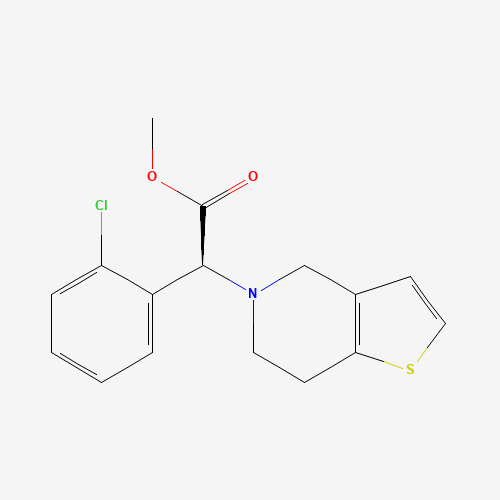
Clopidogrel is a thienopyridine that is 4,5,6,7-tetrahydrothieno[3,2-c]pyridine in which the hydrogen attached to the nitrogen is replaced by an o-chlorobenzyl group, the methylene hydrogen of which is replaced by a methoxycarbonyl group (the S enantiomer). A P2Y12 receptor antagonist, it is used to inhibit blood clots and prevent heart attacks. It has a role as an anticoagulant, a platelet aggregation inhibitor and a P2Y12 receptor antagonist. It is a methyl ester, a thienopyridine and a member of monochlorobenzenes. It is functionally related to a ticlopidine.
科学粮草官-词典编辑部,修订于:2026-07-06
Toxicity
ToxicityFate Summary
ATMOSPHERIC FATE: According to a model of gas/particle partitioning of semivolatile organic compounds in the atmosphere(1), clopidogrel, which has an estimated vapor pressure of 2.9X10⁻⁷ mm Hg at 25 °C(SRC), determined from a fragment constant method(2), will exist in both the vapor and particulate phases in the ambient atmosphere. Vapor-phase clopidogrel is degraded in the atmosphere by reaction with photochemically-produced hydroxyl radicals(SRC); the half-life for this reaction in air is estimated to be 1 hour(SRC), calculated from its rate constant of 1.2X10⁻¹⁰ cu cm/molecule-sec at 25 °C(SRC) that was derived using a structure estimation method(3). Particulate-phase clopidogrel may be removed from the air by wet or dry deposition(SRC). Clopidogrel does not contain chromophores that...
Soil Adsorption / Mobility
Using a structure estimation method based on molecular connectivity indices(1), the Koc of clopidogrel can be estimated to be 9600(SRC). According to a classification scheme(2), this estimated Koc value suggests that clopidogrel is expected to be immobile in soil. The estimated pKa of clopidogrel is 5.3 (tertiary amine)(3), indicating that this compound will exist partially as a cation in the environment under acidic conditions and cations generally adsorb to soil more strongly than their neutral counterparts(4).
Environmental Bioconcentration
An estimated BCF of 150 was calculated in fish for clopidogrel(SRC), using an estimated log Kow of 3.82(1) and a regression-derived equation(2). According to a classification scheme(3), this BCF suggests the potential for bioconcentration in aquatic organisms is high(SRC), provided the compound is not metabolized by the organism(SRC).
Volatilization from Water / Soil
The Henry's Law constant for clopidogrel is estimated as 2.2X10⁻⁹ atm-cu m/mole(SRC) using a fragment constant estimation method(1). This Henry's Law constant indicates that clopidogrel is expected to be essentially nonvolatile from water and moist soil surfaces(2). Clopidogrel is not expected to volatilize from dry soil surfaces(SRC) based upon an estimated vapor pressure of 2.9X10⁻⁷ mm Hg(SRC), determined from a fragment constant method(3).
Environmental Abiotic Degradation
The rate constant for the vapor-phase reaction of clopidogrel with photochemically-produced hydroxyl radicals has been estimated as 1.2X10⁻¹⁰ cu cm/molecule-sec at 25 °C(SRC) using a structure estimation method(1). This corresponds to an atmospheric half-life of about one hour at an atmospheric concentration of 5X10+5 hydroxyl radicals per cu cm(1). A base-catalyzed second-order hydrolysis rate constant of 9.5X10⁻³ L/mole-sec(SRC) was estimated using a structure estimation method(2); this corresponds to half-lives of 23 and 2 years at pH values of 7 and 8, respectively(2). Clopidogrel does not contain chromophores that absorb at wavelengths >290 nm(3), and therefore is not expected to be susceptible to direct photolysis by sunlight(SRC).
Environmental Water Concentrations
While data specific to clopidogrel were not located(SRC, 2011), the literature suggests that some pharmaceutically active compounds originating from human and veterinary therapy are not eliminated completely in municipal sewage treatment plants and are therefore discharged into receiving waters(1). Wastewater treatment processes often were not designed to remove them from the effluent(2). Selected organic waste compounds may be degrading to new and more persistent compounds that may be released instead of or in addition to the parent compound(2). Studies have indicated that several polar pharmaceutically active compounds can leach through soils(1).
Artificial Pollution Sources
Clopidogrel's production and use as an antithrombotic(1) may result in its release to the environment through various waste streams(SRC).
Probable Routes of Human Exposure
Occupational exposure to clopidogrel may occur through inhalation and dermal contact with this compound at workplaces where clopidogrel is produced or used. Exposure among the general population may be limited to those being adminstered pharmaceutical products containing clopidogrel. (SRC)
Environmental Fate / Exposure Summary
Clopidogrel's production and use as an antithrombotic may result in its release to the environment through various waste streams. If released to air, an estimated vapor pressure of 2.9X10⁻⁷ mm Hg at 25 °C indicates clopidogrel will exist in both the vapor and particulate phases in the atmosphere. Vapor-phase clopidogrel will be degraded in the atmosphere by reaction with photochemically-produced hydroxyl radicals; the half-life for this reaction in air is estimated to be one hour. Particulate-phase clopidogrel will be removed from the atmosphere by wet or dry deposition. Clopidogrel does not contain chromophores that absorb at wavelengths >290 nm, and therefore is not expected to be susceptible to direct photolysis by sunlight. If released to soil, clopidogrel is expected to have no mob...
Interactions
Concurrent use of clopidogrel and omeprazole, a potent inhibitor of CYP2C19, also has been shown to reduce the antiplatelet effects of clopidogrel. Although the clinical importance of this interaction has not been fully elucidated, some evidence suggests that concurrent use of clopidogrel and omeprazole may result in reduced efficacy of clopidogrel in preventing cardiovascular events. Concomitant use of other drugs that inhibit CYP2C19 also may decrease the response to clopidogrel.
Hepatotoxicity
Likelihood score: B (highly likely but rare cause of clinically apparent liver injury).
Adverse Effects
* Repaglinide: Clopidogrel's acyl-β-glucuronide metabolite inhibits CYP2C8, potentially increasing systemic exposure to drugs metabolized by this enzyme, such as repaglinide. Glucose monitoring and dose adjustments are required.
Toxicity Summary
In the above scenario, given the patient’s stable condition and lack of significant symptoms, the treatment focused on supportive care. A Foley catheter was inserted, and the urinary bladder was irrigated with isotonic saline, which lightened the pinkish-red urine. No active charcoal was administered due to the delayed presentation (5 hours after ingestion) and unavailability. The patient was monitored in the emergency department for 48 hours. Hemoglobin levels remained stable, and no complications developed. He was discharged after an uneventful observation period. According to the product labeling, platelet transfusion could help restore the clotting function in an emergency. According to the literature review, platelet transfusion in patients on clopidogrel can partially restore plat...
Human Toxicity Excerpts
/CASE REPORTS/ The cases of 2 patients who lost their sense of taste during clopidogrel treatment are reported. A 76-yr-old woman was taking clopidogrel 75 mg daily for 6 wk when she observed a loss of taste. Three wk after the loss of taste was observed, clopidogrel treatment was discontinued. About 3 wk later, there was full recovery of taste. A 64-yr-old man was given clopidogrel 75 mg daily for 2 months when loss of taste was observed. The clopidogrel treatment was stopped. Full recovery of the loss of taste was observed within 6 wk. Clopidogrel treatment was then resumed but with a different preparation. About 2 wk later, the patient again reported a loss of taste. Therefore, the treatment was discontinued again. Six wk later the loss of taste persisted.
Drug Induced Liver Injury
References: DOI:10.1016/j.drudis.2019.09.022
Non-Human Toxicity Excerpts
/GENOTOXICITY/ Clopidogrel was not genotoxic in four in vitro tests (Ames test, DNA-repair test in rat hepatocytes, gene mutation assay in Chinese hamster fibroblasts, and metaphase chromosome analysis of human lymphocytes) and in one in vivo test (micronucleus test by oral route in mice).
Populations at Special Risk
The effectiveness of Plavix is dependent on its activation to an active metabolite by the cytochrome P450 (CYP) system, principally CYP2C19. Plavix at recommended doses forms less of that metabolite and has a smaller effect on platelet function in patients who are CYP2C19 poor metabolizers. Poor metabolizers with acute coronary syndrome or undergoing percutaneous coronary intervention treated with Plavix at recommended doses exhibit higher cardiovascular event rates than do patients with normal CYP2C19 function. Tests are available to identify a patient's CYP2C19 genotype; these tests can be used as an aid in determining therapeutic strategy. Consider alternative treatment or treatment strategies in patients identified as CYP2C19 poor metabolizers
Antidote and Emergency Treatment
Thienopyridines inhibit platelet aggregation for the lifetime of the platelet (7-10 days), so withholding a dose will not be useful in managing a bleeding event or the risk of bleeding associated with an invasive procedure. Because the half-life of clopidogrel's active metabolite is short, it may be possible to restore hemostasis by administering exogenous platelets; however, platelet transfusions within 4 hours of the loading dose or 2 hours of the maintenance dose may be less effective.
Effects During Pregnancy and Lactation
Studies have not been done in humans to see if clopidogrel could affect male fertility (ability to get partner pregnant) or increase the chance of birth defects above the background risk. In animal studies, there were no reported effects on fertility. In general, exposures that fathers or sperm donors have are unlikely to increase risks to a pregnancy. For more information, please see the MotherToBaby fact sheet Paternal Exposures at https://mothertobaby.org/fact-sheets/paternal-exposures-pregnancy/.









