


 一键配货
一键配货
化合物详情
CAS114311-32-9
分子式C15H19N3O4
分子量305.33 g/mol g/mol
危化品
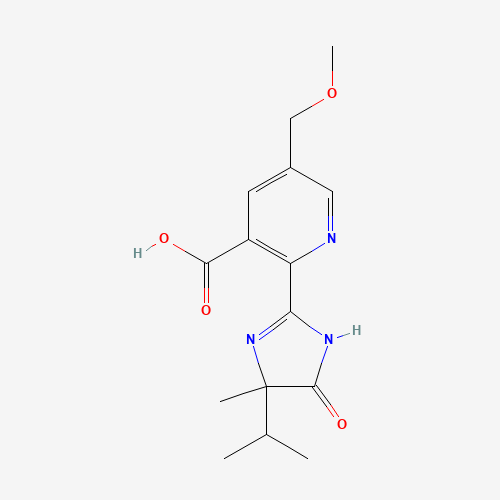
2-(4-isopropyl-4-methyl-5-oxo-4,5-dihydro-1H-imidazol-2-yl)-5-(methoxymethyl)nicotinic acid is a pyridinemonocarboxylic acid that is nicotinic acid which is substituted substituted at position 5 by a methoxymethyl group and at position 2 by a 4,5-dihydro-1H-imidazol-2-yl group, that in turn is substituted by isopropyl, methyl, and oxo groups at positions 4, 4, and 5, respectively. It is an imidazolone, an ether, a pyridinemonocarboxylic acid and a member of imidazolines.
科学粮草官-词典编辑部,修订于:2026-07-06
Toxicity
ToxicityEPA Ecotoxicity
Pesticide Ecotoxicity Data from EPA: 69
Fate Summary
ATMOSPHERIC FATE: According to a model of gas/particle partitioning of semivolatile organic compounds in the atmosphere(1), imazamox, which has an estimated vapor pressure of 1.26X10⁻¹¹ mm Hg at 25 °C determined from a fragment constant method(2), is expected to exist solely in the particulate phase in the ambient atmosphere. Particulate-phase imazamox may be removed from the air by wet and dry deposition(SRC). Imazamox photolytically decays with reported half-lives of 6.8 hours (or 0.3 days)(5,6) and 78 minutes (or 3 days)(7) for primary degradation in aqueous media. Direct aqueous photolysis results in several stable degradates(7). Photolysis in soil is a slower process with a half-life of 65 days(6). The rate of photodegradation decreases in the presence of Cu(II) and Ca(II) salts wh...
Soil Adsorption / Mobility
The experimental Koc of imazamox ranges from 5 to 143, tested in soils with 0.29 to 2.59% organic carbon(1). According to a classification scheme(2), these Koc values suggest that imazamox is expected to have very high mobility in soil. The pKa values of imazamox have been reported as 2.3, 3.3 and 10.8(3), indicating that this compound will exist entirely in anion form in the environment and anions generally do not adsorb as strongly to soils containing organic carbon and clay than their neutral counterparts(4). While imazamox is considered very mobile, the terminal soil metabolite is moderately mobile to immobile, with Koc values ranging between 331 to 1924(5). Leaching of imazamox in field studies was very limited(5). Imazamox is generally weakly bound to soil, but adsorption increase...
Environmental Biodegradation
ANAEROBIC: Imazamox is not susceptible to anaerobic biodegradation in water and soil(1).
Environmental Bioconcentration
Imazamox concentrations in whole and edible bluegill fish tissue were below the quantification limit, and the BCF for inedible tissue was less than 1X the concentration tested(1). An estimated BCF of 3.2 was calculated in fish for imazamox(SRC), using a log Kow of 0.73(2) and a regression-derived equation(3). According to a classification scheme(4), this BCF data suggests the potential for bioconcentration in aquatic organisms is low(SRC).
Volatilization from Water / Soil
The Henry's Law constant for imazamox is estimated as 9.15X10⁻¹⁹ atm-cu m/mole(SRC) using a fragment constant estimation method(1). This Henry's Law constant indicates that imazamox is expected to be essentially nonvolatile from water surfaces(2). The pKa values of imazamox have been reported as 2.3, 3.3, and 10.8(3). These values indicate imazamox will exist entirely in the anion form at pH values of 5 to 9 and, therefore, volatilization from moist soil is not expected to be an important fate process(2). Imazamox is not expected to volatilize from dry soil surfaces(SRC) based upon an estimated vapor pressure of 1.26X10⁻¹¹ mm Hg(SRC), determined from a fragment constant method(4).
Environmental Abiotic Degradation
The rate constant for the vapor-phase reaction of imazamox with photochemically-produced hydroxyl radicals has been estimated as 2.13X10⁻¹¹ cu cm/molecule-sec at 25 °C(SRC) using a structure estimation method(1). This corresponds to an atmospheric half-life of about 18 hours at an atmospheric concentration of 5X10+5 hydroxyl radicals per cu cm(2). However, this is not expected to be an important fate process as this chemical does not exist in the vapor phase in the ambient atmosphere. Imazamox is stable to hydrolysis at environmentally relevant pH values(3,5). No degradation was observed at 25 °C and pH values of 4, 5, 7, and 9 and a hydrolysis half-life of 192 days was reported for pH 9 at 25 °C(4,5). Imazamox photolytically decays with reported half-lives of 6.8 hours(or 0.3 days )(3,...
Environmental Water Concentrations
[Table#6621]: IkRhdGUiLCJOby4gUG9zaXRpdmUiLCJDb25jbiIsIk1vbml0b3JpbmcgU3RhdGUiCiJKYW4gLSBEZWMgMjAxMiIsIjcgb2YgNTc0IiwiNi44IC0gNTguNSBuZy9MIiwiVVQsIFNDLCBOTSwgSUEsIE9SLCBOQywgQ0EsIExBLCBXQSwgTUksIElOLCBUWCwgRkwsIE5KLCBXWSwgTkUsIFROLCBNTywgTlksIENULCBHQSwgTUQsIENPLCBJTCwgTlYsIEtZIgoiSmFuIC0gRGVjIDIwMTMiLCIzMyBvZiAyNzY1IiwiMS43IC0gMjU4IG5nL0wiLCJVVCwgU0MsIE5NLCBJQSwgT1IsIE5DLCBDQSwgTEEsIFdBLCBNSSwgSU4sIFRYLCBGTCwgTkosIFdZLCBORSwgVE4sIE1PLCBOWSwgQ1QsIEdBLCBNRCwgQ08sIElMLCBBWiwgTlYsIEtZIgoiSmFuIC0gRGVjIDIwMTQiLCIxMSBvZiAyMjgwIiwiMi43IC0gMzQuOCBuZy9MIiwiVVQsIFNDLCBOTSwgSUEsIE9SLCBOQywgQ0EsIExBLCBXQSwgTUksIElOLCBUWCwgRkwsIE5KLCBXWSwgTkUsIFROLCBNTywgTlksIENULCBHQSwgTUQsIENPLCBJTCwgQVosIE5WLCBLWSIKIkphbiAtIERlYyAyMDE1IiwiMTkgb2YgMjQ0MyIsIjYuMiAtIDIsNjgwIG5nL0wiLCJVVCwgU0MsIE5NLCBJQSwgT1IsIE5DLCB...
Food Survey Values
In FDA total diet studies analyzing foods as part of the pesticide monitoring program during the fiscal year 2014, imazamox was detected in 3% of food items examined at concentrations of 0.0001-0.005 ppm, in FY2013 imazamox was detected in 2% (0.0001-0.0007 ppm)(1). For fiscal years 2009 through 2012 imazamox was not listed in the reports(1). Imazamox was not listed in the FDA total diet study Market Baskets 2004 to 2005(2).
Ecotoxicity Excerpts
/OTHER TOXICITY INFORMATION/ ...Imazamox is practically nontoxic to avian species, finfish, aquatic invertebrates, and honeybees following acute exposure.
Artificial Pollution Sources
Imazamox's production may result in its release to the environment through various waste streams; its use as a broad-spectrum herbicide for post-emergence control of broadleaf weeds and grass (1,2) will result in its direct release to the environment(SRC).
Sediment/Soil Concentrations
SOIL: Water quality data compiled from the USGS National Water Information System (NWIS) reports soil monitoring data for imazamox. One routine sample was reported for Oct 22, 2014, imazamox was not detected, LOD = 31.1 ng/L(1).
Probable Routes of Human Exposure
Occupational exposure to imazamox may occur through inhalation of dust and dermal contact with this compound at workplaces where imazamox is produced or used. Monitoring data indicate that the general population may be exposed to imazamox via ingestion of food and drinking water contaminated with this compound and dermal contact with surface waters containing this compound, especially in areas where it has been applied.(SRC)
Environmental Fate / Exposure Summary
Imazamox's production may result in its release to the environment through various waste streams; its use as a broad-spectrum herbicide for post-emergence control of broadleaf weeds and grass will result in its direct release to the environment. If released to air, an estimated vapor pressure of 1.26X10⁻¹¹ mm Hg at 25 °C indicates imazamox will exist solely in the particulate phase in the atmosphere. Particulate-phase imazamox will be removed from the atmosphere by wet and dry deposition. Photodegradation is rapid in shallow waters but slow on soil. If released to soil, imazamox is expected to have very high mobility based upon Koc values of 5 to 143.The pKa values of imazamox have been reported as 2.3, 3.3 and 10.8, indicating that this compound will exist entirely in the anion form in...
Effect Level
collection=toxvaldb&kind=^EL$
Lethal Dose
collection=toxvaldb&kind=^LD$
Toxicity Data
LC50 (rat) > 6,300 mg/m3
Toxicity Summary
IDENTIFICATION AND USE: Imazamox is off-white powdered solid. It is a herbicide applied post-emergence in soybean. HUMAN STUDIES: In an in vitro study, human embryonic stem cells were treated with imazamox at a concentration of 0, 1, 10 or 100 umol/L, incubation did not induce cytotoxicity. ANIMAL STUDIES: In the acute toxicity studies, the substance has low acute toxicity when administered orally, dermally or by inhalation to rats. It is not a significant skin or eye irritant or a skin sensitizer. Imazamox showed no short-term and long-term toxicity after oral exposure to rats, mice and dogs up to the limit top dose level tested in each study. Based on available genotoxicity studies imazamox is unlikely to be genotoxic. The substance showed no carcinogenic potential in both species. In...
Human Toxicity Excerpts
/PREGNANCY AND HUMAN REPRODUCTION/ In an in vitro study, human embryonic stem cells (WA09) were treated with imazamox at a concentration of 0, 1, 10 or 100 umol/L. Metabolomic changes were assessed by liquid chromatographic-mass spectrometric analysis. According to the authors, incubation did not induce cytotoxicity. Data were analysed with models to predict developmental toxicity, which were set up with data from (1) pharmaceutical agents or (2) selected pesticides from the USEPA's Toxicity Reference Database (ToxRefDB). ...
Carcinogen Classification
No indication of carcinogenicity to humans (not listed by IARC).
Non-Human Toxicity Values
LD50 Rabbit dermal >4000 mg/kg bw
Non-Human Toxicity Excerpts
/LABORATORY ANIMALS: Subchronic or Prechronic Exposure/ /Imazamox/ was admixed to the diet at dose levels of 0 (untreated diet), 1000, 10000, or 20000 ppm (0, 76, 785, and 1550 mg/kg/day, respectively, for males and 0, 86, 880, and 1772 mg/kg/day, for females) and fed to 10 CD rats per sex per dose for 13 consecutive weeks. No mortalities occurred. No treatment-related clinical signs were observed. No treatment-related body weight, hematological, or serum chemistry effects were observed. Macroscopic and microscopic examinations revealed no treatment-related abnormalities.
Evidence for Carcinogenicity
Cancer Classification: Not likely to be carcinogenic to humans
Antidote and Emergency Treatment
Advanced treatment: Consider orotracheal or nasotracheal intubation for airway control in the patient who is unconscious, has severe pulmonary edema, or is in respiratory arrest. Positive pressure ventilation techniques with a bag-valve-mask device may be beneficial. Monitor cardiac rhythm and treat arrhythmias as necessary ... . Start an iv with D5W /SRP: "To keep open", minimal flow rate/. Use lactated Ringer's if signs of hypovolemia are present. Watch for signs of fluid overload. Consider drug therapy for pulmonary edema ... . For hypotension with signs of hypovolemia, administer fluid cautiously. Watch for signs of fluid overload ... . Treat seizures with diazepam (Valium) ... . Use proparacaine hydrochloride to assist eye irrigation ... . /Poison A and B/
USGS Health-Based Screening Levels for Evaluating Water-Quality
Reference: Smith, C.D. and Nowell, L.H., 2024. Health-Based Screening Levels for evaluating water-quality data (3rd ed.). DOI:10.5066/F71C1TWP









