


 一键配货
一键配货
化合物详情
CAS115103-54-3
分子式C20H25NO2S2
分子量375.55 g/mol
非危品
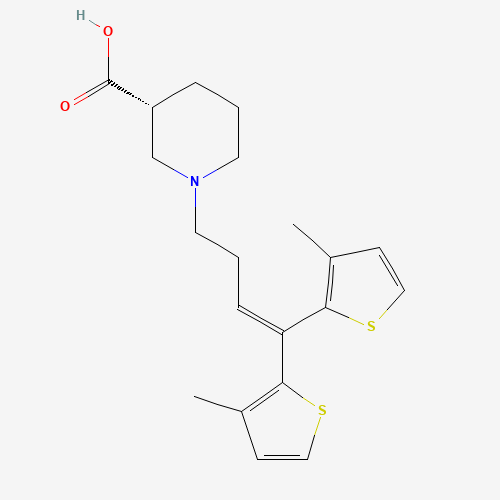
Tiagabine is a piperidinemonocarboxylic acid that is (R)-nipecotic acid in which the hydrogen attached to the nitrogen has been replaced by a 1,1-bis(3-methyl-2-thienyl)but-1-en-4-yl group. A GABA reuptake inhibitor, it is used (generally as the hydrochloride salt) for the treatment of epilepsy. It has a role as an anticonvulsant and a GABA reuptake inhibitor. It is a piperidinemonocarboxylic acid, a member of thiophenes, a beta-amino acid and a tertiary amino compound. It is functionally related to a (R)-nipecotic acid. It is a conjugate base of a tiagabine(1+).
科学粮草官-词典编辑部,修订于:2026-07-06
Toxicity
ToxicityEnvironmental Water Concentrations
While data specific to tiagabine were not located(SRC, 2007), the literature suggests that some pharmaceutically active compounds originating from human and veterinary therapy are not eliminated completely in municipal sewage treatment plants and are therefore discharged into receiving waters(1). Wastewater treatment processes often were not designed to remove them from the effluent(2). Selected organic waste compounds may be degrading to new and more persistent compounds that may be released instead of or in addition to the parent compound(2).
Symptoms
Symptoms most often accompanying tiagabine overdose, alone or in combination with other drugs, have included: seizures including status epilepticus in patients with and without underlying seizure disorders, nonconvulsive status epilepticus, coma, ataxia, confusion, somnolence, drowsiness, impaired speech, agitation, lethargy, myoclonus, spike wave stupor, tremors, disorientation, vomiting, hostility, and temporary paralysis. Respiratory depression was seen in a number of patients, including children, in the context of seizures.
Treatment
There is no specific antidote for overdose with Tiagabine. If indicated, elimination of unabsorbed drug should be achieved by emesis or gastric lavage; usual precautions should be observed to maintain the airway. General supportive care of the patient is indicated including monitoring of vital signs and observation of clinical status of the patient. Since tiagabine is mostly metabolized by the liver and is highly protein bound, dialysis is unlikely to be beneficial. (L1712)
Interactions
Co-administration of cimetidine (800 mg/day) to patients taking tiagabine chronically had no effect on tiagabine pharmacokinetics.
Health Effects
Respiratory depression was seen in a number of patients, including children, in the context of seizures. May cause a potentially dangerous rash that may develop into Stevens Johnson syndrome, an extremely rare but potentially fatal skin disease.
Hepatotoxicity
Likelihood score: E (unlikely cause of clinically apparent liver injury).
Exposure Routes
Oral. Tiagabine is nearly completely absorbed (>95%).
Toxicity Summary
Though the exact mechanism by which Tiagabine exerts its effect on the human body is unknown, it does appear to operate as a selective GABA reuptake inhibitor.
Human Toxicity Excerpts
/CASE REPORTS/ There have been as many as 10 cases of sudden unexpected deaths during the clinical development of tiagabine among 2531 patients with epilepsy (3831 patient-years of exposure). This represents an estimated incidence of 0.0026 deaths per patient-year. This rate is within the range of estimates for the incidence of sudden and unexpected deaths in patients with epilepsy not receiving /tiagabine/ (ranging from 0.0005 for the general population with epilepsy, 0.003 to 0.004 for clinical trial populations similar to that in the clinical development program for /tiagabine/, to 0.005 for patients with refractory epilepsy). The estimated SUDEP rates in patients receiving /tiagabine/ are also similar to those observed in patients receiving other antiepilepsy drugs, chemically unrel...
Carcinogen Classification
No indication of carcinogenicity to humans (not listed by IARC).
Drug Induced Liver Injury
References: DOI:10.1016/j.drudis.2019.09.022
Non-Human Toxicity Excerpts
/LABORATORY ANIMALS: Developmental or Reproductive Toxicity/ Decreased maternal weight gain, increased resorption of embryos and increased incidences of fetal variations, but not malformations, were observed when pregnant rabbits were given 25 mg/kg/day (8 times the MRHD) during organogenesis. The no effect level for maternal and embryo-fetal toxicity in rabbits was 5 mg/kg/day (equivalent to the MRHD).
Antidote and Emergency Treatment
/SRP:/ Advanced treatment: Consider orotracheal or nasotracheal intubation for airway control in the patient who is unconscious, has severe pulmonary edema, or is in severe respiratory distress. Positive-pressure ventilation techniques with a bag valve mask device may be beneficial. Consider drug therapy for pulmonary edema ... . Consider administering a beta agonist such as albuterol for severe bronchospasm ... . Monitor cardiac rhythm and treat arrhythmias as necessary ... . Start IV administration of D5W /SRP: "To keep open", minimal flow rate/. Use 0.9% saline (NS) or lactated Ringer's if signs of hypovolemia are present. For hypotension with signs of hypovolemia, administer fluid cautiously. Watch for signs of fluid overload ... . Treat seizures with diazepam or lorazepam ... . Use...
Effects During Pregnancy and Lactation
Relevant published information was not found as of the revision date.









