


 一键配货
一键配货
化合物详情
CAS115256-11-6
分子式C19H27N3O5S2
分子量441.56 g/mol g/mol
危化品
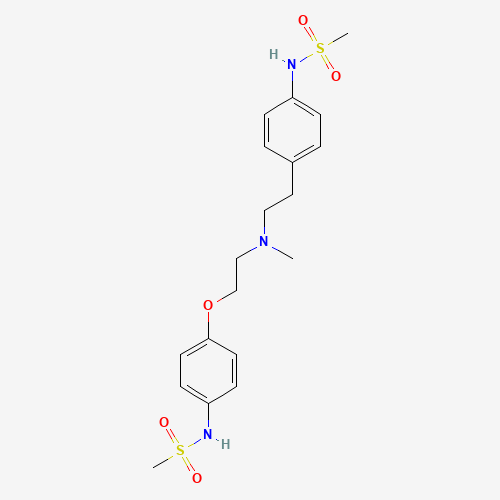
Dofetilide is a tertiary amino compound that is N-ethyl-N-methylethanamine substituted by a 4-[(methylsulfonyl)amino]phenoxy and a 4-[(methylsulfonyl)amino]phenyl group at the terminal carbon atoms respectively. It is used as an anti-arrhythmia drug. It has a role as an anti-arrhythmia drug and a potassium channel blocker. It is a sulfonamide, an aromatic ether and a tertiary amino compound.
科学粮草官-词典编辑部,修订于:2026-07-06
Toxicity
ToxicityEffect Level
collection=toxvaldb&kind=^EL$
Interactions
Hypokalemia or hypomagnesemia may occur with administration of potassium-depleting diuretics, increasing the potential for torsade de pointes. Potassium levels should be within the normal range prior to administration of Tikosyn and maintained in the normal range during administration of Tikosyn.
Hepatotoxicity
Likelihood score: E (unlikely cause of clinically apparent liver injury).
Adverse Effects
* QT-prolonging drugs: Class III antiarrhythmics are QTc-prolonging agents, and their use may significantly increase QTc interval prolongation. Combining these drugs with other QT-prolonging agents, such as erythromycin, can further elevate the risk of severe toxicities, including torsades de pointes, though evidence on such combinations remains limited. Drugs like dofetilide, methadone, chlorpromazine, sotalol, amiodarone, procainamide, ziprasidone, quinidine, disopyramide, cisapride, quinine, dronedarone, and bedaquiline, among others, may amplify this risk.
Toxicity Summary
The suggested approach by (Crosby J et al, 2021) for managing acquired QT prolongation with torsades de pointes (TdP) begins with administering 2 grams of intravenous magnesium, which reduces calcium influx into the cytoplasm from the sarcoplasmic reticulum. This influx, triggered by L-type calcium channels, contributes to early afterdepolarizations and triggered activity responsible for self-limiting TdP episodes. If the symptoms persist, lidocaine is used, as it blocks late sodium currents, significantly shortening the QT interval in cases caused by hERG potassium-channel blockers like dofetilide. In cases where the patient becomes hemodynamically unstable or progresses to ventricular fibrillation, immediate defibrillation is performed following Advanced Cardiac Life Support guideline...
Human Toxicity Excerpts
/CASE REPORTS/ This report is about a 62-year old male patient with an implantable cardioverter defibrillator (ICD) for patient activated termination of atrial fibrillation who experienced dofetilide-associated ventricular tachyarrhythmias and ICD-induced ventricular fibrillation six months after the initiation of the antiarrhythmic drug therapy.
Drug Induced Liver Injury
References: DOI:10.1016/j.drudis.2019.09.022
Non-Human Toxicity Excerpts
/LABORATORY ANIMALS: Developmental or Reproductive Toxicity/ Gestation day 11 (GD11) and 14 (GD14) embryos were cultured for up to 4 hours in the presence of Dofetilide (0.01-0.50 ug/mL), a potent Class III Antiarrhythmic which selectively inhibits the rapid component of the time dependent outward potassium current (IKr). Significant (P < or = 0.05) reductions in heart rate as measured over a 4 hour period were dose dependent and reversible. The sensitivity of the GD11 embryos was greater than GD14 embryos (14-64% decrease in heart rate vs. an 11-43% decrease in HR, respectively) at the same concentrations tested. These in vitro results support the hypothesis that the embryo-lethality of Class III Anti-arrhythmics observed in vivo may be a class effect of the IKr subtype potassium chann...
Populations at Special Risk
Female patients constituted 32% of the patients in the placebo-controlled trials of Tikosyn. As with other drugs that cause torsade de pointes, Tikosyn was associated with a greater risk of torsade de pointes in female patients than in male patients. During the Tikosyn clinical development program the risk of torsade de pointes in females was approximately 3 times the risk in males. Unlike torsade de pointes, the incidence of other ventricular arrhythmias was similar in female patients receiving Tikosyn and patients receiving placebo. Although no study specifically investigated this risk, in post-hoc analyses, no increased mortality was observed in females on Tikosyn compared to females on placebo.
Antidote and Emergency Treatment
/SRP:/ Advanced treatment: Consider orotracheal or nasotracheal intubation for airway control in the patient who is unconscious, has severe pulmonary edema, or is in severe respiratory distress. Positive-pressure ventilation techniques with a bag valve mask device may be beneficial. Consider drug therapy for pulmonary edema ... . Consider administering a beta agonist such as albuterol for severe bronchospasm ... . Monitor cardiac rhythm and treat arrhythmias as necessary ... . Start IV administration of D5W /SRP: "To keep open", minimal flow rate/. Use 0.9% saline (NS) or lactated Ringer's if signs of hypovolemia are present. For hypotension with signs of hypovolemia, administer fluid cautiously. Watch for signs of fluid overload ... . Treat seizures with diazepam or lorazepam ... . Use...









