


 一键配货
一键配货
化合物详情
CAS116539-59-4
分子式C18H19NOS
分子量297.41 g/mol
非危品
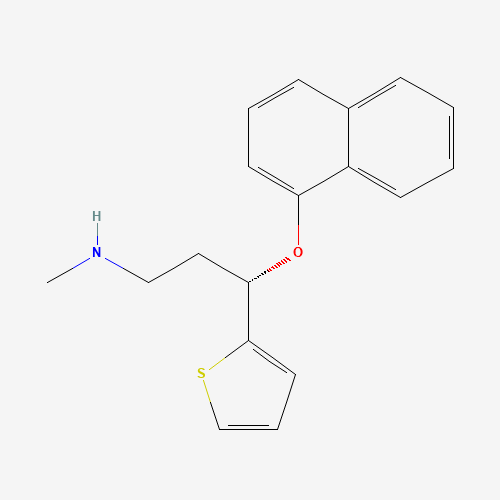
(S)-duloxetine is a duloxetine. It is an enantiomer of a (R)-duloxetine.
科学粮草官-词典编辑部,修订于:2026-07-06
Toxicity
ToxicityFate Summary
ATMOSPHERIC FATE: According to a model of gas/particle partitioning of semivolatile organic compounds in the atmosphere(1), duloxetine, which has an estimated vapor pressure of 1.2X10⁻⁷ mm Hg at 25 °C(SRC), determined from a fragment constant method(2), will exist in both the vapor and particulate phases in the ambient atmosphere. Vapor-phase duloxetine is degraded in the atmosphere by reaction with photochemically-produced hydroxyl radicals(SRC); the half-life for this reaction in air is estimated to be 25 min(SRC), calculated from its rate constant of 3.13X10⁻¹⁰ cu cm/molecule-sec at 25 °C(SRC) that was derived using a structure estimation method(3). Particulate-phase duloxetine may be removed from the air by wet and dry deposition(SRC). Duloxetine contains chromophores that absorb at...
Soil Adsorption / Mobility
Using a structure estimation method based on molecular connectivity indices(1), the Koc of duloxetine can be estimated to be 8.1X10+4(SRC). According to a classification scheme(2), this estimated Koc value suggests that duloxetine is expected to be immobile in soil. The estimated pKa of duloxetine is 9.70(3), indicating that this compound will exist almost entirely in the cation form in the environment and cations generally adsorb more strongly to soils containing organic carbon and clay than their neutral counterparts(4). Duloxetine, present at 0.08 ug/L, exhibited Kd values of 1.3X10+4, 3.2X10+3 and 2.9X10+3 in primary, secondary sludge (short age) and secondary sludge (long age), respectively(5).
Environmental Bioconcentration
An estimated BCF of 370 was calculated in fish for duloxetine(SRC), using an estimated log Kow of 4.68(1) and a regression-derived equation(1). According to a classification scheme(2), this BCF suggests the potential for bioconcentration in aquatic organisms is high(SRC).
Volatilization from Water / Soil
The estimated pKa of duloxetine is 9.70(1), indicating duloxetine will exist almost entirely in the cation form at pH values of 5 to 9 and, therefore, volatilization from water and moist soil surfaces is not expected to be an important fate process. Duloxetine is not expected to volatilize from dry soil surfaces(SRC) based upon an estimated vapor pressure of 1.2X10⁻⁷ mm Hg(SRC), determined from a fragment constant method(3).
Environmental Abiotic Degradation
The rate constant for the vapor-phase reaction of duloxetine with photochemically-produced hydroxyl radicals has been estimated as 3.1X10⁻¹⁰ cu cm/molecule-sec at 25 °C(SRC) using a structure estimation method(1). This corresponds to an atmospheric half-life of about 25 minutes at an atmospheric concentration of 5X10+5 hydroxyl radicals per cu cm(1). Duloxetine is not expected to undergo hydrolysis in the environment due to the lack of functional groups that hydrolyze under environmental conditions(2). Duloxetine contains the chromophore naphthalene which absorbs at wavelengths >290 nm(3,4) and, therefore, may be susceptible to direct photolysis by sunlight(SRC).
Environmental Water Concentrations
While data specific to duloxetine were not located(SRC, 2015), the literature suggests that some pharmaceutically active compounds originating from human and veterinary therapy are not eliminated completely in municipal sewage treatment plants and are therefore discharged into receiving waters(1). Wastewater treatment processes often were not designed to remove them from the effluent(2). Selected organic waste compounds may be degrading to new and more persistent compounds that may be released instead of or in addition to the parent compound(2).
Milk Concentrations
It is not known whether duloxetine and/or its metabolites are distributed into breast milk. However, duloxetine and/or its metabolite are distributed into the milk of lactating rats.
Artificial Pollution Sources
Duloxetine's production and adminsitration as a medication(1) may result in its release to the environment through various waste streams(SRC).
Probable Routes of Human Exposure
Occupational exposure to duloxetine may occur through inhalation and dermal contact with this compound at workplaces where duloxetine is produced or used. Exposure to duloxetine among the general population may be limited to those administered this drug, an antidepressant. (SRC)
Environmental Fate / Exposure Summary
Duloxetine's production and administration as a medication may result in its release to the environment through various waste streams. If released to air, an estimated vapor pressure of 1.2X10⁻⁷ mm Hg at 25 °C indicates duloxetine will exist in both the vapor and particulate phases in the atmosphere. Vapor-phase duloxetine will be degraded in the atmosphere by reaction with photochemically-produced hydroxyl radicals; the half-life for this reaction in air is estimated to be 25 minutes. Particulate-phase duloxetine will be removed from the atmosphere by wet and dry deposition. Duloxetine contains chromophores that absorb at wavelengths >290 nm and, therefore, may be susceptible to direct photolysis by sunlight. If released to soil, duloxetine is expected to be immobile based upon an esti...
Symptoms
Symptoms of overdose include tremors, convulsions, reduced activity, slow pupillary response, intermittent tremors, and rigidity.
Treatment
There is no specific antidote to Duloxetine, but if serotonin syndrome ensues, specific treatment (such as with cyproheptadine and/or temperature control) may be considered. In case of acute overdose, treatment should consist of those general measures employed in the management of overdose with any drug. An adequate airway, oxygenation, and ventilation should be assured, and cardiac rhythm and vital signs should be monitored. Induction of emesis is not recommended. Gastric lavage with a large-bore orogastric tube with appropriate airway protection, if needed, may be indicated if performed soon after ingestion or in symptomatic patients. Activated charcoal may be useful in limiting absorption of duloxetine from the gastrointestinal tract. Administration of activated charcoal has been sho...
Interactions
When duloxetine 60 mg was co-administered with fluvoxamine 100 mg, a potent CYP1A2 inhibitor, to male subjects (n=14) duloxetine AUC was increased approximately 6-fold, the Cmax was increased about 2.5-fold, and duloxetine t1/2 was increased approximately 3-fold. Other drugs that inhibit CYP1A2 metabolism include cimetidine and quinolone antimicrobials such as ciprofloxacin and enoxacin.
Toxicity Data
Oral, rat LD<sub>50</sub>: 491 mg/kg for males and 279 mg/kg for females (A308).
Hepatotoxicity
Likelihood score: B (likely cause of clinically apparent liver injury).
Adverse Effects
* Erectile dysfunction
Exposure Routes
Orally administered duloxetine hydrochloride is well absorbed.
Toxicity Summary
Duloxetine is a potent inhibitor of neuronal serotonin and norepinephrine reuptake and a less potent inhibitor of dopamine reuptake. Duloxetine has no significant affinity for dopaminergic, adrenergic, cholinergic, histaminergic, opioid, glutamate, and GABA receptors. The antidepressant and pain inhibitory actions of duloxetine are believed to be related to its potentiation of serotonergic and noradrenergic activity in the CNS. The mechanism of action of duloxetine in SUI has not been determined, but is thought to be associated with the potentiation of serotonin and norepinephrine activity in the spinal cord, which increases urethral closure forces and thereby reduces involuntary urine loss.
Human Toxicity Excerpts
/SIGNS AND SYMPTOMS/ The most frequently observed adverse reactions in the clinical trials included nausea, headache, decreased weight, and abdominal pain. Decreased appetite and weight loss have been observed in association with the use of SSRIs and SNRIs. Perform regular monitoring of weight and growth in children and adolescents treated with an SNRI such as CYMBALTA.
Carcinogen Classification
No indication of carcinogenicity to humans (not listed by IARC).
Drug Induced Liver Injury
References: DOI:10.1016/j.drudis.2019.09.022
Non-Human Toxicity Excerpts
/LABORATORY ANIMALS: Developmental or Reproductive Toxicity/ In animal studies with duloxetine, fetal weights were decreased but there was no evidence of teratogenicity in pregnant rats and rabbits at oral doses administered during the period of organogenesis up to 4 and 7 times the maximum recommended human dose (MRHD) of 120 mg/day, respectively. When duloxetine was administered orally to pregnant rats throughout gestation and lactation, pup weights at birth and pup survival to 1 day postpartum were decreased at a dose 2 times the MRHD. At this dose, pup behaviors consistent with increased reactivity, such as increased startle response to noise and decreased habituation of locomotor activity were observed. Post-weaning growth was not adversely affected. CYMBALTA should be used in preg...
Populations at Special Risk
Patients with clinically evident hepatic impairment have decreased duloxetine metabolism and elimination. After a single 20 mg dose of CYMBALTA, 6 cirrhotic patients with moderate liver impairment (Child-Pugh Class B) had a mean plasma duloxetine clearance about 15% that of age- and gender-matched healthy subjects, with a 5-fold increase in mean exposure (AUC). Although Cmax was similar to normals in the cirrhotic patients, the half-life was about 3 times longer.
Antidote and Emergency Treatment
Enhanced elimination. In general, owing to extensive protein binding and large volumes of distribution, dialysis, hemoperfusion, peritoneal dialysis, and repeat-dose charcoal are not effective. /Antidepressants, general (noncyclic)/
Effects During Pregnancy and Lactation
One study reported that duloxetine was not associated with any effects on male fertility (ability to get partner pregnant). Studies have not been done to see if duloxetine use in males can increase the chance of birth defects above the background risk. In general, exposures that fathers or sperm donors have are unlikely to increase risks to a pregnancy. For more information, please see the MotherToBaby fact sheet Paternal Exposures at https://mothertobaby.org/fact-sheets/paternal-exposures-pregnancy/.
USGS Health-Based Screening Levels for Evaluating Water-Quality
Reference: Smith, C.D. and Nowell, L.H., 2024. Health-Based Screening Levels for evaluating water-quality data (3rd ed.). DOI:10.5066/F71C1TWP









