

 一键配货
一键配货
化合物详情
CAS117337-19-6
分子式C15H15ClFN3O3S2
分子量403.88 g/mol
非危品
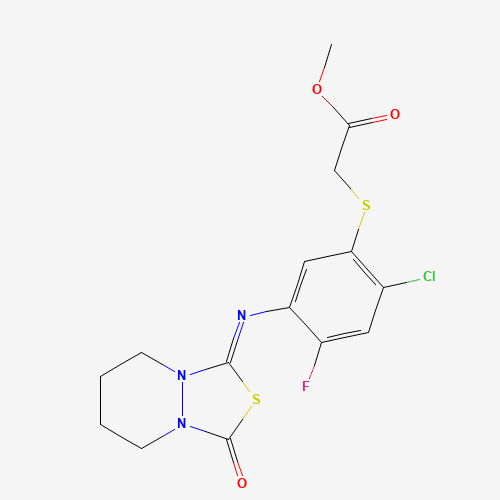
Fluthiacet-methyl is a methyl ester resulting from the formal condensation of the carboxy group of fluthiacet with methanol. A proherbicide for fluthiacet, it is used for the control of broad-leaved weeds in crops such as maize and soya. It has a role as a proherbicide, an agrochemical and an EC 1.3.3.4 (protoporphyrinogen oxidase) inhibitor. It is an organic sulfide, a methyl ester, a thiadiazolopyridazine, a member of monochlorobenzenes and a member of monofluorobenzenes. It is functionally related to a fluthiacet.
科学粮草官-词典编辑部,修订于:2026-07-06
Toxicity
ToxicityEPA Ecotoxicity
Pesticide Ecotoxicity Data from EPA: 75
Ecotoxicity Values
LC50 Anas platyrhynchos (Mallard duck) dietary >5620 mg/kg (5 days)
Fate Summary
Stability in water DT50 484.8 days (pH 5), 17.7 days (pH 7), 0.2 days (pH 9). In light DT50 of 4.92 days.
Soil Adsorption / Mobility
The Koc of fluthiacet-methyl is estimated as 2,700(SRC), using a log Kow of 3.77(1) and a regression-derived equation(2). According to a classification scheme(3), this estimated Koc value suggests that fluthiacet-methyl is expected to have slight mobility in soil.
Environmental Bioconcentration
An estimated BCF of 160 was calculated for fluthiacet-methyl(SRC), using a log Kow of 3.77(1) and a regression-derived equation(2). According to a classification scheme(3), this BCF suggests the potential for bioconcentration in aquatic organisms is high(SRC), provided the compound is not altered physically or chemically once released into the environment.
Volatilization from Water / Soil
The Henry's Law constant for fluthiacet-methyl is estimated as 2.1X10⁻⁹ atm-cu m/mole(SRC) derived from its vapor pressure, 3.31X10⁻⁹ mm Hg(1), and water solubility, 0.85 mg/L(1). This Henry's Law constant indicates that fluthiacet-methyl is expected to be essentially nonvolatile from water surfaces(2). Fluthiacet-methyl is not expected to volatilize from dry soil surfaces(SRC) based upon its vapor pressure(1).
Environmental Abiotic Degradation
A hydrolysis half-life of 18 days at pH 7 and a photolysis on soil half-life of 21 days have been reported for fluthiacet-methyl(2).
Artificial Pollution Sources
Fluthiacet-methyl's production may result in its release to the environment through various waste streams; it's use as a herbicide(1) will result in its direct release to the environment(SRC).
Probable Routes of Human Exposure
Occupational exposure to fluthiacet-methyl may occur through inhalation and dermal contact with this compound at workplaces where fluthiacet-methyl is produced or used. (SRC)
Environmental Fate / Exposure Summary
Fluthiacet-methyl's production may result in its release to the environment through various waste streams; it's use as a herbicide will result in its direct release to the environment. If released to air, a vapor pressure of 3.31X10⁻⁹ mm Hg at 25 °C indicates fluthiacet-methyl will exist solely in the particulate phase in the ambient atmosphere. Particulate-phase fluthiacet-methyl will be removed from the atmosphere by wet and dry deposition. A half-life in light of 4.92 days has been reported. If released to soil, fluthiacet-methyl is expected to have slight mobility based upon an estimated Koc of 2,700. Volatilization from moist soil surfaces is not expected to be an important fate process based upon an estimated Henry's Law constant of 2.1X10⁻⁹ atm-cu m/mole. A photolysis half-life o...
Effect Level
collection=toxvaldb&kind=^EL$
Toxicity Data
LC50 (rat) >5,000 mg/m3
Adverse Effects
Occupational hepatotoxin - Secondary hepatotoxins: the potential for toxic effect in the occupational setting is based on cases of poisoning by human ingestion or animal experimentation.
RAIS Toxicity Values
Oral Slope Factor Reference: OPP
Carcinogen Classification
No indication of carcinogenicity to humans (not listed by IARC).
Non-Human Toxicity Values
LD50 Rabbit dermal >2000 mg/kg
Reference and Risk Values
collection=toxvaldb&kind=^RRV$
Non-Human Toxicity Excerpts
/LABORATORY ANIMALS: Chronic Exposure or Carcinogenicity/ In the mouse carcinogenicity study the systemic toxicity NOAEL was 0.1 mg/kg/day in males and females and the systemic toxicity LOAEL was 1.0 mg/kg/day in males and 1.2 mg/kg/day in females based on non-neoplastic liver findings. In males at 10 and 32 mg/kg/day, respectively, there was an increase in the number of mice with hepatocellular adenomas, carcinomas and/or adenomas/carcinomas.
Antidote and Emergency Treatment
/SRP:/ Advanced treatment: Consider orotracheal or nasotracheal intubation for airway control in the patient who is unconscious, has severe pulmonary edema, or is in respiratory arrest. Positive pressure ventilation techniques with a bag valve mask device may be beneficial. Monitor cardiac rhythm and treat arrhythmias as necessary ... . Start an IV with D5W /SRP: "To keep open", minimal flow rate/. Use lactated Ringer's if signs of hypovolemia are present. Watch for signs of fluid overload. Consider drug therapy for pulmonary edema ... . For hypotension with signs of hypovolemia, administer fluid cautiously. Watch for signs of fluid overload ... . Treat seizures with diazepam (Valium) ... . Use proparacaine hydrochloride to assist eye irrigation ... . /Poison A and B/