


 一键配货
一键配货
化合物详情
CAS119168-77-3
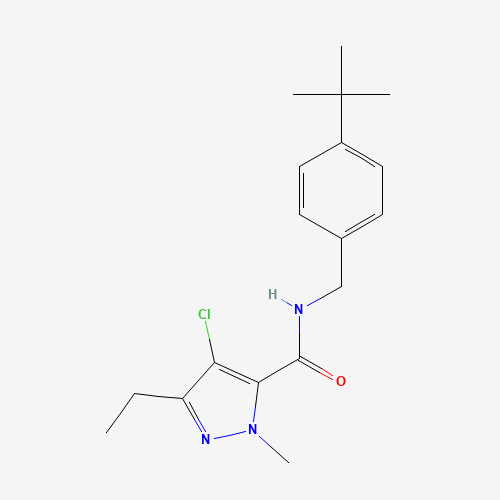
分子式C18H24ClN3O
分子量333.86 g/mol g/mol
危化品
Tebufenpyrad is a pyrazole insecticide and a pyrazole acaricide. It has a role as a mitochondrial NADH:ubiquinone reductase inhibitor.
科学粮草官-词典编辑部,修订于:2026-07-06
Toxicity
ToxicityEPA Ecotoxicity
Pesticide Ecotoxicity Data from EPA: 6
Ecotoxicity Values
LC50; Species: Baetis rhodani (Mayfly); Conditions: freshwater, static, 15 °C, pH 7.4, hardness 180 mg/L CaCO3; Concentration: 2.69 ug/L for 48 hr (95% confidence interval: 1.41-5.12 ug/L) /100% purity/
Fate Summary
ATMOSPHERIC FATE: According to a model of gas/particle partitioning of semivolatile organic compounds in the atmosphere(1), tebufenpyrad, which has a vapor pressure of <7.3X10⁻⁸ mm Hg at 20 °C(2), is expected to exist solely in the particulate phase in the ambient atmosphere. Particulate-phase tebufenpyrad may be removed from the air by wet or dry deposition(SRC).
Soil Adsorption / Mobility
Koc values of 1380 to 9310 have been reported for tebufenpyrad(1). According to a classification scheme(2), this Koc range suggests that tebufenpyrad is expected to have low to no mobility in soil.
Environmental Biodegradation
AEROBIC: Microbially-mediated degradation has been identified as a major route of dissipation for tebufenpyrad(1). Additional details were not provided.
Environmental Bioconcentration
An estimated BCF of 830 was calculated in fish for tebufenpyrad(SRC), using a log Kow of 4.93(1) and a regression-derived equation(2). According to a classification scheme(3), this BCF suggests the potential for bioconcentration in aquatic organisms is high(SRC).
Volatilization from Water / Soil
The Henry's Law constant for tebufenpyrad is estimated as <1.2X10⁻⁸ atm-cu m/mole(SRC) derived from its vapor pressure, <7.3X10⁻⁸ mm Hg(1), and water solubility, 2.61 mg/L(2). This Henry's Law constant indicates that tebufenpyrad is expected to be essentially nonvolatile from water and moist soil surfaces(3). Tebufenpyrad is not expected to volatilize from dry soil surfaces(SRC) based upon its vapor pressure(1).
Environmental Abiotic Degradation
Tebufenpyrad is reported stable to hydrolysis at pH 4, 7 and 9(1). Tebufenpyrad has an aqueous photolysis half-life of 187 days at pH 7 and 25 °C(1).
Food Survey Values
Tebufenpyrad residues were detected in 12 of 86 apple samples taken during a study of pesticides in agricultural products in Hyogo Prefecture, Japan from 1995 to 1999. Five of these residues were detected at <0.01 ug/g, five were detected at 0.01 to <0.05 ug/g and two were detected at 0.05 to <0.1 ug/g(1).
Artificial Pollution Sources
Tebufenpyrad's production may result in its release to the environment through various waste streams; its use as an acaricide(1) will result in its direct release to the environment(SRC).
Probable Routes of Human Exposure
Occupational exposure to tebufenpyrad may occur through inhalation and dermal contact with this compound at workplaces where tebufenpyrad is produced or used. Limited monitoring data indicate that the general population may be exposed to tebufenpyrad via ingestion of food. (SRC)
Environmental Fate / Exposure Summary
Tebufenpyrad's production may result in its release to the environment through various waste streams; its use as an acaricide will result in its direct release to the environment. If released to air, a vapor pressure of <7.3X10⁻⁸ mm Hg at 20 °C indicates tebufenpyrad will exist solely in the particulate phase in the atmosphere. Particulate-phase tebufenpyrad will be removed from the atmosphere by wet or dry deposition. If released to soil, tebufenpyrad is expected to have low to no mobility based upon reported Koc values of 1380 to 8310. Volatilization from moist soil surfaces is not expected to be an important fate process based upon an estimated Henry's Law constant of <1.2X10⁻⁸ atm-cu m/mole. Specific biodegradation data were unavailable, but tebufenpyrad had reported soil dissipatio...
Effect Level
collection=toxvaldb&kind=^EL$
Lethal Dose
collection=toxvaldb&kind=^LD$
Toxicity Data
LC50 (rat) = 2,660 mg/m3
Adverse Effects
Skin Sensitizer - An agent that can induce an allergic reaction in the skin.
Lethal Concentration
collection=toxvaldb&kind=^LC$
Human Toxicity Excerpts
/GENOTOXICITY/ /In/ in vitro cytogenetics assays with human lymphocytes tebufenpyrad /at concentrations of/ a)6, 8, 20, 40, 60, 80 ug/mL for 21 hours without activation and 8.25, 11, 27.5, 55, 82.5, 110 ug/mL for 4 hours with activation /or/ b)6.25, 12.5, 25:g/ml for 2 hours without activation and 12.5, 25 and 50 ug/mL for 3 hours with activation, the combined data from both studies indicate that without S9 activation, tebufenpyrad induced variable but nevertheless reproducible significant increases in the percentage of aberrant cells in two of three experiments using treatment times of 20-24 hours. In general, levels causing < 40% decrease in the MI /mitotic index/ were negative, whereas concentrations causing >42% decrease in the MI induced significant effects with reproducibly flat d...
Carcinogen Classification
No indication of carcinogenicity to humans (not listed by IARC).
Non-Human Toxicity Values
LD50 Rat dermal >2000 mg/kg
Non-Human Toxicity Excerpts
/LABORATORY ANIMALS: Chronic Exposure or Carcinogenicity/ Chronic toxicity/carcinogenicity in rats /was studied at doses of/ 0, 5, 20, 150, or 300 ppm (M; 0, 0.21, 0.82, 6.52, 13.43 mg/kg/day: F: 0, 0.26, 1.01, 8.13, 16.95 mg/kg/day). ...Male rats had a significant increasing trend, and a significant difference in the pair-wise comparison of the 300 ppm dose group with the controls, for hepatocellular adenomas, both at p<0.01. The incidence at the high dose (300 ppm) exceeded the historical control range. ...The increase in benign liver tumors /was considered/ to be treatment-related in males. No hepatocellular carcinomas were observed in any group, including controls. Female rats had a significant increasing trend, and a significant difference in the pair-wise comparison of the 150 ppm...
Evidence for Carcinogenicity
Cancer Classification: Suggestive Evidence of Carcinogenicity, but Not Sufficient to Assess Human Carcinogenic Potential
Antidote and Emergency Treatment
/SRP:/ Advanced treatment: Consider orotracheal or nasotracheal intubation for airway control in the patient who is unconscious, has severe pulmonary edema, or is in severe respiratory distress. Positive-pressure ventilation techniques with a bag valve mask device may be beneficial. Consider drug therapy for pulmonary edema ... . Consider administering a beta agonist such as albuterol for severe bronchospasm ... . Monitor cardiac rhythm and treat arrhythmias as necessary ... . Start IV administration of D5W /SRP: "To keep open", minimal flow rate/. Use 0.9% saline (NS) or lactated Ringer's if signs of hypovolemia are present. For hypotension with signs of hypovolemia, administer fluid cautiously. Watch for signs of fluid overload ... . Treat seizures with diazepam or lorazepam ... . Use...









