


 一键配货
一键配货
化合物详情
CAS119446-68-3
分子式C19H17Cl2N3O3
分子量406.26 g/mol g/mol
危化品
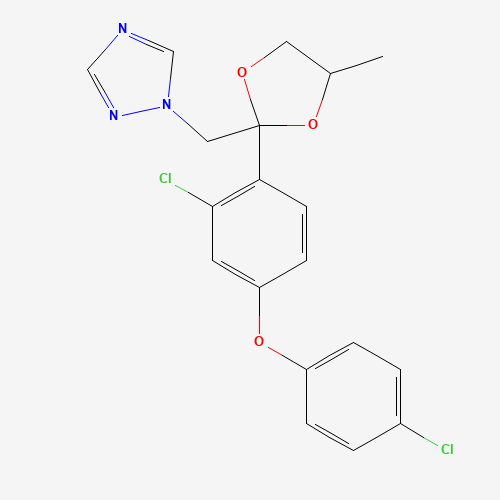
Difenoconazole is a member of the class of dioxolanes that is 1,3-dioxolane substituted at position 2 by 2-chloro-4-(4-chlorophenoxy)phenyl and 1,2,4-triazol-1-ylmethyl groups. A broad spectrum fungicide with novel broad-range activity used as a spray or seed treatment. It is moderately toxic to humans, mammals, birds and most aquatic organisms. It has a role as a xenobiotic, an EC 1.14.13.70 (sterol 14alpha-demethylase) inhibitor, an environmental contaminant and an antifungal agrochemical. It is an aromatic ether, a member of triazoles, a dioxolane, a cyclic ketal, a conazole fungicide and a triazole fungicide.
科学粮草官-词典编辑部,修订于:2026-07-06
Toxicity
ToxicityEPA Ecotoxicity
Pesticide Ecotoxicity Data from EPA: 75
Ecotoxicity Values
LD50; Species: Anas platyrhynchos (Mallard Duck) age 30 weeks; oral via capsule >2150 mg/kg[USEPA, Office of Pesticide Programs; Pesticide Ecotoxicity Database (2000) on 1-[[2-
Fate Summary
ATMOSPHERIC FATE: According to a model of gas/particle partitioning of semivolatile organic compounds in the atmosphere(1), difenoconazole, which has a vapor pressure of 2.5X10⁻¹⁰ mm Hg at 25 °C(2), is expected to exist solely in the particulate phase in the ambient atmosphere. Particulate-phase difenoconazole may be removed from the air by wet and dry deposition(SRC). Difenoconazole contains chromophores that absorb at wavelengths >290 nm(3) and, therefore, may be susceptible to direct photolysis by sunlight(SRC).
Soil Adsorption / Mobility
The mobility of difenoconazole was examined using soil thin layer chromatography with a silt loam containing 2% organic matter; results indicated that this chemical will be essentially immobile in soil(1). Difenoconazole has a reported log Koc = 3.5 (Koc = 3200)(2). Reported adsorption coefficients for difenoconazole in agricultural sand, sandy loam soil, silt loam soil, and silty clay loam soils, are 3866, 3470, 7734, and 7734, respectively(3). According to a classification scheme(4), these Koc values suggest that difenoconazole is expected to be slightly mobile to immobile in soil(SRC).
Environmental Biodegradation
Slow biodegradation of difenoconazole may occur under certain conditions; however, biodegradation may be limited by its bioavailability. Pure culture degradation of structurally similar diaryl ether pesticides and halogenated diphenyl ethers has been reported, although several dead-end metabolites may inhibit complete mineralization(1). In addition, it has been postulated that the bioavailability of diaryl ether pesticides, such as difenoconazole, decreases under the influence of sunlight as the production of polymeric material and formation of bound residues from activated derivatives occurs(1). In addition, structurally similar pyrethroids undergo photodecarboxylation which limits bioavailability for this class of pesticides(1). In water-sediment systems, rapid dissipation from water...
Environmental Bioconcentration
Following an EPA guideline study, a whole body BCF of 330 was reported for difenoconazole in bluegill fish (Lepomic macrochirus) exposed for 28 days(1), this BCF suggests that bioconcentration in aquatic organisms is high(SRC).
Volatilization from Water / Soil
The Henry's Law constant for difenoconazole is estimated as 8.9X10⁻¹² atm-cu m/mole(SRC) derived from its vapor pressure, 2.5X10⁻¹⁰ mm Hg(1), and water solubility, 15 mg/L(1). This Henry's Law constant indicates that difenoconazole is expected to be essentially nonvolatile from water surfaces(2). Difenoconazole's estimated Henry's Law constant indicates that volatilization from moist soil surfaces is not expected(SRC). Difenoconazole is not expected to volatilize from dry soil surfaces(SRC) based upon its vapor pressure(1).
Environmental Abiotic Degradation
Difenoconazole is hydrolytically stable and is not expected to hydrolyze under environmental conditions(1,2). Appreciable hydrolysis of difenoconazole (test concentration of 2 mg/L) was not observed after 30 days in buffered sterile solutions of pH 5, 7, and 9 at 25 °C(2). Difenoconazole (test concentration of 1.5 mg/L) exhibited less than 10% photodegradation after 15 days using simulated sunlight at pH 7 and 25 °C(2). Dissipation half-lives for difenoconazole in 3 soil samples ranged from 2.82 to 23.26 days(3).
Environmental Water Concentrations
Seasonal monitoring studies were conducted at 18 sites in southeastern Australia, sampling took place between September 2008 and March 2009(1). Difenoconazole was detected in water samples with an average detection frequency of 18%, a mean concentration of 0.03 ug/L and a maximum of 0.10 ug/L; the greatest detection frequency occurred in November (31%) and December (31%) while the lowest detection frequency occurred in March (0%) and September(6%)(1).
Food Survey Values
In an FDA total diet study analyzing foods in 4 market basket studies from the fiscal year 2012, difenoconazole was detected in 20 of 159 food items considered to be infant and toddler foods at a range of 0.0001 to 0.0009 ppm and in 47 of 912 food items other than infant and toddler foods at a range of 0.0001 to 0.006 ppm(1). In an FDA total diet study analyzing foods in 4 market basket studies from the fiscal year 2013, difenoconazole was detected in 73 of 1,070 food items at a range of 0.0001 to 0.005 ppm(2).
Ecotoxicity Excerpts
/AQUATIC SPECIES/ We report here an investigation of the mechanisms contributing to the divergent sensitivity toward the triazole fungicide difenoconazole of zebrafish (Danio reio) during different life stages. Adult and embryonic zebrafish were exposed to three different concentrations of difenoconazole (0.01, 0.5 and 1.0 mg/L). The death rate, bioaccumulation of difenoconazole, oxidative stress parameters and transcription of related genes were tested at 4 and 8 days post-exposure (dpe). The death rate for adult zebrafish was much higher than that of the embryos at an exposure concentration of 1.0 mg/L at both 4 and 8 dpe. The concentrations of difenoconazole in both the embryos and adult fish were similar, except for the group exposed to 0.01 mg/L difenoconazole. A decrease in antiox...
Plant Concentrations
Metabolism studies conducted with tomoatos, wheat, potatoes, grapes, and oilseed rape indicated that difenoconazole was the major residue found on these plants (fruits, seeds, and foliage) 7 to 40 days after the final application of this chemical(1).
Artificial Pollution Sources
Difenoconazole's production may result in its release to the environment through various waste streams; its use as an agricultural fungicide(1) will result in its direct release to the environment(SRC).
Sediment/Soil Concentrations
SOIL: In 2010 residues of difenoconazole in rice fields were examined in samples from Guangxi, Hubei and Zhejiang province; residues of difenoconazole were undetectable in paddy soil samples 30, 40, and 50 days after application of pesticide at 90 to 135 grams a.i./ha(1).
Probable Routes of Human Exposure
Occupational exposure to difenoconazole may occur through inhalation and dermal contact with this compound at workplaces where difenoconazole is produced or used. Monitoring and use data indicate that the general population may be exposed to difenoconazole via ingestion of food with residues of this chemical, dermal contact with foliage having residues of this chemical, and dermal contact with consumer products containing difenoconazole. (SRC)
Other Environmental Concentrations
In orchard areas in Slovenia, difenoconazole was detected at a concentration of 0.01 mg/kg in a sample of bee pollen collected May 3, 2007 one day after the application of the pesticide, and was also detected under the LOD of 0.02 mg/kg in another sample of bee pollen 6 days after the application of the pesticide(1). In 2010, straw samples from Guangxi, Hubei and Zhejiang province, had concentrations of difenoconazole ranging from 0.037 mg/kg to 2.53 mg/kg 30, 40, and 50 days after application(2). In 1991, after application of pesticide at 0.5 kg a.i./ha, difenoconazole residues on the leaves, on grass sward, in soil below the grass, and in soil below the trees of an apple orchard in Switzerland were 3.8, 0.12, 0.02, and 0.11 mg/kg, respectively(3).
Environmental Fate / Exposure Summary
Difenoconazole's production may result in its release to the environment through various waste streams; its use as an agricultural fungicide will result in its direct release to the environment. If released to air, a vapor pressure of 2.5X10⁻¹⁰ mm Hg at 25 °C indicates difenoconazole will exist solely in the particulate phase in the atmosphere. Particulate-phase difenoconazole will be removed from the atmosphere by wet and dry deposition. Difenoconazole contains chromophores that absorb at wavelengths >290 nm and, therefore, may be susceptible to direct photolysis by sunlight. If released to soil, difenoconazole is expected to have slight to no mobility based upon reported Koc values of 3200 to 7734. Volatilization from moist soil surfaces is not expected to be an important fate process...
Effect Level
collection=toxvaldb&kind=^EL$
Lethal Dose
collection=toxvaldb&kind=^LD$
Toxicity Summary
IDENTIFICATION AND USE: Difenoconazole is a white crystalline solid. It is used as fungicide, insecticide, seed treatment/protectant. HUMAN EXPOSURE AND TOXICITY: Harmful if inhaled or absorbed through skin. Causes moderate eye irritation. It did not cause chromosomal aberrations in human lymphocytes. One case of allergic reaction to a formulated product was reported. ANIMAL STUDIES: Difenoconazole was moderately and transiently irritating to the eyes of rabbits. It was very slightly and transiently irritating to the skin of rabbits. Difenoconazole was considered to be essentially non-toxic when applied topically under occlusion to intact rabbit skin. In rats treated dermally for 28 days there was an increased incidence of minimal centrilobular hepatocellular hypertrophy in males and fe...
Lethal Concentration
collection=toxvaldb&kind=^LC$
RAIS Toxicity Values
Oral Chronic Reference Dose Reference: OPP
Human Toxicity Excerpts
/OTHER TOXICITY INFORMATION/ Monthey, Switzerland; reporting period, 1992 until December 2002. Difenoconazole had been handled since 1992 in three buildings, with an estimated 5300 tons being produced over the decade. In 2002, about two thirds of the product was handled and packed as powder. The remaining one third was used in two premixes, which were either formulated in Monthey or sent in bulk to Aigues Vives, France. The exact number of people potentially in contact with the material was unknown, but it was estimated that "several hundred" temporary workers had been involved with difenaconazole over the 10-year period. No adverse health effects had been recorded within the three buildings concerned or within the medical service based at Monthey.
Carcinogen Classification
No indication of carcinogenicity to humans (not listed by IARC).
Non-Human Toxicity Values
LD50 Rat oral 1453 mg/kg
Reference and Risk Values
collection=toxvaldb&kind=^RRV$
Non-Human Toxicity Excerpts
/LABORATORY ANIMALS: Acute Exposure/ The acute percutaneous (dermal) toxicity of difenoconazole technical (purity not specified) was investigated after administering the test material at a dose of 2010 mg/kg bw as a 50% ethanol preparation to the shaved flank skin of groups of five New Zealand White rabbits. The treated area represented about 10% of the body surface. The treated area was covered with a gauze dressing attached by tape. Exposure lasted 24 hr. ... No mortality occurred after dermal application of difenoconazole at a dose of 2010 mg/kg bw for 24 hr. Clinical observations that were performed over 14 days after treatment were unremarkable for all rabbits; however, slight erythema (Draize grade 1) at the treatment site of three rabbits was observed at the end of the dosing per...
Antidote and Emergency Treatment
If in eyes: Hold eye open and rinse slowly and gently with water for 15 to 20 minutes. Remove contact lenses, if present, after the first 5 minutes, then continue rinsing eye. Call a poison control center or doctor for treatment advice.









