


 一键配货
一键配货
化合物详情
CAS120066-54-8
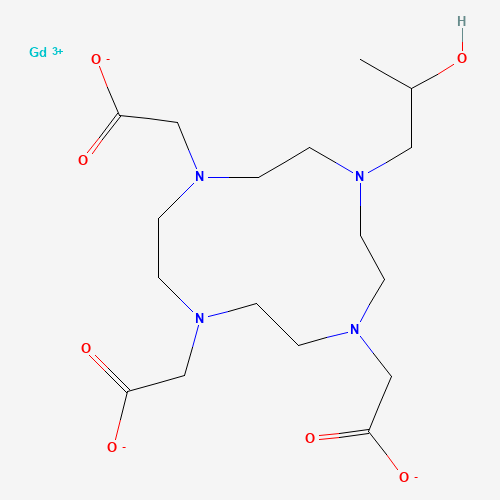
分子式C17H29GdN4O7
分子量558.68 g/mol
非危品
Gadoteridol is a macrocyclic nonionic gadolinium that provides contrast enhancement of the brain, spine, and surrounding tissues, resulting in improved visualization (compared with unenhanced MRI) of lesions with abnormal vascularity or those thought to disrupt the normal blood-brain barrier. It was 1 of the 3 macrocyclic gadolinium-based contrast agents (GBCAs) that was mandated by the EMA to replace linear gadolinium-based contrast agents due to concerns about retained gadolinium in the brain. Initially approved by the FDA in 1992, gadoteridol received additional approval in 2020 for use in pediatric patients less than 2 years old.
科学粮草官-词典编辑部,修订于:2026-07-06
Toxicity
ToxicityFate Summary
TERRESTRIAL FATE: The elements of the lanthanide series typically occur as the +3 ion either in solution or in compounds(1). Based on the Gd3+/Gd reduction potential of -2.28 V(1), gadolinium(III) ions do not undergo oxidation-reduction reactions under normal environmental conditions(SRC). Gadolinium ions are likely to adsorb to soils(SRC). In general, metal cations in solution are attracted to the negatively charged surfaces of soil particles(2). The extent of adsorption of metal ions to soils depends on the pH, the mineral content, and organic content of the soil(2). Gadolinium compounds do not volatilize from dry or moist soil surfaces due to their ionic character(SRC).
Environmental Biodegradation
AEROBIC: Gadolinium-containing MRI contrast media are not biodegradable and these complexes are stable enough to pass through municipal sewage treatment plants(1).
Environmental Bioconcentration
Bioconcentration is not expected to be an important fate process due to the ionic nature of gadolinium compounds. (SRC)
Volatilization from Water / Soil
Ionic gadolinium compounds will not volatilize from dry or moist soils or from water surfaces. (SRC)
Environmental Water Concentrations
While data specific to gadoteridol were not located(SRC, 2014), the literature suggests that some contrast agents originating from human and veterinary therapy are not eliminated completely in municipal sewage treatment plants and are therefore discharged into receiving waters(1). Wastewater treatment processes often were not designed to remove them from the effluent(2).
Artificial Pollution Sources
Gadoteriol's use as a contrast agent in magnetic resonance imaging (MRI) may result in its release to the environment through various waste streams(SRC).
Probable Routes of Human Exposure
Occupational exposure to gadolinium compounds may occur through dermal contact with these compounds at workplaces where gadolinium is produced or used. Monitoring data indicate that the general population may be exposed to gadolinium compounds via ingestion of contaminated drinking water. Limited monitoring data indicate that exposure may occur via ingestion of contaminated food and inhalation. Direct exposure to gadolinium compounds among the general population will also be to those administered contrast agents containing gadolinium prior to MRI procedures. (SRC)
Environmental Fate / Exposure Summary
Gadoteriol use as a contrast agent in magnetic resonance imaging (MRI) may result in its release to the environment through various waste streams. Gadolinium-containing MRI contrast media are not biodegradable and these complexes are stable enough to pass through municipal sewage treatment plants. Occupational exposure to gadoteriol may occur through dermal contact with this compounds at workplaces where it is produced or used. Direct exposure to gadoteriol among the general population will be to those administered contrast agents containing gadoteriol prior to MRI procedures. (SRC)
Toxicity Summary
IDENTIFICATION AND USE: Gadoteridol is used as injectable contrast medium for Magnetic Resonance Imaging (MRI). HUMAN EXPOSURE AND TOXICITY: Gadolinium-based contrast agents (GBCAs) increase the risk for nephrogenic systemic fibrosis (NSF) among patients with impaired elimination of the drugs. Avoid use of GBCAs in these patients unless the diagnostic information is essential and not available with non-contrasted MRI or other modalities. NSF may result in fatal or debilitating systemic fibrosis affecting the skin, muscle and internal organs. The risk for NSF appears highest among patients with: chronic, severe kidney disease, or acute kidney injury. Screen patients for acute kidney injury and other conditions that may reduce renal function. For patients at risk for chronically reduced r...
Human Toxicity Excerpts
/ALTERNATIVE and IN VITRO TESTS/ In an in vitro test, gadoteridol did not demonstrate any potential to hemolyze human erythrocytes when incubated in high concentrations with whole blood, suggesting there is little probability gadoteridol will cause hemolysis in vivo.
Drug Induced Liver Injury
References: DOI:10.1016/j.drudis.2019.09.022
Non-Human Toxicity Values
LD50 Rat iv >10 mmol/kg /Gadoteridol injection/
Non-Human Toxicity Excerpts
/LABORATORY ANIMALS: Subchronic or Prechronic Exposure/ In 2-week studies with gadoteridol, no serious effects were observed in mice given 3 mmol/kg or dogs given 1.5 mmol/kg daily.
Populations at Special Risk
The possibility of a reaction, including serious, life threatening, or fatal, anaphylactic or cardiovascular reactions, or other idiosyncratic reactions, should always be considered, especially in those patients with a history of a known clinical hypersensitivity or a history of asthma or other allergic respiratory disorders.
Antidote and Emergency Treatment
/SRP:/ Advanced treatment: Consider orotracheal or nasotracheal intubation for airway control in the patient who is unconscious, has severe pulmonary edema, or is in severe respiratory distress. Positive-pressure ventilation techniques with a bag valve mask device may be beneficial. Consider drug therapy for pulmonary edema ... . Consider administering a beta agonist such as albuterol for severe bronchospasm ... . Monitor cardiac rhythm and treat arrhythmias as necessary ... . Start IV administration of D5W TKO /SRP: "To keep open", minimal flow rate/. Use 0.9% saline (NS) or lactated Ringer's (LR) if signs of hypovolemia are present. For hypotension with signs of hypovolemia, administer fluid cautiously. Watch for signs of fluid overload ... . Treat seizures with diazepam or lorazepam...









