


 一键配货
一键配货
化合物详情
CAS120928-09-8
分子式C20H22N2O
分子量306.4 g/mol g/mol
危化品
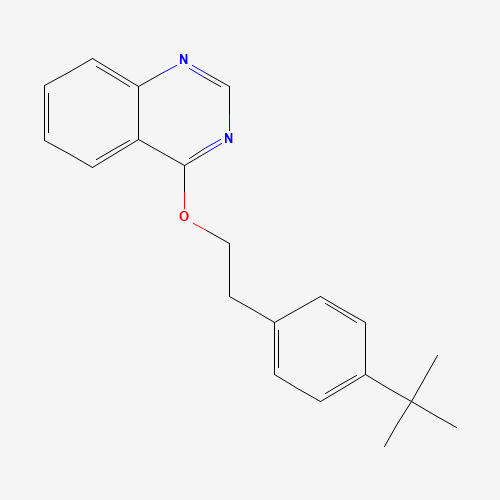
Fenazaquin is a member of quinazolines. It has a role as an acaricide and a mitochondrial NADH:ubiquinone reductase inhibitor.
科学粮草官-词典编辑部,修订于:2026-07-06
Toxicity
ToxicityEPA Ecotoxicity
Pesticide Ecotoxicity Data from EPA: 84
Ecotoxicity Values
LC50; Species: Anas platyrhynchos (Mallard duck) diet >5030 ppm for 5 days /98.4% a.i./
Fate Summary
ATMOSPHERIC FATE: According to a model of gas/particle partitioning of semivolatile organic compounds in the atmosphere(1), fenazaquin, which has a vapor pressure of 2.55X10⁻⁸ mm Hg at 25 °C(SRC), determined from a fragment constant method(2), is expected to exist solely in the particulate phase in the ambient atmosphere. Particulate-phase fenazaquin may be removed from the air by wet or dry deposition(SRC). Fenazaquin contains chromophores that absorb at wavelengths >290 nm(4), and therefore may be susceptible to direct photolysis by sunlight(SRC).
Soil Adsorption / Mobility
The Koc of fenazaquin has been reported to range from 18700 to 42100(1). The compound is rapidly adsorbed onto soil particles with 88% and 96% of the adsorption from a sandy loam soil and a clay loam soil, respectively, occurring within 2 hours. Adsorption increases with the organic content and clay content(1). According to a classification scheme(2), this Koc range suggests that fenazaquin is expected to be immobile in soil.
Environmental Bioconcentration
A BCF range of 500 was measured in fish for radio-labeled fenazaquin, at a concentration of 0.02 and 0.01 ug/L, using rainbow trout (Oncorhynchus mykiss) exposed for 21 to 28 days. BCF values were 400-500 for days 1-2 and 400-600 on days 21-28, irrespective of initial test compound concentration. At the end of the depuration period (days 1 and 14) no radioactivity was detected in the water above the detection limit of 0.05 ug/L. Residues in fish fell rapidly with 80% of radioactivity eliminated within the first 24 hours, <7% remaining on day 7. The depuration half-life was 1.4 days over days 1-7(1). According to a classification scheme(2), this BCF suggests the potential for bioconcentration in aquatic organisms is high(SRC), provided the compound is not metabolized by the organism(SRC).
Volatilization from Water / Soil
The Henry's Law constant for fenazaquin is estimated as 1.0X10⁻⁷ atm-cu m/mole(SRC) derived from its vapor pressure, 2.55X10⁻⁸ mm Hg(1), and water solubility, 0.102 mg/L(1). This Henry's Law constant indicates that fenazaquin is expected to be essentially nonvolatile from water and moist soil surfaces(2). Fenazaquin is not expected to volatilize from dry soil surfaces(SRC) based upon its vapor pressure(1).
Environmental Abiotic Degradation
Fenazaquin is not expected to undergo hydrolysis in the environment due to the lack of functional groups that hydrolyze under environmental conditions(1). Fenazaquin contains chromophores that absorb at wavelengths >290 nm(1), and therefore may be susceptible to direct photolysis by sunlight(SRC). The photolysis half-life in water is about 15 days(2).
Ecotoxicity Excerpts
/AQUATIC SPECIES/ The 48 hr acute toxicity of EL-436 (fenazaquin) to Daphnia magna was studied under static conditions. Daphnids (30 organisms/level) were exposed to EL-436 at nominal concentrations of 0 (control and solvent control), 0.3, 1.0, 3.0, 4.5, 7.0, and 10.0 ug/L. Mean measured concentrations of fenazaquin were <0.2 (<LOD, controls), 0.3, 0.8, 3.0, 4.4, 6.8, and 9.8 ug ai/L, respectively. Following 48 hr of exposure, cumulative immobility was 4% in the negative control group, 13% in the solvent control group, and 0, 7, 20, 23, 83, and 100% in the mean-measured 0.3, 0.8, 3.0, 4.4, 6.8, and 9.8 ug ai/L treatment groups, respectively. The 48-hr EC50 (with 95% CI) for immobility was 5.6 (5.0-6.3) ug ai/L. Hypoactivity or prostration was also observed at the > or =3.0 ug ai/L expos...
Artificial Pollution Sources
Fenazaquin's production may result in its release to the environment through various waste streams; its use as an acaricide(1) will result in its direct release to the environment(SRC).
Probable Routes of Human Exposure
Occupational exposure to fenazaquin may occur through inhalation and dermal contact with this compound at workplaces where fenazaquin is produced or used. (SRC)
Environmental Fate / Exposure Summary
Fenazaquin's production may result in its release to the environment through various waste streams; its use as an acaricide will result in its direct release to the environment. If released to air, a vapor pressure of 2.55X10⁻⁸ mm Hg at 25 °C indicates fenazaquin will exist solely in the particulate phase in the atmosphere. Particulate-phase fenazaquin will be removed from the atmosphere by wet or dry deposition. Fenazaquin contains chromophores that absorb at wavelengths >290 nm, and therefore may be susceptible to direct photolysis by sunlight. If released to soil, fenazaquin is expected to have no mobility based upon a Koc range of 18700 to 42100. Volatilization from moist soil surfaces is not expected to be an important fate process based upon an estimated Henry's Law constant of 1....
Effect Level
collection=toxvaldb&kind=^EL$
Lethal Dose
collection=toxvaldb&kind=^LD$
Effect Concentration
collection=toxvaldb&kind=^EC$
Lethal Concentration
collection=toxvaldb&kind=^LC$
RAIS Toxicity Values
Oral Chronic Reference Dose Reference: OPP
Non-Human Toxicity Values
LD50 Mouse oral (male) 2449 mg/kg
Reference and Risk Values
collection=toxvaldb&kind=^RRV$
Non-Human Toxicity Excerpts
/LABORATORY ANIMALS: Subchronic or Prechronic Exposure/ In a 90-day oral toxicity study, EL-436 (/Fenazaquin/ > or = 99% ai) was administered to 15 F344 rats/sex/dose group daily by gavage at dose levels of 0, 1, 3, 10, or 30 mg/kg/day for 90 days. In addition, 10 rats/sex in the control and high-dose groups were maintained 1-month post treatment to evaluate the reversibility of observed effects. There were no compound related effects on survival, clinical signs, ophthalmic, hematologic, or urinary parameters. Statistically significant decreases in body weight (8%-12% in males) and body weight gain (18% and 13% in males and females, respectively) were noted only among high-dose rats. The high dose also resulted in a statistically significant decrease in food consumption (4%-8%) and food...
Antidote and Emergency Treatment
/SRP:/ Advanced treatment: Consider orotracheal or nasotracheal intubation for airway control in the patient who is unconscious, has severe pulmonary edema, or is in severe respiratory distress. Positive-pressure ventilation techniques with a bag valve mask device may be beneficial. Consider drug therapy for pulmonary edema ... . Consider administering a beta agonist such as albuterol for severe bronchospasm ... . Monitor cardiac rhythm and treat arrhythmias as necessary ... . Start IV administration of D5W /SRP: "To keep open", minimal flow rate/. Use 0.9% saline (NS) or lactated Ringer's if signs of hypovolemia are present. For hypotension with signs of hypovolemia, administer fluid cautiously. Watch for signs of fluid overload ... . Treat seizures with diazepam or lorazepam ... . Use...









