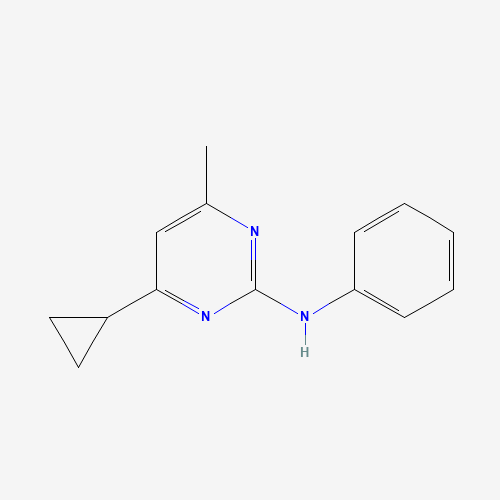
Body Burden
Cyprodinil was detected at a maximum of 1161 pg/mg in hair samples collected March to Nov 2009 from 18 farm workers(1).
EPA Ecotoxicity
Pesticide Ecotoxicity Data from EPA: 35
Ecotoxicity Values
LC50; Species: Colinus virginianus (Bobwhite) age 9 days; diet >5180 ppm for 8 days
Fate Summary
ATMOSPHERIC FATE: According to a model of gas/particle partitioning of semivolatile organic compounds in the atmosphere(1), cyprodinil, which has a vapor pressure of 3.68X10⁻⁶ mm Hg at 25 °C(2), will exist in both the vapor and particulate phases in the ambient atmosphere. Vapor-phase cyprodinil is degraded in the atmosphere by reaction with photochemically-produced hydroxyl radicals(SRC); the half-life for this reaction in air is estimated to be 1.9 hours(SRC), calculated from its rate constant of 2.0X10⁻¹⁰ cu cm/molecule-sec at 25 °C(SRC) that was derived using a structure estimation method(3). Particulate-phase cyprodinil may be removed from the air by wet and dry deposition(SRC). Cyprodinil does not contain chromophores that absorb at wavelengths >290 nm(4) and, therefore, is not ex...
Soil Adsorption / Mobility
[Table#6634]: IlNvaWwiLCJwSDsgJSBPcmdhbmljIENhcmJvbiIsIkNvbmNuIChwcG0pIiwiSW5jdWJhdGlvbiAoZGF5cykiLCIlIEJvdW5kIgoiSGFnZXJzdG93biIsIjUuNzsgMS41OSIsIjMiLCIxOTciLCI1NC4xIgoiQ2FsaWZvcm5pYSIsIjUuMDsgMS4wMCIsIjMiLCIyMzkiLCI1NiIKIkNvbGxvbWJleSIsIjcuMjsgMi4yMCIsIjEuNSIsIjE1NCIsIjYzIgoiTGVzIEV2b3VldHRlcyIsIjcuMjsgMS45NSIsIjEuNSIsIjYyIiwiNTguMyIK
Environmental Biodegradation
ANAEROBIC: Cyprodinil was persistent under flooded conditions following 16 days of aerobic incubation using Hagerstown (pH 5.7, 1.59% organic carbon), California (pH 5.0, 1.00% organic carbon), Collombey (pH 7.2, 2.20% organic carbon), and Les Evouettes (pH 7.2, 1.95% organic carbon) soils(1).
Environmental Bioconcentration
The BCF of cyprodinil was reported as 511, measured in bluegill sunfish (Lepomis macrochirus)(1). According to a classification scheme(2), this BCF suggests bioconcentration in aquatic organisms is high(SRC).
Volatilization from Water / Soil
The Henry's Law constant for cyprodinil is estimated as 8.4X10⁻⁸ atm-cu m/mole(SRC) derived from its vapor pressure, 3.68X10⁻⁶ mm Hg(1), and water solubility, 13 mg/L(1). This Henry's Law constant indicates that cyprodinil is expected to be essentially nonvolatile from water and moist soil surfaces(2). Cyprodinil is not expected to volatilize from dry soil surfaces(SRC) based upon its vapor pressure(1).
Environmental Abiotic Degradation
The rate constant for the vapor-phase reaction of cyprodinil with photochemically-produced hydroxyl radicals has been estimated as 2.0X10⁻¹⁰ cu cm/molecule-sec at 25 °C(SRC) using a structure estimation method(1). This corresponds to an atmospheric half-life of about 1.9 hours at an atmospheric concentration of 5X10+5 hydroxyl radicals per cu cm(1). Cyprodinil is stable to hydrolysis under environmental conditions (pH 5 to 9)(2). Cyprodinil does not contain chromophores that absorb at wavelengths >290 nm(3) and, therefore, is not expected to be susceptible to direct photolysis by sunlight(SRC).
Environmental Water Concentrations
SURFACE WATER: Cyprodinil was not detected in surface water samples from Italy as reported in 47 studies published from 1997 to 2013(1). Cyprodinil was not detected (detection limit 0.002-0.004 ug/L) in 96 surface water samples collected from 18 sites in the Yarra catchment area of Australia; samples were collected from Sept 2008 to Mar 2009(2).
Food Survey Values
Greenhouse studies were conducted to evaluate the dissipation rate kinetics and estimate the behavior of selected pesticides after washing, peeling, simmering, and canning of tomato expressed as processing factor (PF). Two varieties (Marissa and Harzfeuer) were treated by six fungicides: azoxystrobin, boscalid, chlorothalonil, cyprodinil, fludioxonil, and pyraclostrobin at single and double dose and risk assessment defined as hazard quotient was performed. The QuEChERS method was used for sample preparation followed by liquid chromatography coupled with tandem mass spectrometry (LC-MS/MS). The dissipation of fungicides approximately fitted to a first-order kinetic model, with half-life values ranging from 2.49 and 2.67 days (cyprodinil) to 5.00 and 5.32 days (chlorothalonil) for Marissa...
Ecotoxicity Excerpts
/PLANTS/ The beneficial fungus Neozygites floridana kills the two-spotted spider mite Tetranychus urticae, which is a serious polyphagous plant pest worldwide. ... The aim of this study was to conduct a laboratory experiment to evaluate the effect of pesticides used in strawberry and soybean crops on N. floridana. Among the pesticides used in strawberry, the fungicides sulfur and cyprodinil + fludioxonil completely inhibited both the sporulation and conidia germination of N. floridana. ...
Artificial Pollution Sources
Cyprodinil's production may result in its release to the environment through various waste streams; its use as a fungicide(1) will result in its direct release to the environment(SRC).
Sediment/Soil Concentrations
SEDIMENT: Cyprodinil was not detected in 96 sediment samples collected from 18 sites in the Yarra catchment area of Australia; samples were collected from Sept 2008 to Mar 2009(1). SOIL: Cyprodinil residues were reported at a maximum of about 400 ug/kg in soil sampled from fields along the River Alongos, Spain(2).
Probable Routes of Human Exposure
Concerns about pesticide drift from neighbouring vineyards affecting children attending school on a farm adjacent to an urban suburb of Cape Town, Western Cape in South Africa were investigated. The study involved a before-after design, measuring levels of environmental exposure before and during pesticide application activities on the neighbouring farms. Samples were collected in air, dust and grass cuttings at the preschool and primary school located on the farms during September-December in 2010 and tested for pesticides using multi-pesticide methods. Eleven different pesticides were detected in the various samples. Six of these chemicals (endosulfan, dimethomorph, penconazole, cyprodinil, boscalid and bromopropylate) were on the spraying schedules of the two farms neighbouring the s...
Environmental Fate / Exposure Summary
Cyprodinil's production may result in its release to the environment through various waste streams; its use as a fungicide will result in its direct release to the environment. If released to air, a vapor pressure of 3.68X10⁻⁶ mm Hg at 25 °C indicates cyprodinil will exist in both the vapor and particulate phases in the atmosphere. Vapor-phase cyprodinil will be degraded in the atmosphere by reaction with photochemically-produced hydroxyl radicals; the half-life for this reaction in air is estimated to be 1.9 hours. Particulate-phase cyprodinil will be removed from the atmosphere by wet and dry deposition. Cyprodinil does not contain chromophores that absorb at wavelengths >290 nm and, therefore, is not expected to be susceptible to direct photolysis by sunlight. If released to soil, cy...
Effect Level
collection=toxvaldb&kind=^EL$
Interactions
... A previous study identified the seven most common pesticide mixtures to which the French population was exposed through food consumption in 2006. The aim of this study was to investigate if the seven mixtures are potentially cytotoxic and genotoxic and if so, whether compounds in a same mixture have a combined effect. The cytotoxicity and genotoxicity of the seven mixtures were investigated with a new assay (gamma-H2AX) using four human cell lines (ACHN, SH-SY5Y, LS-174T, and HepG2). Mixtures were tested at equimolar concentrations and also at concentrations reflecting their actual proportion in the diet. Irrespective of the cell line tested, parallel cytotoxicity of the seven mixtures was observed. Only one mixture was genotoxic for the HepG2 cells at concentrations = 3 uM in equim...
Lethal Dose
collection=toxvaldb&kind=^LD$
Toxicity Data
LC50 (rat) > 1,200 mg/m3/4h
Adverse Effects
Skin Sensitizer - An agent that can induce an allergic reaction in the skin.
Toxicity Summary
IDENTIFICATION AND USE: Cyprodinil is a fine beige powder. It is used as a foliar fungicide in cereals, grapes, pome fruits, stone fruits, strawberries, and vegetables and as a seed dressing on barley; it controls a wide range of pathogens, including Pseudocercosporella herpotrichoides, Erysiphe spp., Pyrenophora teres, Rhynchosporium secalis, and Septoria nodorum. HUMAN EXPOSURE AND TOXICITY: Cyprodinil acts as an aryl hydrocarbon receptor activator, a potential endocrine disrupter, and an extracellular signal-regulated kinase disrupter. Weak androgen receptor binding was shown for cyprodinil. Cyprodinil was genotoxic for HepG2 cells at concentrations 20 uM. ANIMAL STUDIES: In a 28 day gavage study in rats, the LOEL is 100 mg/kg bw/day for rats, based on increased liver weights and abn...
Lethal Concentration
collection=toxvaldb&kind=^LC$
RAIS Toxicity Values
Oral Chronic Reference Dose Reference: OPP
Human Toxicity Excerpts
/ALTERNATIVE and IN VITRO TESTS/ Fenhexamid and cyprodinil are antifungal agents (pesticides) used for agriculture, and are present at measurable amounts in fruits and vegetables. In the current study, the effects of fenhexamid and cyprodinil on cancer cell proliferation and metastasis were examined. Additionally, the protein expression levels of cyclin D1 and cyclin E as well as cathepsin D were analyzed in BG-1 ovarian cancer cells that express estrogen receptors (ERs). The cells were cultured with 0.1% dimethyl sulfoxide (DMSO; control), 17beta-estradiol (E2; 10-9 M), and fenhexamid or cyprodinil (10-5 - 10-7 M). Results of a 3-(4,5-dimethylthiazol-2-yl)-2,5-diphenyltetrazolium bromide (MTT) assay showed that fenhexamid and cyprodinil increased BG-1 cell proliferation about 1.5 to 2...
Carcinogen Classification
No indication of carcinogenicity to humans (not listed by IARC).
Non-Human Toxicity Values
LC50 Rat inhalation >1200 mg/cu m/4 hr
Reference and Risk Values
collection=toxvaldb&kind=^RRV$
Non-Human Toxicity Excerpts
/LABORATORY ANIMALS: Developmental or Reproductive Toxicity/ In a gavage study in female rats, the LOEL for maternal toxicity is 1000 mg/kg/day based on lower bodyweight/bodyweight gain and reduced food consumption. The NOEL for maternal toxicity was 200 mg/kg/day. The LOEL for developmental toxicity is 1000 mg/kg/day based on lower mean fetal weights and an increased incidence of delayed ossification. The NOEL for developmental toxicity is 200 mg/kg/day.
Evidence for Carcinogenicity
Cancer Classification: Not Likely to be Carcinogenic to Humans
Antidote and Emergency Treatment
Advanced treatment: Consider orotracheal or nasotracheal intubation for airway control in the patient who is unconscious, has severe pulmonary edema, or is in severe respiratory distress. Positive-pressure ventilation techniques with a bag valve mask device may be beneficial. Consider drug therapy for pulmonary edema ... . Consider administering a beta agonist such as albuterol for severe bronchospasm ... . Monitor cardiac rhythm and treat arrhythmias as necessary ... . Start IV administration of D5W TKO /SRP: "To keep open", minimal flow rate/. Use 0.9% saline (NS) or lactated Ringer's (LR) if signs of hypovolemia are present. For hypotension with signs of hypovolemia, administer fluid cautiously. Watch for signs of fluid overload ... . Treat seizures with diazepam or lorazepam ... . U...
USGS Health-Based Screening Levels for Evaluating Water-Quality
Reference: Smith, C.D. and Nowell, L.H., 2024. Health-Based Screening Levels for evaluating water-quality data (3rd ed.). DOI:10.5066/F71C1TWP



 一键配货
一键配货