


 一键配货
一键配货
化合物详情
CAS122453-73-0
分子式C15H11BrClF3N2O
分子量407.61 g/mol
非危品
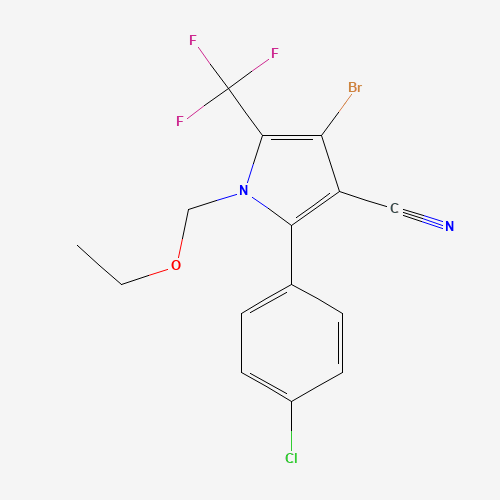
Chlorfenapyr is a member of the class of pyrroles that is 4-bromo-1H-pyrrole-3-carbonitrile which is substituted at positions 1, 2 and 5 by ethoxymethyl, p-chlorophenyl and trifluoromethyl groups, respectively. A proinsecticide used for termite control and crop protection against several insects and mite pests. It has a role as a proinsecticide and a proacaricide. It is a hemiaminal ether, a nitrile, an organochlorine insecticide, a member of pyrroles, an organochlorine acaricide, an organofluorine insecticide, an organofluorine acaricide and a member of monochlorobenzenes. It is functionally related to a tralopyril.
科学粮草官-词典编辑部,修订于:2026-07-06
Toxicity
ToxicityEPA Ecotoxicity
Pesticide Ecotoxicity Data from EPA: 37
Ecotoxicity Values
LD50 /Agelaius phoeniceus/ (Red-winged blackbird) oral 2.2 mg/kg (95% confidence interval 1.5-4.0 mg/kg) /from table/
Fate Summary
ATMOSPHERIC FATE: According to a model of gas/particle partitioning of semivolatile organic compounds in the atmosphere(1), chlorfenapyr, which has an estimated vapor pressure of 7.4X10⁻⁸ mm Hg at 25 °C(SRC), determined from a fragment constant method(2), will exist in both the vapor and particulate phases in the ambient atmosphere. Vapor-phase chlorfenapyr is degraded in the atmosphere by reaction with photochemically-produced hydroxyl radicals(SRC); the half-life for this reaction in air is estimated to be 1.2 days(SRC), calculated from its rate constant of 1.4X10⁻¹¹ cu cm/molecule-sec at 25 °C(SRC) that was derived using a structure estimation method(3). Particulate-phase chlorfenapyr may be removed from the air by wet or dry deposition(SRC). Chlorfenapyr photodegrades in sterile fre...
Soil Adsorption / Mobility
The Koc of chlorfenapyr is estimated as 10,000(SRC), using a log Kow of 4.83(1) and a regression-derived equation(2). According to a classification scheme(3), this estimated Koc value suggests that chlorfenapyr is expected to be immobile in soil.
Environmental Biodegradation
AEROBIC: Biodegradation half-life of chlorfenapyr in soil is 230-250 days and in sediment is 250 days(1).
Environmental Bioconcentration
BCFs of 83-114 are given for bluegill sunfish with a duration half-life of 3-4 days(1). According to a classification scheme(2), this BCF range suggests the potential for bioconcentration in aquatic organisms is moderate to high(SRC).
Volatilization from Water / Soil
The Henry's Law constant for chlorfenapyr is estimated as 5.7X10⁻⁹ atm-cu m/mole(SRC) using a fragment constant estimation method(1). This Henry's Law constant indicates that chlorfenapyr is expected to be essentially nonvolatile from water surfaces(2). Chlorfenapyr's Henry's Law constant indicates that volatilization from moist soil surfaces is not expected(SRC). Chlorfenapyr is not expected to volatilize from dry soil surfaces(SRC) based upon an estimated vapor pressure of 7.4X10⁻⁸ mm Hg(SRC), determined from a fragment constant method(3).
Environmental Abiotic Degradation
The rate constant for the vapor-phase reaction of chlorfenapyr with photochemically-produced hydroxyl radicals has been estimated as 1.4X10⁻¹¹ cu cm/molecule-sec at 25 °C(SRC) using a structure estimation method(1). This corresponds to an atmospheric half-life of about 1.2 days at an atmospheric concentration of 5X10+5 hydroxyl radicals per cu cm(1). Hydrolysis of chlorfenapyr is not expected to be environmentally relevant given a half-life of >30 days(2). Chlorfenapyr photodegrades in sterile fresh water with a half-life of 5-7 days(2).
Food Survey Values
Chlorfenapyr was detected in 10 of 129 sweet peppers tested, at concentrations of <0.5 ug/g, sampled from Hyogo Prefecture, Japan(1).
Ecotoxicity Excerpts
/BIRDS and MAMMALS/ AC 303,268, a soil photolytic degradate, was shown to kill nearly as quickly as the parent compound and was more toxic to northern bobwhite. Deaths prior to day 4 accounted for 88% of the total mortality observed in mallards and northern bobwhite. Weight loss coincided with decreased food consumption at day 3 at treatment groups 40 mg/kg and higher in the mallard and at 25 mg/kg and higher in the northern bobwhite. Signs of intoxication common to both species included shallow rapid breathing, reduced reaction time, and loss of coordination. Necropsy showed small pale yellow spleens and stained vents. /AC 303,268; soil degradate/
Artificial Pollution Sources
Chlorfenapyr's production may result in its release to the environment through various waste streams; it's use as an insecticide and an acaricide(1) will result in its direct release to the environment(SRC).
Probable Routes of Human Exposure
Occupational exposure to chlorfenapyr may occur through dermal contact with this compound at workplaces where chlorfenapyr is produced or used. The general population may be exposed to chlorfenapyr via ingestion of food and dermal contact with this compound near fields where chlorfenapyr is applied. (SRC)
Environmental Fate / Exposure Summary
Chlorfenapyr's production may result in its release to the environment through various waste streams; it's use as an insecticide and an acaricide will result in its direct release to the environment. If released to air, an estimated vapor pressure of 7.4X10⁻⁸ mm Hg at 25 °C indicates chlorfenapyr will exist in both the vapor and particulate phases in the atmosphere. Vapor-phase chlorfenapyr will be degraded in the atmosphere by reaction with photochemically-produced hydroxyl radicals; the half-life for this reaction in air is estimated to be 1.2 days. Particulate-phase chlorfenapyr will be removed from the atmosphere by wet or dry deposition. If released to soil, chlorfenapyr is expected to have no mobility based upon an estimated Koc of 10,000. Volatilization from moist soil surfaces i...
Symptoms
Cyanide poisoning is identified by rapid, deep breathing and shortness of breath, general weakness, giddiness, headaches, vertigo, confusion, convulsions/seizures and eventually loss of consciousness. (L96, L97)
Treatment
Antidotes to cyanide poisoning include hydroxocobalamin and sodium nitrite, which release the cyanide from the cytochrome system, and rhodanase, which is an enzyme occurring naturally in mammals that combines serum cyanide with thiosulfate, producing comparatively harmless thiocyanate. Oxygen therapy can also be administered. (L97)
Effect Level
collection=toxvaldb&kind=^EL$
Interactions
Inhibition of /microsomal/ oxidative activation /of chlorfenapyr/ ... in insects in vivo with piperonyl butoxide antagonizes the toxicity of chlorfenapyr.
Lethal Dose
collection=toxvaldb&kind=^LD$
Toxicity Data
LD50: 441 mg/kg (Oral, Rat) (T91)
Health Effects
Exposure to high levels of cyanide for a short time harms the brain and heart and can even cause coma, seizures, apnea, cardiac arrest and death. Chronic inhalation of cyanide causes breathing difficulties, chest pain, vomiting, blood changes, headaches, and enlargement of the thyroid gland. Skin contact with cyanide salts can irritate and produce sores. (L96, L97)
Adverse Effects
Other Poison - Uncoupler
Exposure Routes
Oral (L96); inhalation (L96); dermal (L96)
Toxicity Summary
Organic nitriles decompose into cyanide ions both in vivo and in vitro. Consequently the primary mechanism of toxicity for organic nitriles is their production of toxic cyanide ions or hydrogen cyanide. Cyanide is an inhibitor of cytochrome c oxidase in the fourth complex of the electron transport chain (found in the membrane of the mitochondria of eukaryotic cells). It complexes with the ferric iron atom in this enzyme. The binding of cyanide to this cytochrome prevents transport of electrons from cytochrome c oxidase to oxygen. As a result, the electron transport chain is disrupted and the cell can no longer aerobically produce ATP for energy. Tissues that mainly depend on aerobic respiration, such as the central nervous system and the heart, are particularly affected. Cyanide is also...
RAIS Toxicity Values
Oral Chronic Reference Dose Reference: OPP
Human Toxicity Excerpts
/ALTERNATIVE and IN VITRO TESTS/ The estrogenic activities of 32 pesticides in agricultural products were evaluated using the E-CALUX assay system developed by Xenobiotic Detection Systems Inc (North Carolina, USA). This system utilizes human ovarian carcinoma cells (BG1) stably transfected with an estrogen-responsive luciferase reporter gene plasmid. ... Chlorfenapyr had anti-estrogenic activity. ...
Carcinogen Classification
No indication of carcinogenicity to humans (not listed by IARC).
Non-Human Toxicity Values
LD50 Mouse (female) oral 78 mg/kg /from table/
Reference and Risk Values
collection=toxvaldb&kind=^RRV$
Non-Human Toxicity Excerpts
/LABORATORY ANIMALS: Acute Exposure/ .../Chlorofenapyr/ does not cause dermal sensitization in guinea pigs.
Antidote and Emergency Treatment
Advanced treatment: Consider orotracheal or nasotracheal intubation for airway control in the patient who is unconscious, has severe pulmonary edema, or is in severe respiratory distress. Positive-pressure ventilation techniques with a bag valve mask device may be beneficial. Consider drug therapy for pulmonary edema ... . Consider administering a beta agonist such as albuterol for severe bronchospasm ... . Monitor cardiac rhythm and treat arrhythmias as necessary ... . Start IV administration of D5W /SRP: "To keep open", minimal flow rate/. Use 0.9% saline (NS) or lactated Ringer's if signs of hypovolemia are present. For hypotension with signs of hypovolemia, administer fluid cautiously. Watch for signs of fluid overload ... . Treat seizures with diazepam or lorazepam ... . Use propar...









