

 一键配货
一键配货
化合物详情
CAS122548-33-8
分子式C14H13ClN6O5S
分子量412.81 g/mol
非危品
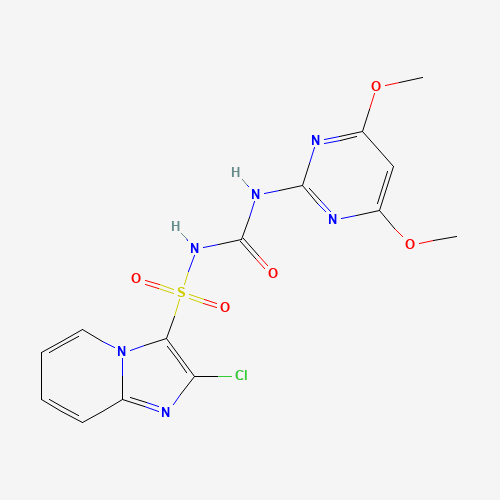
Imazosulfuron is an imidazopyridine.
科学粮草官-词典编辑部,修订于:2026-07-06
Toxicity
ToxicityEPA Ecotoxicity
Pesticide Ecotoxicity Data from EPA: 70
Ecotoxicity Values
LD50; Species: Colinus virginianus (Northern Bobwhite Quail) age 26 weeks; oral via capsule >2250 mg/kg /99.6% purity/
Fate Summary
ATMOSPHERIC FATE: According to a model of gas/particle partitioning of semivolatile organic compounds in the atmosphere(1), imazosulfuron, which has a vapor pressure of 3.38X10⁻¹⁰ mm Hg at 25 °C(2), is expected to exist solely in the particulate phase in the ambient atmosphere. Particulate-phase imazosulfuron may be removed from the air by wet and dry deposition(SRC). Imazosulfuron has a quantum yield of 0.00262 in water at wavelengths >290 nm(3) and, therefore, is expected to be susceptible to direct photolysis by sunlight(SRC).
Soil Adsorption / Mobility
Soil sorption studies using four Italian soils determined imazosulfuron Koc values of 98.7, 102 and 117 in soils of pH 7.0-7.5 and a Koc of 208 in a soil of pH 4.5(1). Additional tests in pH-modified soils indicated that imazosulfuron adsorption generally increased as the pH of the soil decreased(1); with a pKa of about 4, imazosulfuron at pH 7 and above will exist almost entirely in anionic form that can be repelled by negatively charged clay particles in soils lowering overall sorption(1); soil Kd values measured in one pH-modified sandy clay soil were 102 (pH 2.5), 6.58 (pH 4.4) and 0.91-1.76 (pH 7.4-7.5)(1). A measured Koc range 111-215 has also been reported(2,3) with a mean Koc of 163(2). According to a classification scheme(4), these Koc values suggests that imazosulfuron is expe...
Environmental Biodegradation
Study of the degradation of 14C-labeled imazosulfuron in flooded soils under laboratory conditions (water pH of 5.5) found aerobic and anaerobic half-lives of 60 and 3 days respectively(1). Imazosulfuron was subjected to the cleavage of the sulfonylurea bond to yield 2-amino-4,6-dimethoxypyrimidine and other degradation products. Tests in sterilized versus non-sterilized conditions(30 days) found that degradation rates under aerobic conditions were nearly the same in both sterilized and non-sterilized media indicating that abiotic hydrolysis was mostly responsible for the degradation. Under anaerobic conditions, soil microorganisms were the dominant degradation mechanism(1). Degradation of imazosulfuron in acidic upland soils under laboratory conditions resulted in a half-lives of appro...
Environmental Bioconcentration
An estimated BCF of 19 was calculated in fish for imazosulfuron(SRC), using a log Kow of 2.43(1) and a regression-derived equation(2). According to a classification scheme(3), this BCF suggests the potential for bioconcentration in aquatic organisms is low(SRC). Bioacccumulation in fish is reported to be "not relevant" as an ecotoxicological factor in aquatic organisms(4).
Volatilization from Water / Soil
A pKa of 3.94(1) indicates imazosulfuron will exist partially in anion form at pH 5 and almost entirely in anion form at pH 6-9(SRC), and therefore, since anions do not volatilize, volatilization of anionic imazosulfuron will not be an important fate process(SRC). The Henry's Law constant for non-ionized imazosulfuron is estimated as 3.70X10⁻¹¹ atm-cu m/mole(SRC) derived from its vapor pressure, 3.38X10⁻¹⁰ mm Hg(2), and water solubility, 5 mg/L at pH 5(3). This Henry's Law constant indicates that non-ionized imazosulfuron is expected to be essentially nonvolatile from water surfaces(4). Imazosulfuron's estimated Henry's Law constant and ionization indicates that volatilization from moist soil surfaces is not expected to occur(SRC). Imazosulfuron is not expected to volatilize from dry so...
Environmental Abiotic Degradation
... The photodegradation of imazosulfuron (IMZ), a potent broad-spectrum herbicide, was investigated under simulated rice field conditions. Previous reports have indicated that it is photolabile, but have failed to report radiation intensity or determine a quantum yield, precluding extrapolation to environmental rates. Therefore, the objective of this investigation was to determine the photolytic rate of IMZ under simulated rice field conditions and how it is influenced by environmental factors such as turbidity, salinity and temperature. RESULTS: IMZ was efficiently photolyzed in all solutions and fitted pseudo-first-order kinetics. Degradation was faster in HPLC-grade water than in field water. Field-relevant variances in temperature, turbidity and salinity did not significantly influ...
Environmental Water Concentrations
GROUNDWATER: The mobility and degradation of imazosulfuron, labeled with carbon-14 at the imidazole ([imi-(14)C]imazo) or pyrimidine ring ([pyr-(14)C]imazo), in lysimeters with 1 m(2) surface and 110 cm depth were investigated for three years. One lysimeter was treated with [imi-(14)C]imazo in two successive years at the rate of 50 g of active ingredient (ai)/ha each. The other two lysimeters were treated once with [pyr-(14)C]imazo and a mixture (1:1, w/w) of the two labeled imazosulfurons, respectively (50 g of ai/ha). In the first and second years of monitoring, the yearly mean concentration of (14)C in the leachate water was <0.10 microg/L in each lysimeter. Although in the third year the concentration of (14)C in the leachate water was 0.17 microg/L for the lysimeter treated twice w...
Artificial Pollution Sources
Imazosulfuron's production may result in its release to the environment through various waste streams; its use as a selective herbicide providing both pre- and post-emergence control of sedges and broadleaf weeds(1) will result in its direct release to the environment(SRC). Imazosulfuron is registered for application to residential and commercial turfgrass, rice, tomatoes, and peppers(1).
Probable Routes of Human Exposure
Occupational exposure to imazosulfuron may occur through inhalation and dermal contact with this compound at workplaces where imazosulfuron is produced or used. The general population may be exposed to imazosulfuron via inhalation and dermal contact in localized areas where imazosulfuron is being applied or recently applied as a herbicide(SRC). There is a potential for exposure of homeowners applying products containing imazosulfuron on home lawns(1). There is also a potential for post-application exposure of adults and children entering turf areas that have been treated with imazosulfuron and for bystander exposure of adults and children in areas adjacent to pesticide applications(1).
Environmental Fate / Exposure Summary
Imazosulfuron's production may result in its release to the environment through various waste streams; its use as a selective herbicide providing both pre- and post-emergence control of sedges and broadleaf weeds will result in its direct release to the environment. If released to air, a vapor pressure of 3.38X10⁻¹⁰ mm Hg at 25 °C indicates imazosulfuron will exist solely in the particulate phase in the atmosphere. Particulate-phase imazosulfuron will be removed from the atmosphere by wet and dry deposition. Imazosulfuron has a quantum yield of 0.00262 in water at wavelengths >290 nm and, therefore, is expected to be susceptible to direct photolysis by sunlight. If released to soil, imazosulfuron is expected to have high to moderate mobility based upon a Koc range of 98.7-208. A pKa of...
Effect Level
collection=toxvaldb&kind=^EL$
Lethal Dose
collection=toxvaldb&kind=^LD$
Toxicity Summary
IDENTIFICATION AND USE: Imazosulfuron is a herbicide, which is used to control most annual and perennial broad-leaved weeds and sedges in paddy rice and turf. HUMAN STUDIES: In a case report, ingestion of imazosulfuron and mefenacet changed urine color to green almost immediately. ANIMAL STUDIES: In mice, treatment-related increase in the mean relative liver weight was observed in males at 10,000 and 45,000 ppm and in females at 45,000 ppm. In rats treated for 24 months, examination of the eyes revealed treatment-related retinal degeneration and posterior subcapsular or complete cataracts at 20,000 ppm in males at termination (24 months) and in females at 6 months (cataracts only), 12 months, and 18 months. Microscopic examination revealed bilateral retinal atrophy in both sexes at 20,0...
Lethal Concentration
collection=toxvaldb&kind=^LC$
RAIS Toxicity Values
Oral Chronic Reference Dose Reference: OPP
Human Toxicity Excerpts
/CASE REPORTS/ The development of discolored urine may have many possible causes. Here we present the case of a 76-year-old woman who was admitted after ingesting the inorganic herbicides, mefenacet and imazosulfuron. Her urine color changed to green almost immediately. Since the patient had no specific medication or medical history we considered that the most likely cause of the change in urine color was the ingestion of the herbicides. Spectrophotometric analysis of the urine was conducted and a peak was observed in the green area of the wavelength spectrum. These findings show that mefenacet and imazosulfuron should be considered in the differential diagnosis of green discolored urine.
Reference and Risk Values
collection=toxvaldb&kind=^RRV$
Non-Human Toxicity Excerpts
/LABORATORY ANIMALS: Subchronic or Prechronic Exposure/ TH-913 Technical (purity = 99.7%) was administered orally by gelatin capsules to 2 beagle dogs per sex per dose at dose levels of 0 (empty gelatin capsules), 50, 100, 200, and 300 mg/kg/day for 4 weeks. No mortalities occurred. No treatment-related clinical signs were observed. Possible treatment-related decreases in mean body weight gain and food consumption were observed in both sexes at 300 mg/kg/day. Apparent increases in mean relative liver and thyroid/parathyroid weights were observed in females at 300 mg/kg/day. Macroscopic examinations revealed yellow/green kidneys and congested mesenteric lymph nodes in 1 male and 1 female at 300 mg/kg/day. NOEL (M) and (F) = 200 mg/kg/day (based on decreases in mean body weight gain and f...
Antidote and Emergency Treatment
/SRP:/ Advanced treatment: Consider orotracheal or nasotracheal intubation for airway control in the patient who is unconscious, has severe pulmonary edema, or is in severe respiratory distress. Positive-pressure ventilation techniques with a bag valve mask device may be beneficial. Consider drug therapy for pulmonary edema ... . Consider administering a beta agonist such as albuterol for severe bronchospasm ... . Monitor cardiac rhythm and treat arrhythmias as necessary ... . Start IV administration of D5W TKO /SRP: "To keep open", minimal flow rate/. Use 0.9% saline (NS) or lactated Ringer's (LR) if signs of hypovolemia are present. For hypotension with signs of hypovolemia, administer fluid cautiously. Watch for signs of fluid overload ... . Treat seizures with diazepam (Valium) or l...
USGS Health-Based Screening Levels for Evaluating Water-Quality
Reference: Smith, C.D. and Nowell, L.H., 2024. Health-Based Screening Levels for evaluating water-quality data (3rd ed.). DOI:10.5066/F71C1TWP