

 一键配货
一键配货
化合物详情
CAS122931-48-0
分子式C14H17N5O7S2
分子量431.44 g/mol
非危品
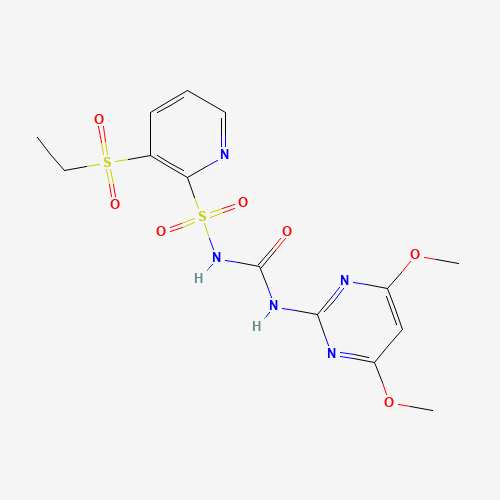
Rimsulfuron is a N-sulfonylurea that is N-carbamoyl-3-(ethylsulfonyl)pyridine-2-sulfonamide substituted by a 4,6-dimethoxypyrimidin-2-yl group at the amino nitrogen atom. It has a role as a herbicide, a xenobiotic and an environmental contaminant. It is a member of pyridines, an aromatic ether, a sulfone, a member of pyrimidines and a N-sulfonylurea.
科学粮草官-词典编辑部,修订于:2026-07-06
Toxicity
ToxicityEPA Ecotoxicity
Pesticide Ecotoxicity Data from EPA: 79
Ecotoxicity Values
LD50; Species: Anas platyrhynchos (Mallard Duck, age 23 weeks) oral via capsule >2250 mg/kg
Fate Summary
TERRESTRIAL FATE: Pyridine-2-14C-labeled rimsulfuron added to Fullsington silt loam (Newark, DE; 13% sand, 65% silt, 22% clay, 1.4% organic matter, pH 6.0, 4.9 mequiv/100 g cation exchange capacity) degraded rapidly with an average half-life of 5.6 days based on the first 14 days of data(1).
Soil Adsorption / Mobility
The Koc of rimsulfuron is reported to range from 13 to 76(1). According to a classification scheme(2), this Koc range suggests that rimsulfuron is expected to have very high to high mobility in soil. Sulfonylurea herbicides are more mobile in alkaline soils and in soils with lower organic matter content(1). Rimsulfuron, applied at 14.7 g/ha to a 9 hectare tile-drained field in Outlook, Saskatchewan, Canada followed by 300 mm of irrigation water over a 2-week period, was not detected in underlying groundwater. Soil characteristics were Dark Brown Chernozem, 30.9-59.4% sand, 1.6%-0.5% organic matter (decreasing with depth), pH 7.8 to 8.4, increasing with depth(1). Using a southern Italian soil from Sellata Mountain (organic content 4.78%; cation exchange capacity 12.4 cmol/kg, 19.6% sand,...
Environmental Biodegradation
ANAEROBIC: Pyridine-2-14C-labeled rimsulfuron, added at a field equivalent of 110 g/ha, degraded rapidly in sandy loam soil at 75% field moisture holding capacity under laboratory anaerobic conditions. The compound was 91% degraded after 75 days, corresponding to a half-life of 22.2 days(1).
Environmental Bioconcentration
An estimated BCF of 3 was calculated in fish for rimsulfuron(SRC), using a log Kow of 0.29(1) and a regression-derived equation(2). According to a classification scheme(3), this BCF suggests the potential for bioconcentration in aquatic organisms is low(SRC).
Volatilization from Water / Soil
The Henry's Law constant for rimsulfuron is estimated as 6.4X10⁻¹⁰ atm-cu m/mole(SRC) derived from its vapor pressure, 1.13X10⁻⁸ mm Hg(1), and water solubility, 10 mg/L(2). This Henry's Law constant indicates that rimsulfuron is expected to be essentially nonvolatile from water and moist soil surfaces(3). Rimsulfuron is not expected to volatilize from dry soil surfaces(SRC) based upon its vapor pressure(1).
Environmental Abiotic Degradation
Rimsulfuron hydrolysis half-lives at 25 °C were reported as 4.6 days at pH 5, 7.2 days at pH 7, and 0.3 days at pH 9(1).
Environmental Water Concentrations
GROUNDWATER: Rimsulfuron was not detected in monitoring wells at two sandy agricultural research fields in Jyndevad and Tylstrup, Denmark following pesticide application (per common agricultural practice of 0.003 g/sq m) to crops on May 23, 2003 and June 3, 2004, respectively(1).
Ecotoxicity Excerpts
/AQUATIC SPECIES/ ...The ecotoxicity of /rimsulfuron, and the metabolites 1-(N-(4,6-dimethoxypyrimidin-2-yl)-N-(3-(ethylsulfonyl)-2-pyridinylurea)) and 2-(N-((3-(ethylsulfonyl)-2-pyridinyl)-4,6-dimethoxy-2-pyrimidineamine))/ was evaluated through their effect on Daphnia magna and Vibrio fischeri (Microtox bioassay). No effect was observed on D. magna with 24 and 48 hr acute toxicity tests. Similarly, no toxic effect was observed with the Microtox test for the three chemicals in the range of concentrations tested that included the field application dose. ...
Artificial Pollution Sources
Rimsulfuron's production may result in its release to the environment through various waste streams; its use as a herbicide(1) will result in its direct release to the environment(SRC).
Probable Routes of Human Exposure
Occupational exposure to rimsulfuron may occur through inhalation and dermal contact with this compound at workplaces where rimsulfuron is produced or used. (SRC)
Environmental Fate / Exposure Summary
Rimsulfuron's production may result in its release to the environment through various waste streams; its use as a herbicide will result in its direct release to the environment. If released to air, a vapor pressure of 1.13X10⁻⁸ mm Hg at 25 °C indicates rimsulfuron will exist solely in the particulate phase in the atmosphere. Particulate-phase rimsulfuron will be removed from the atmosphere by wet or dry deposition. Rimsulfuron absorbs light at wavelengths 216 nm, 249 nm, and 298 nm, and therefore may be susceptible to direct photolysis by sunlight. If released to soil, rimsulfuron is expected to have very high to high mobility based upon a Koc range of 13 to 76. Sulfonylurea herbicides, such as rimsulfuron, are more mobile in alkaline soils and in soils with lower organic matter content...
Effect Level
collection=toxvaldb&kind=^EL$
Lethal Dose
collection=toxvaldb&kind=^LD$
Effect Concentration
collection=toxvaldb&kind=^EC$
Lethal Concentration
collection=toxvaldb&kind=^LC$
RAIS Toxicity Values
Oral Chronic Reference Dose Reference: OPP
Human Toxicity Excerpts
/GENOTOXICITY/ /In a/ structural chromosome aberration /assay/, human Lymphocytes /were exposed to/ rimsulfuron (DPX-E9636-22, purity: 98.8%) /at concentrations of/ 0, 0.1, 0.6, 1.0, and 1.3 mg/mL (high dose based on peak solubility) 3 hr exposure. No change in the number of aberrations/cell, % aberrant cells, % of cells with greater than 1 aberration, or mitotic index was observed at any rimsulfuron concentration in the absence or presence of S9-mediated metabolic activation. /The/ positive controls, mitomycin C (-S9) increases the number of aberrations/cell over negative controls by 16.5-42-fold, the % abnormal cells by 10-32-fold, and the % of cells with greater than 1 aberration from 0 to 8-16%. Cyclophosphamide (+S9) generated increases in number of aberrations/cell of 8.7-26-fold,...
Carcinogen Classification
No indication of carcinogenicity to humans (not listed by IARC).
Non-Human Toxicity Values
LD50 Rabbit dermal >2000 mg/kg
Reference and Risk Values
collection=toxvaldb&kind=^RRV$
Non-Human Toxicity Excerpts
/LABORATORY ANIMALS: Subchronic or Prechronic Exposure/ In a 90-day oral toxicity study, dogs /were administered/ rimsulfuron /at concentrations of/ 0, 250, 5000, 20000 ppm (0, 6.25, 125, or 500 mg/kg bw/day). ... Diuresis indicated by increased urinary volume, platelet concentration and kidney weights accompanied by decreased urinary osmolality was observed at >/= 125 mg/kg bw/day after 90 days. ... At 500 mg/kg bw/day, decreased liver enzymes and bilirubin, fatty change, and hepatocellular hypertrophy were observed in dogs. NOAEL = 6.25 mg/kg bw/day. LOAEL = 125 mg/kg/day based on urinary volume and osmolarity. /From Table/
Antidote and Emergency Treatment
/SRP:/ Advanced treatment: Consider orotracheal or nasotracheal intubation for airway control in the patient who is unconscious, has severe pulmonary edema, or is in severe respiratory distress. Positive-pressure ventilation techniques with a bag valve mask device may be beneficial. Consider drug therapy for pulmonary edema ... . Consider administering a beta agonist such as albuterol for severe bronchospasm ... . Monitor cardiac rhythm and treat arrhythmias as necessary ... . Start IV administration of D5W /SRP: "To keep open", minimal flow rate/. Use 0.9% saline (NS) or lactated Ringer's if signs of hypovolemia are present. For hypotension with signs of hypovolemia, administer fluid cautiously. Watch for signs of fluid overload ... . Treat seizures with diazepam or lorazepam ... . Use...