


 一键配货
一键配货
化合物详情
CAS129722-12-9
分子式C23H27Cl2N3O2
分子量448.39 g/mol g/mol
危化品
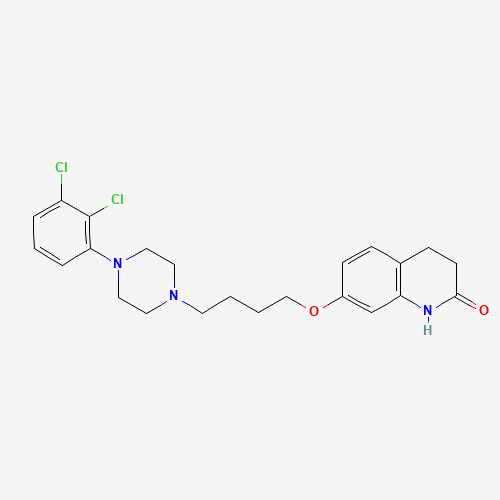
Aripiprazole is an N-arylpiperazine that is piperazine substituted by a 4-[(2-oxo-1,2,3,4-tetrahydroquinolin-7-yl)oxy]butyl group at position 1 and by a 2,3-dichlorophenyl group at position 4. It is an antipsychotic drug used for the treatment of Schizophrenia, and other mood disorders. It has a role as a serotonergic agonist, a H1-receptor antagonist, a drug metabolite and a second generation antipsychotic. It is a dichlorobenzene, a quinolone, an aromatic ether, a N-alkylpiperazine, a N-arylpiperazine and a delta-lactam.
科学粮草官-词典编辑部,修订于:2026-07-06
Toxicity
ToxicityFate Summary
ATMOSPHERIC FATE: According to a model of gas/particle partitioning of semivolatile organic compounds in the atmosphere(1), aripiprazole, which has an estimated vapor pressure of 3.2X10⁻¹³ mm Hg at 25 °C(SRC), determined from a fragment constant method(2), is expected to exist solely in the particulate phase. Particulate-phase aripiprazole may be removed from the air by wet and dry deposition(SRC). Aripiprazole contains chromophores that absorb at wavelengths >290 nm(4) and, therefore, may be susceptible to direct photolysis by sunlight(SRC).
Soil Adsorption / Mobility
Using a structure estimation method based on molecular connectivity indices(1), the Koc of aripiprazole can be estimated to be 2.5X10+4(SRC). According to a classification scheme(2), this estimated Koc value suggests that aripiprazole is expected to be immobile in soil. The estimated pKa of aripiprazole is 7.46(3), indicating that this compound will exist partially in the cation form in the environment and cations generally adsorb more strongly to soils containing organic carbon and clay than their neutral counterparts(4).
Environmental Bioconcentration
An estimated BCF of 1500 was calculated in fish for aripiprazole(SRC), using an estimated log Kow of 5.30(1) and a regression-derived equation(1). According to a classification scheme(2), this BCF suggests the potential for bioconcentration in aquatic organisms is very high(SRC), provided the compound is not metabolized by the organism(SRC).
Volatilization from Water / Soil
The Henry's Law constant for aripiprazole is estimated as 7.7X10⁻¹⁷ atm-cu m/mole(SRC) using a fragment constant estimation method(1). This Henry's Law constant indicates that aripiprazole is expected to be essentially nonvolatile from water and moist soil surfaces(2). Aripiprazole is not expected to volatilize from dry soil surfaces(SRC) based upon an estimated vapor pressure of 3.2X10⁻¹³ mm Hg(SRC), determined from a fragment constant method(3).
Environmental Abiotic Degradation
Aripiprazole is not expected to undergo hydrolysis in the environment due to the lack of functional groups that hydrolyze under environmental conditions(1). Aripiprazole contains chromophores that absorb at wavelengths >290 nm(1) and, therefore, may be susceptible to direct photolysis by sunlight(SRC). Based on UV spectra of other amino chlorobenzenes(2), aripiprazole may absorb light at wavelengths >290 nm(SRC).
Environmental Water Concentrations
While data specific to aripiprazole were not located(SRC, 2015), the literature suggests that some pharmaceutically active compounds originating from human and veterinary therapy are not eliminated completely in municipal sewage treatment plants and are, therefore, discharged into receiving waters(1). Wastewater treatment processes often were not designed to remove them from the effluent(2). Selected organic waste compounds may be degrading to new and more persistent compounds that may be released instead of or in addition to the parent compound(2).
Milk Concentrations
Aripiprazole is excreted in human breast milk. A decision should be made whether to discontinue nursing or to discontinue the drug, taking into account the importance of the drug to the mother.
Artificial Pollution Sources
Aripiprazole's production and administration as a medication(1) may result in its release to the environment through various waste streams(SRC).
Probable Routes of Human Exposure
Occupational exposure to aripiprazole may occur through inhalation and dermal contact with this compound at workplaces where aripiprazole is produced or used. Exposure to aripiprazole among the general population may be limited to those administered the drug, an antipsycholtic. (SRC)
Environmental Fate / Exposure Summary
Aripiprazole's production and administration as a medication may result in its release to the environment through various waste streams. If released to air, an estimated vapor pressure of 3.2X10⁻¹³ mm Hg at 25 °C indicates aripiprazole will exist solely in the particulate phase in the atmosphere. Particulate-phase aripiprazole will be removed from the atmosphere by wet and dry deposition. Aripiprazole contains chromophores that absorb at wavelengths >290 nm and, therefore, may be susceptible to direct photolysis by sunlight. If released to soil, aripiprazole is expected to be immobile based upon an estimated Koc of 2.5X10+4. The estimated pKa1 of aripiprazole is 7.46, indicating that this compound will exist partially in the cation form in the environment and cations generally adsorb mo...
Treatment
No specific information is available on the treatment of overdose with aripiprazole. An electrocardiogram should be obtained in case of overdosage and if QT interval prolongation is present, cardiac monitoring should be instituted. Otherwise, management of overdose should concentrate on supportive therapy, maintaining an adequate airway, oxygenation and ventilation, and management of symptoms. Close medical supervision and monitoring should continue until the patient recovers. Consider charcoal and hemodialysis. (A308)
Interactions
Valproate: When valproate (500-1500 mg/day) and aripiprazole (30 mg/day) were coadministered at steady state, the C max and AUC of aripiprazole were decreased by 25%. No dosage adjustment of aripiprazole is required when administered concomitantly with valproate.
Health Effects
Health effetcs include hyperpyrexia,muscle rigidity,altered mental status,and evidence of autonomic instability (irregular pulse or blood pressure, tachycardia, diaphoresis, and cardiac dysrhythmia). Other effects may include central anticholinergic toxicity, heat stroke, drug fever, and primary central nervous system pathology (RxList, A308).
Hepatotoxicity
Likelihood score: D (possible rare cause of clinically apparent liver injury).
Adverse Effects
Rare adverse effects may include neuroleptic malignant syndrome, liver function abnormalities and jaundice, seizures, and agranulocytosis. As with other antipsychotics, aripiprazole carries an FDA boxed warning for increased risk of cerebrovascular events and death in elderly patients with psychosis related to the major neurocognitive disorder and suicidal thoughts among children, adolescents, and young adults.
Exposure Routes
Oral
Toxicity Summary
Aripiprazole's antipsychotic activity is likely due to a combination of antagonism at D2 receptors in the mesolimbic pathway and 5HT2A receptors in the frontal cortex. Antagonism at D2 receptors relieves positive symptoms while antagonism at 5HT2A receptors relieves negative symptoms of schizophrenia. Aripiprazole exhibits high affinity for dopamine D2 and D3, serotonin 5-HT1A and 5- HT2A receptors, moderate affinity for dopamine D4, serotonin 5-HT2C and 5-HT7, alpha1-adrenergic and histamine H1 receptors and moderate affinity for the serotonin reuptake pump. Aripiprazole has no appreciable affinity for cholinergic muscarinic receptors. Aripiprazole functions as a partial agonist at the dopamine D2 and the serotonin 5-HT1A receptors, and as an antagonist at serotonin 5-HT2A receptor.
Human Toxicity Excerpts
/SIGNS AND SYMPTOMS/ A syndrome of potentially irreversible, involuntary, dyskinetic movements may develop in patients treated with antipsychotic drugs. Although the prevalence of the syndrome appears to be highest among the elderly, especially elderly women, it is impossible to rely upon prevalence estimates to predict, at the inception of antipsychotic treatment, which patients are likely to develop the syndrome. Whether antipsychotic drug products differ in their potential to cause tardive dyskinesia is unknown. The risk of developing tardive dyskinesia and the likelihood that it will become irreversible are believed to increase as the duration of treatment and the total cumulative dose of antipsychotic drugs administered to the patient increase. However, the syndrome can develop, al...
Carcinogen Classification
No indication of carcinogenicity to humans (not listed by IARC).
Drug Induced Liver Injury
References: DOI:10.1016/j.drudis.2019.09.022
Non-Human Toxicity Excerpts
/LABORATORY ANIMALS: Developmental or Reproductive Toxicity/ Male rats were treated with oral doses of 20 mg/kg/day, 40 mg/kg/day, and 60 mg/kg/day (6 times, 13 times, and 19 times the MRHD on a mg/m2 basis) of aripiprazole from 9 weeks prior to mating through mating. Disturbances in spermatogenesis were seen at 60 mg/kg and prostate atrophy was seen at 40 mg/kg and 60 mg/kg, but no impairment of fertility was seen.
Populations at Special Risk
Aripiprazole should be used with caution in patients with known cardiovascular disease (history of myocardial infarction or ischemic heart disease, heart failure or conduction abnormalities), cerebrovascular disease, or conditions which would predispose patients to hypotension (dehydration, hypovolemia, and treatment with antihypertensive medications).
Antidote and Emergency Treatment
Enhanced elimination. Owing to extensive tissue distribution, these drugs are not effectively removed by dialysis or hemoperfusion. Repeat-dose activated charcoal has not been evaluated. /Antipsychotic drugs/
Effects During Pregnancy and Lactation
Studies have not been done to see if aripiprazole could affect male fertility (ability to get partner pregnant) or increase the chance of birth defects above the background risk. In general, exposures that fathers or sperm donors have are unlikely to increase risks to a pregnancy. For more information, please see the MotherToBaby fact sheet Paternal Exposures at https://mothertobaby.org/fact-sheets/paternal-exposures-pregnancy/.









