

 一键配货
一键配货
化合物详情
CAS134523-00-5
分子式C33H35FN2O5
分子量558.65 g/mol
非危品
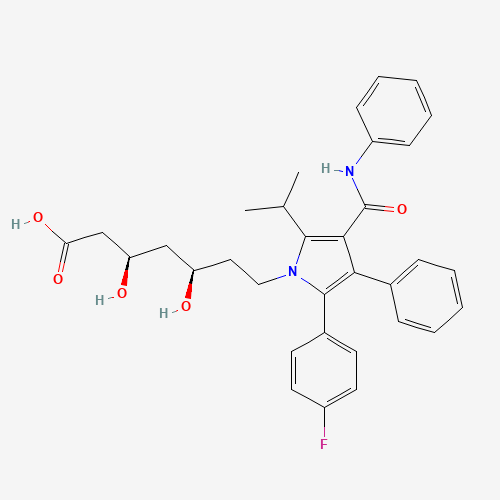
Atorvastatin is a dihydroxy monocarboxylic acid that is a member of the drug class known as statins, used primarily for lowering blood cholesterol and for preventing cardiovascular diseases. It has a role as a xenobiotic and an environmental contaminant. It is a member of pyrroles, a dihydroxy monocarboxylic acid, an aromatic amide, a member of monofluorobenzenes and a statin (synthetic). It is functionally related to a heptanoic acid. It is a conjugate acid of an atorvastatin(1-).
科学粮草官-词典编辑部,修订于:2026-07-06
Toxicity
ToxicityEcotoxicity Values
EC50; Species: Lemna gibba (Inflated Duckweed); Conditions: freshwater, renewal, 25 °C; Concentration: 214 ug/L for 7 days (95% confidence interval: 157-272 ug/L); Effect: growth, decreased biomass /98% purity/
Fate Summary
ATMOSPHERIC FATE: According to a model of gas/particle partitioning of semivolatile organic compounds in the atmosphere(1), atorvastatin, which has an estimated vapor pressure of 7.0X10⁻²⁵ mm Hg at 25 °C(SRC), determined from a fragment constant method(2), is expected to exist solely in the particulate phase in the ambient atmosphere. Particulate-phase atorvastatin may be removed from the air by wet and dry deposition(SRC). Atorvastatin contains chromophores that absorb at wavelengths >290 nm(3) and, therefore, may be susceptible to direct photolysis by sunlight(SRC).
Soil Adsorption / Mobility
The Koc of atorvastatin is estimated as 400(SRC), using an estimated log Kow of 6.36(1) and a regression-derived equation(1). According to a classification scheme(2), this estimated Koc value suggests that atorvastatin is expected to have moderate mobility in soil. The estimated pKa1 of atorvastatin is 4.3(3), indicating that this compound will exist partially in the anion form in the environment and anions generally do not adsorb more strongly to soils containing organic carbon and clay than their neutral counterparts(4).
Environmental Biodegradation
AEROBIC: Atorvastatin, present at 1 mg/L, was 80-90% removed using an activated sludge biomass from a wastewater treatment plant located in southeastern US. <10% sorption occurred(1).
Environmental Bioconcentration
An estimated BCF of 60 was calculated in fish for atorvastatin(SRC), using an estimated log Kow of 6.36(1) and a regression-derived equation(1). According to a classification scheme(2), this BCF suggests the potential for bioconcentration in aquatic organisms is moderate(SRC). No bioconcentration was observed in rainbow trout (Oncorhynchus mykiss) which were exposed over an 8-day period(3).
Volatilization from Water / Soil
The Henry's Law constant for atorvastatin is estimated as 2.4X10⁻²³ atm-cu m/mole(SRC) using a fragment constant estimation method(1). This Henry's Law constant indicates that atorvastatin is expected to be essentially nonvolatile from water and moist soil surfaces(2). Atorvastatin is not expected to volatilize from dry soil surfaces(SRC) based upon an estimated vapor pressure of 6.9X10⁻²⁵ mm Hg(SRC), determined from a fragment constant method(3).
Environmental Abiotic Degradation
Atorvastatin is not expected to undergo hydrolysis in the environment due to the lack of functional groups that hydrolyze under environmental conditions(1). Atorvastatin contains chromophores that absorb at wavelengths >290 nm(1) and, therefore, may be susceptible to direct photolysis by sunlight(SRC). Atorvastatin, present at 10 uM in solution, photodegraded rapidly when exposed to a Xe lamp at lamp intensity of 765 w/sq m suggesting photodegradation in sunlit water may be an important fate process(2).
Environmental Water Concentrations
SURFACE WATER: Atorvastatin was detected at <0.50-2.6 ng/L in 6 surface water samples from the Han River and at 0.9-14 ng/L in 4 samples from an effluent dominated creek water that flows into the Han River in Seoul, South Korea; samples were collected Sept 30, 2008(1). The compound was reported at a maximum concentration of 198 ng/L in surface water samples from northern and central Italy, reviewed from 1997-2013(2). A concentration range of not detected to 52.3 ng/L was reported for the Elbe River, northeast Spain, sampled in December 2009(3). Atorvastatin concentration range of 3.0-101.3 ng/L (median 6.8 ng/L) and a detection frequency of 4.7% was reported following sampling of the upper Tennessee River basin from December 2006 to October 2007(4). Atorvastatin exhibited a 50% frequenc...
Ecotoxicity Excerpts
/AQUATIC SPECIES/ ...The aim of the present study was to quantify the cytotoxic effects of acid and lactone forms of two statins, atorvastatin and simvastatin, as well as selected metabolites (ortho- and para-hydroxy atorvastatin acid, ortho-hydroxy atorvastatin lactone, simvastatin hydroxyl carboxylic acid, and 3''hydroxy simvastatin lactone) to hepatocytes from rainbow trout (Oncorhynchus mykiss). Hepatocytes were exposed for 24, 48, and 72 hr to different concentrations of each test substance (0.4-400 uM). Cytotoxicity was measured as metabolic inhibition and loss of membrane integrity with the fluorescent probes alamar blue (AB) and 5-carboxyfluorescein diacetate, acetoxymethyl ester (CFDA-AM), respectively. Atorvastatin, simvastatin, and ortho-hydroxy atorvastatin lactone had dose-...
Effluent Concentrations
Atorvastatin concentrations of 1.56 and 0.21 ug/L were reported in influent and effluent, respectively, at a wastewater treatment plant in southeastern US(1). Based on an annual consumption of 6496.94 kg/yr, the estimated atovastatin elimination from primary and secondary treatment processes was 56.25 and 58%, respectively, from wastewater facilities in Spain in 2009, giving a predicted environmental occurrence of 15.31 ng/L(2).
Artificial Pollution Sources
Atorvastatin's production and administration as a medication(1) may result in its release to the environment through various waste streams(SRC).
Sediment/Soil Concentrations
SEDIMENT: A concentration range of not detected to 2.99 ng/g was reported for sediments from the Elbe River, northeast Spain, sampled in December 2009(1).
Probable Routes of Human Exposure
Occupational exposure to atorvastatin may occur through inhalation and dermal contact with this compound at workplaces where atorvastatin is produced or used. Monitoring data indicate that the general population may be exposed to atorvastatin via inhalation of dermal contact with ingestion of contaminated water, and medical administration of atorvastatin. (SRC)
Environmental Fate / Exposure Summary
Atorvastatin's production and administration as a medication may result in its release to the environment through various waste streams. If released to air, an estimated vapor pressure of 7.0X10⁻²⁵ mm Hg at 25 °C indicates atorvastatin will exist solely in the particulate phase in the atmosphere. Particulate-phase atorvastatin will be removed from the atmosphere by wet and dry deposition. Atorvastatin contains chromophores that absorb at wavelengths >290 nm and, therefore, may be susceptible to direct photolysis by sunlight. If released to soil, atorvastatin is expected to have moderate mobility based upon an estimated Koc of 400. The estimated pKa1 of atorvastatin is 4.3, indicating that this compound will exist partially in the anion form in the environment and anions generally do not...
Interactions
Concomitant use of atorvastatin and cyclosporine increases the risk of myopathy or rhabdomyolysis. Following concomitant use of atorvastatin (10 mg daily for 28 days) and cyclosporine (5.2 mg/kg daily), atorvastatin peak plasma concentration and AUC were increased by 10.7- and 8.7-fold, respectively. Concomitant use of atorvastatin and cyclosporine should be avoided.
Toxicity Data
Generally well-tolerated. Side effects may include myalgia, constipation, asthenia, abdominal pain, and nausea. Other possible side effects include myotoxicity (myopathy, myositis, rhabdomyolysis) and hepatotoxicity. To avoid toxicity in Asian patients, lower doses should be considered.
Hepatotoxicity
Likelihood score: A (well known cause of clinically apparent liver injury).
Adverse Effects
Atorvastatin can cause liver function test abnormalities. If patients develop serum transaminases over 3 times the upper limit of normal, plasma concentrations require more frequent monitoring until normalized or atorvastatin therapy should undergo dose reduction or be discontinued.
Exposure Routes
Atorvastatin is rapidly absorbed after oral administration with maximum plasma concentrations achieved in 1 to 2 hours. The absolute bioavailability of atorvastatin (parent drug) is approximately 14% and the systemic availability of HMG-CoA reductase inhibitory activity is approximately 30%. The low systemic bioavailability is due to presystemic clearance by gastrointestinal mucosa and first-pass metabolism in the liver.
Toxicity Summary
Atorvastatin selectively and competitively inhibits the hepatic enzyme HMG-CoA reductase. As HMG-CoA reductase is responsible for converting HMG-CoA to mevalonate in the cholesterol biosynthesis pathway, this results in a subsequent decrease in hepatic cholesterol levels. Decreased hepatic cholesterol levels stimulates upregulation of hepatic LDL-C receptors which increases hepatic uptake of LDL-C and reduces serum LDL-C concentrations.
Human Toxicity Excerpts
/EPIDEMIOLOGY STUDIES/ ...In a prospective, observational cohort study with a comparison group to examine a fetal toxicity risk of statins, we followed 64 pregnant women taking statins, and 64 comparison group women without exposure to known teratogens. The statin group women were exposed to atorvastatin (n=46), simvastatin (n=9), pravastatin (n=6), or rosuvastatin (n=3) during the first trimester. There was no difference in the rate of major malformations between the statin group (1/46 live birth: 2.2%) and the comparison group (1/52 live birth: 1.9%, p=0.93). Similarly, there were no statistical differences between the statin and comparison groups in live births (71.9% vs 81.2%), spontaneous abortions (14: 21.9% vs 11: 17.2%), therapeutic abortions (3: 4.7% vs 0: 0%) and stillbirths (...
Carcinogen Classification
No indication of carcinogenicity to humans (not listed by IARC).
Drug Induced Liver Injury
References: DOI:10.1016/j.drudis.2019.09.022
Non-Human Toxicity Excerpts
/LABORATORY ANIMALS: Chronic Exposure or Carcinogenicity/ In a 2-year carcinogenicity study in rats at dose levels of 10, 30, and 100 mg/kg/day, 2 rare tumors were found in muscle in high-dose females: in one, there was a rhabdomyosarcoma and, in another, there was a fibrosarcoma. This dose represents a plasma AUC (0-24) value of approximately 16 times the mean human plasma drug exposure after an 80 mg oral dose.
Populations at Special Risk
The risk of myopathy or rhabdomyolysis is increased in geriatric patients (65 years of age or older) and in patients with uncontrolled hypothyroidism or renal impairment. Patients with renal impairment should be more closely monitored for adverse musculoskeletal effects. The risk of myopathy and/or rhabdomyolysis also is increased when atorvastatin is used concomitantly with cyclosporine, fibric acid derivatives, antilipemic dosages (1 g daily or higher) of niacin, or potent inhibitors of cytochrome P-450 (CYP) isoenzyme 3A4 (e.g., azole antifungals, certain macrolide antibiotics, certain HIV protease inhibitors or ritonavir-boosted protease inhibitor regimens, certain hepatitis C virus [HCV] protease inhibitors). Myopathy, including rhabdomyolysis, has been reported following concomita...
Antidote and Emergency Treatment
/SRP:/ Advanced treatment: Consider orotracheal or nasotracheal intubation for airway control in the patient who is unconscious, has severe pulmonary edema, or is in severe respiratory distress. Positive-pressure ventilation techniques with a bag valve mask device may be beneficial. Consider drug therapy for pulmonary edema ... . Consider administering a beta agonist such as albuterol for severe bronchospasm ... . Monitor cardiac rhythm and treat arrhythmias as necessary ... . Start IV administration of D5W TKO /SRP: "To keep open", minimal flow rate/. Use 0.9% saline (NS) or lactated Ringer's (LR) if signs of hypovolemia are present. For hypotension with signs of hypovolemia, administer fluid cautiously. Watch for signs of fluid overload ... . Treat seizures with diazepam or lorazepam...
Effects During Pregnancy and Lactation
Three women who were taking atorvastatin in doses of 20, 40 and 80 mg once daily donated milk samples at 0, 1, 2, 4, 6, 8, 10, 12, and 24 hours after their dose. Aliquots of complete milk collections were analyzed for cholesterol. Milk cholesterol levels were within previously established norms in the range of 10 mg/dL.