


 一键配货
一键配货
化合物详情
CAS134678-17-4
分子式C8H11N3O3S
分子量229.26 g/mol g/mol
危化品
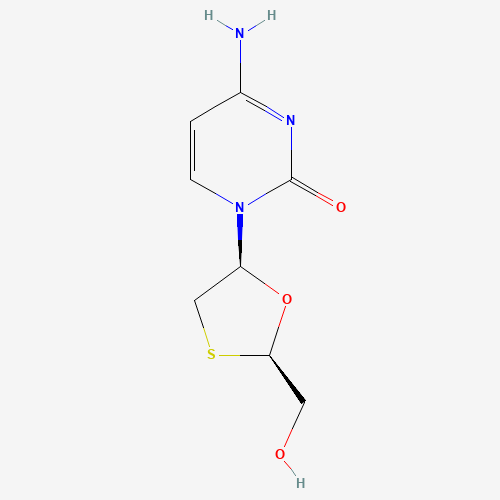
Lamivudine is a monothioacetal that consists of cytosine having a (2R,5S)-2-(hydroxymethyl)-1,3-oxathiolan-5-yl moiety attached at position 1. An inhibitor of HIV-1 reverse transcriptase, it is used as an antiviral in the treatment of AIDS and hepatitis B. It has a role as an antiviral drug, a prodrug, an allergen, a HIV-1 reverse transcriptase inhibitor, an EC 2.7.7.49 (RNA-directed DNA polymerase) inhibitor and an anti-HBV agent. It is a primary alcohol, an oxacycle, a monothioacetal and a nucleoside analogue. It is functionally related to a cytosine.
科学粮草官-词典编辑部,修订于:2026-07-06
Toxicity
ToxicityMilk Concentrations
...Lamivudine and zidovudine freely crossed the placenta and were secreted in breast milk.
Interactions
Lamivudine and zalcitabine may inhibit the phosphorylation of one another and concurrent administration is not recommended.
Hepatotoxicity
Likelihood score: E (unlikely cause of clinically apparent liver injury although flares of hepatitis B can occur during or following therapy).
Adverse Effects
The above is not a complete list. As always, a thorough medication reconciliation should take place whenever pharmaceutical therapy is started or modified.
Toxicity Summary
Lamivudine is usually well tolerated with milder toxicities compared to other NRTIs. If an overdose of lamivudine occurs, supportive care should be provided with monitoring. Dialysis is not a reliable treatment for an overdose of lamivudine. No human trials to date have shown evidence of carcinogenesis, mutagenesis, or fertility impairment.
Human Toxicity Excerpts
/CASE REPORTS/ The aim of this report is to describe five patients with lamivudine-induced pure red cell aplasia, an association not previously described. We describe patients with unresponsive anemia in whom a complete study including blood cell counts, reticulocyte counts, hemolysis tests, and bone marrow aspiration was performed. Pure red cell aplasia was considered when anemia was associated with normal leukocyte and platelet counts with a corrected reticulocyte count below 1% and less than 5% bone marrow erythroid progenitors in the absence of positive hemolysis tests. Complete remission was considered when bone marrow erythroid progenitors were at least 16%. Five male patients had pure red cell aplasia with a median age of 32 years (range 29 to 37 years). Before lamivudine, they h...
Carcinogen Classification
Summary: - AZT, 3TC, and NFV - Under the conditions of this transplacental exposure study, there was no evidence of carcinogenic activity of mixtures of AZT, 3TC, and NFV in male or female B6C3F1 mice whose dams were exposed to 80/40/336, 160/80/672, or 240/120/1,008 mg/kg by gavage.
Drug Induced Liver Injury
References: DOI:10.1016/j.drudis.2019.09.022
Non-Human Toxicity Excerpts
/GENOTOXICITY/ The carcinogenic potential of lamivudine has been studied in mice and rats. No evidence of carcinogenicity was seen in long-term studies in mice or rats.
Antidote and Emergency Treatment
Advanced treatment: Consider orotracheal or nasotracheal intubation for airway control in the patient who is unconscious, has severe pulmonary edema, or is in respiratory arrest. Positive pressure ventilation techniques with a bag valve mask device may be beneficial. Monitor cardiac rhythm and treat arrhythmias as necessary ... . Start an IV with D5W /SRP: "To keep open", minimal flow rate/. Use lactated Ringer's if signs of hypovolemia are present. Watch for signs of fluid overload. Consider drug therapy for pulmonary edema ... . For hypotension with signs of hypovolemia, administer fluid cautiously. Watch for signs of fluid overload ... . Treat seizures with diazepam (Valium) ... . Use proparacaine hydrochloride to assist eye irrigation ... . /Poison A and B/
Effects During Pregnancy and Lactation
Gynecomastia has been reported among men receiving highly active antiretroviral therapy. Gynecomastia is unilateral initially, but progresses to bilateral in about half of cases. No alterations in serum prolactin were noted and spontaneous resolution usually occurred within one year, even with continuation of the regimen. Some case reports and in vitro studies have suggested that protease inhibitors might cause hyperprolactinemia and galactorrhea in some male patients, although this has been disputed. The relevance of these findings to nursing mothers is not known. The prolactin level in a mother with established lactation may not affect her ability to breastfeed.
USGS Health-Based Screening Levels for Evaluating Water-Quality
Reference: Smith, C.D. and Nowell, L.H., 2024. Health-Based Screening Levels for evaluating water-quality data (3rd ed.). DOI:10.5066/F71C1TWP









