


 一键配货
一键配货
化合物详情
CAS137862-53-4
分子式C24H29N5O3
分子量435.52 g/mol g/mol
危化品
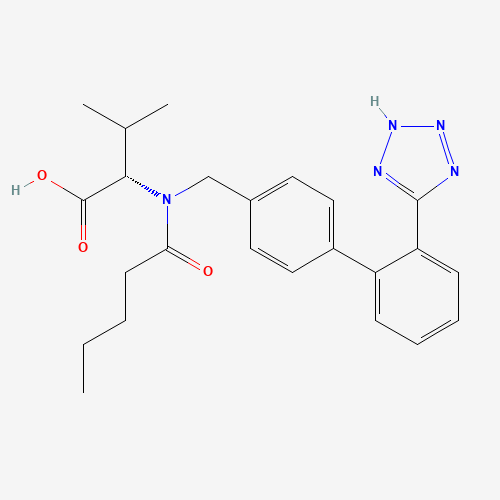
Valsartan is a monocarboxylic acid amide consisting of L-valine in which the amino hydrogens have been replaced by a pentanoyl and a [2'-(1H-tetrazol-5-yl)biphenyl]-4-yl]methyl group. It exhibits antihypertensive activity. It has a role as an antihypertensive agent, a xenobiotic, an angiotensin receptor antagonist and an environmental contaminant. It is a monocarboxylic acid, a monocarboxylic acid amide and a biphenylyltetrazole.
科学粮草官-词典编辑部,修订于:2026-07-06
Toxicity
ToxicityFate Summary
ATMOSPHERIC FATE: According to a model of gas/particle partitioning of semivolatile organic compounds in the atmosphere(1), valsartan, which has an estimated vapor pressure of 8.2X10⁻¹⁶ mm Hg at 25 °C(SRC), determined from a fragment constant method(2), is expected to exist solely in the particulate phase in the ambient atmosphere. Particulate-phase valsartan may be removed from the air by wet and dry deposition(SRC). Valsartan contains chromophores that absorb at wavelengths >290 nm(4) and, therefore, may be susceptible to direct photolysis by sunlight(SRC).
Soil Adsorption / Mobility
The Koc of valsartan is estimated as 250(SRC), using a log Kow of 4.00(1) and a regression-derived equation(2). Using a structure estimation method based on molecular connectivity indices(2), the Koc of valsartan can be estimated to be 2.3X10+4(SRC). According to a classification scheme(3), these estimated Koc values suggest that valsartan is expected to have moderate to no mobility in soil. The estimated pKa values of valsartan are 4.00 (tetrazole moiety) and 4.61 (carboxylic acid moiety)(4), indicating that this compound will exist in the zwitterion form in the environment. Valsartan breaks down to the anionic product 2'-(2H-tetrazol-5-yl)-[1,1'-biphenyl]-4-carboxylic acid in wastewater treatment(5), suggesting that the anionic form may dominate under environmental conditions(SRC). An...
Environmental Bioconcentration
An estimated BCF of 3 was calculated in fish for valsartan(SRC), using a log Kow of 4.0(1) and a regression-derived equation(2). According to a classification scheme(3), this BCF suggests the potential for bioconcentration in aquatic organisms is low(SRC).
Volatilization from Water / Soil
The estimated pKa values of 4.00 and 4.61(1) indicate valsartan will exist as a zwitterion. Valsartan breaks down to the anionic product 2'-(2H-tetrazol-5-yl)-[1,1'-biphenyl]-4-carboxylic acid in wastewater treatment(2), suggesting that the anionic form may dominate at pH values of 5 to 9(SRC). Therefore, volatilization from water surfaces is not expected to be an important fate process(SRC). Valsartan is not expected to volatilize from dry soil surfaces(SRC) based upon an estimated vapor pressure of 8.2X10⁻¹⁶ mm Hg(SRC), determined from a fragment constant method(3).
Environmental Abiotic Degradation
Valsartan is not expected to undergo hydrolysis in the environment due to the lack of functional groups that hydrolyze under environmental conditions(1). During the activated sludge process, it has been observed that substantial transformation of valsartan to 2'-(2H-tetrazol-5-yl)-[1,1'-biphenyl]-4-carboxylic acid (referred to as valsartan acid) occurs(2). Valsartan contains chromophores that absorb at wavelengths >290 nm(1) and, therefore, may be susceptible to direct photolysis by sunlight(SRC). -
Environmental Water Concentrations
SURFACE WATER: Novel methods utilizing liquid chromatography-tandem mass spectrometry and gas chromatography-mass spectrometry were validated for low-level detection of 104 pharmaceuticals and personal care products ingredients (PPCPs) and four alkylphenols (APs) in environmental samples. The methods were applied to surface water, sediment, and mussel tissue samples collected from San Francisco Bay, CA, USA, an urban estuary that receives direct discharge from over forty municipal and industrial wastewater outfalls. Among the target PPCPs, 35% were detected in at least one sample, with 31, 10, and 17 compounds detected in water, sediment, and mussels, respectively. Maximum /concentration was/ 92 ng/L in water (valsartan) ...(1).
Milk Concentrations
EXPERIMENTAL: Valsartan is distributed into milk in rats. It is not known whether valsartan is distributed into human milk
Effluent Concentrations
We measured concentrations of 56 active pharmaceutical ingredients (APIs) in effluent samples from 50 large wastewater treatment plants across the US. Hydrochlorothiazide was found in every sample. Metoprolol, atenolol, and carbamazepine were found in over 90% of the samples. Valsartan had the highest concentration (5300 ng/L), and also had the highest average concentration (1600 ng/L) across all 50 samples. Estimates of potential risks to healthy human adults were greatest for six anti-hypertensive APIs (lisinopril, hydrochlorothiazide, valsartan, atenolol, enalaprilat, and metoprolol), but nevertheless suggest risks of exposure to individual APIs as well as their mixtures are generally very low. Estimates of potential risks to aquatic life were also low for most APIs, but suggest more...
Artificial Pollution Sources
Valsartan's production and use in the treatment of hypertension(1) may result in its release to the environment through various waste streams(SRC).
Probable Routes of Human Exposure
Occupational exposure to valsartan may occur through inhalation and dermal contact with this compound at workplaces where valsartan is produced or used. Monitoring and use data indicate that the general population may be exposed to valsartan via ingestion of drinking water and to those administered this hypertension drug. (SRC)
Environmental Fate / Exposure Summary
Valsartan's production and administration for the treatment of hypertension may result in its release to the environment through various waste streams. If released to air, an estimated vapor pressure of 8.2X16 mm Hg at 25 °C indicates valsartan will exist solely in the particulate phase in the atmosphere. Particulate-phase valsartan will be removed from the atmosphere by wet and dry deposition. Valsartan contains chromophores that absorb at wavelengths >290 nm and, therefore, may be susceptible to direct photolysis by sunlight. If released to soil, valsartan is expected to have moderate to no mobility based upon estimated Koc values of 250 and 2.3X10+4. The estimated pKa values of valsartan are 4.00 (tetrazole moiety) and 4.61 (carboxylic acid moiety), indicating that this compound will...
Interactions
Dual Blockade of the Renin-Angiotensin System (RAS): Dual blockade of the RAS with angiotensin receptor blockers, ACE inhibitors, or aliskiren is associated with increased risks of hypotension, hyperkalemia, and changes in renal function (including acute renal failure) compared to monotherapy. Closely monitor blood pressure, renal function and electrolytes in patients on Diovan and other agents that affect the RAS.
Hepatotoxicity
Likelihood score: D (Possible rare cause of clinically apparent liver injury).
Toxicity Summary
IDENTIFICATION AND USE: Valsartan is a white to practically white fine powder that is formulated into oral tablets. Valsartan is an angiotensin II type 1 (AT1) receptor antagonist. It is used in the management of hypertension. Valsartan is also used to treat heart failure or left ventricular dysfunction after acute myocardial infarction. HUMAN EXPOSURE AND TOXICITY: The most likely manifestations of overdosage include hypotension and tachycardia; bradycardia could occur from parasympathetic (vagal) stimulation. Depressed levels of consciousness, circulatory collapse and shock have been reported. The use of valsartan during pregnancy is contraindicated. While use during the first trimester does not suggest a risk of major anomalies, use during the second and third trimester may cause ter...
Human Toxicity Excerpts
/CASE REPORTS/ The fetal toxicity of angiotensin-converting enzyme inhibitors (ACEI) is now well known. Sartans which are angiotensin II inhibitors, are supposed to have the same side effects on the fetus as ACE inhibitors because of their similar mechanism of action. This is supported by experimental and clinical data. Clinical presentation of fetal exposition to sartans varies from transient oligamnios to permanent renal failure, potentially complicated by Potter syndrome. A case of transitory fetal oliguria secondary to the exposure to an angiotensin-II-receptor inhibitor (valsartan) between 19 and 21 weeks' gestation /is reported/. ...
Drug Induced Liver Injury
References: DOI:10.1016/j.drudis.2019.09.022
Non-Human Toxicity Values
LD50 Rat gavage >2000 mg/kg (approximate)
Non-Human Toxicity Excerpts
/LABORATORY ANIMALS: Developmental or Reproductive Toxicity/ No teratogenic effects were observed when valsartan was administered to pregnant mice and rats at oral doses up to 600 mg/kg/day and to pregnant rabbits at oral doses up to 10 mg/kg/day. However, significant decreases in fetal weight, pup birth weight, pup survival rate, and slight delays in developmental milestones were observed in studies in which parental rats were treated with valsartan at oral, maternally toxic (reduction in body weight gain and food consumption) doses of 600 mg/kg/day during organogenesis or late gestation and lactation.
Populations at Special Risk
Hyperkalemia may occur in patients receiving valsartan, especially in those with heart failure and preexisting renal impairment.
Antidote and Emergency Treatment
Treatment and supportive measures. Monitor blood pressure and heart rate for 6 hours after ingestion. If symptomatic or significant hypotension develops, observe for at least 24 hours. 1. If hypotension occurs, treat it with supine positioning and IV fluids. Vasopressors are rarely necessary. 2. Treat angioedema with usual measures (eg, diphenhydramine, corticosteroids) and discontinue the ACE inhibitors. Switching to an AR blocker may not be appropriate as angioedema has also been reported with these agents. 3. Treat hyperkalemia if it occurs. /Angiotensin blockers and ACE inhibitors/
Effects During Pregnancy and Lactation
Relevant published information was not found as of the revision date.









