


 一键配货
一键配货
化合物详情
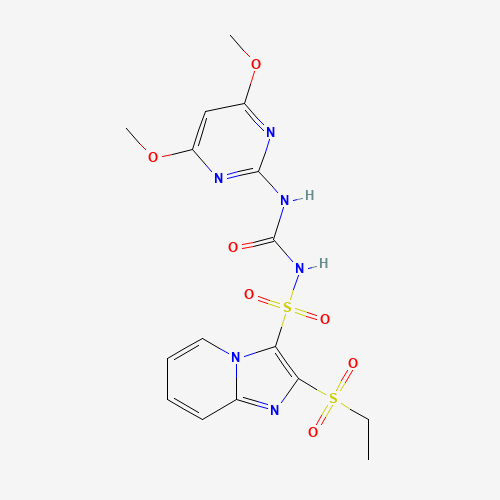
CAS141776-32-1
分子式C16H18N6O7S2
分子量470.48 g/mol
非危品
科学粮草官-词典编辑部,修订于:2026-07-06
Toxicity
ToxicityEPA Ecotoxicity
Pesticide Ecotoxicity Data from EPA: 70
Ecotoxicity Values
LD50; Species: Anas platyrhynchos (Mallard Duck, age 25 weeks) oral via capsule >2250 mg/kg
Fate Summary
ATMOSPHERIC FATE: According to a model of gas/particle partitioning of semivolatile organic compounds in the atmosphere(1), sulfosulfuron, which has a vapor pressure of 6.61X10⁻¹⁰ mm Hg at 25 °C(2), is expected to exist solely in the particulate phase in the ambient atmosphere. Particulate-phase sulfosulfuron may be removed from the air by wet or dry deposition(SRC). Sulfosulfuron exhibited a half-life of 9.1 days irradiated as an acetonitrile solution(4), suggesting that it may be susceptible to direct photolysis by sunlight(SRC).
Soil Adsorption / Mobility
Using a structure estimation method based on molecular connectivity indices(1), the Koc of sulfosulfuron can be estimated to be 33(SRC). According to a classification scheme(2), this estimated Koc value suggests that sulfosulfuron is expected to have very high mobility in soil. Sulfonylurea herbicides, such as sulfosulfuron, are more mobile in alkaline soils and in soils with lower organic matter content(3). The pKa of sulfosulfuron is 3.51(4), indicating that this compound will partially exist in the anion form in the environment and anions generally do not adsorb more strongly to soils containing organic carbon and clay than their neutral counterparts(5).
Environmental Bioconcentration
An estimated BCF of 3 was calculated in fish for sulfosulfuron(SRC), using an estimated log Kow of -0.77(1) and a regression-derived equation(2). According to a classification scheme(3), this BCF suggests the potential for bioconcentration in aquatic organisms is low(SRC). However, bioaccumulation studies of sulfosulfuron residues in catfish (Genus species not specified) exposed to 9 and 18 mg/L over 56 days showed the presence of high amounts of the herbicide (0.009 to 0.496 ug/g) and its metabolite aminopyrimidine in homogenized fish samples(4).
Volatilization from Water / Soil
The Henry's Law constant for sulfosulfuron is estimated as 2.3X10⁻¹¹ atm-cu m/mole at pH 5(SRC) derived from its vapor pressure, 6.61X10⁻¹⁰ mm Hg(1), and water solubility, 18 mg/L(2). This Henry's Law constant indicates that sulfosulfuron is expected to be essentially nonvolatile from water and moist soil surfaces(3). Sulfosulfuron is not expected to volatilize from dry soil surfaces(SRC) based upon its vapor pressure(1).
Environmental Abiotic Degradation
Hydrolysis half-lives of 9.3, 40.6, 13.9 and 35.0 days at pH values of 4.0, 7.0, 9.2, and 6.8 (distilled water), respectively, were measured. Alkaline hydrolysis yielded 1-(2-ethylsulfonylimidazo[1,2-a]-pyridin-3-yl-3-(4,6-dimethoxypyrimidin-2-yl) amine(1). Hydrolysis half-lives of 7 (pH 4), 48 (pH 5), 168 (pH 7), and 156 days (pH 9) (all 25 °C) have also been reported(2). Under acidic conditions, 1-(2-ethylsulfonylimidazo[1,2-a]pyridin)-3-sulfonamide and 4,6-dimethoxy-2-aminopyrimidine were identified as hydrolytic degradation products(1). After irradiation for 11 days, the compound, present as an acetonitrile solution, decomposed with first-order rate kinetics, exhibiting a half-life of 9.1 days under sunlight. Photodegradation involved breaking of the sulfonylurea bridge as does acid...
Environmental Water Concentrations
DRINKING WATER: Sulfosulfuron was tested for in 206 surface drinking-water supplies of 15 communities in Manitoba, Saskatchewan, and Alberta, Canada in midsummer (July 2003). The source of drinking water in reservoirs was primarily from snowmelt runoff from crop lands. Sulfosulfuron was detected in 21 of 206 reservoir samples with a maximum concentration of 36.1 ng/L; detection limit = 1.0 ng/L. Positive detections were found in two of four reservoirs in Manitoba, exhibiting mean concentrations of 1.4 and 25 ng/L; it was not detected in six reservoirs in Saskatchewan and five reservoirs in Alberta(1).
Ecotoxicity Excerpts
/AQUATIC SPECIES/ ... Data presented here demonstrate that exposure to initial sulfosulfuron concentrations of 3.33 ug/L for up to 21 days was tolerated by /Glyceria maxima (Hartm) Holmb, Lagarosiphon major (Ridl) Moss and Myriophyllum spicatum L/ ... and that adverse effects were observed only when plants were exposed to initial concentrations of 3.33 and 10 ug/L for 70 days. As the occurrence of such high initial concentrations for long periods is unlikely in the aquatic environment, sulfosulfuron is not expected to have adverse effects on the growth of these species. ...
Artificial Pollution Sources
Sulfosulfuron's production may result in its release to the environment through various waste streams; its use as a herbicide(1) will result in its direct release to the environment(SRC).
Probable Routes of Human Exposure
Occupational exposure to sulfosulfuron may occur through inhalation and dermal contact with this compound at workplaces where sulfosulfuron is produced or used. Limited monitoring data indicate that the general population may be exposed to sulfosulfuron via inhalation of ingestion of contaminated drinking water. (SRC)
Environmental Fate / Exposure Summary
Sulfosulfuron's production may result in its release to the environment through various waste streams; its use as a herbicide will result in its direct release to the environment. If released to air, a vapor pressure of 6.6X10⁻¹⁰ mm Hg at 25 °C indicates sulfosulfuron will exist solely in the particulate phase in the atmosphere. Particulate-phase sulfosulfuron will be removed from the atmosphere by wet or dry deposition. Sulfosulfuron exhibited a half-life of 9.1 days irradiated as an acetonitrile solution, suggesting that it may be susceptible to direct photolysis by sunlight. If released to soil, sulfosulfuron is expected to have very high mobility based upon an estimated Koc of 33. Sulfonylurea herbicides, such as sulfosulfuron, are more mobile in alkaline soils and in soils with low...
Effect Level
collection=toxvaldb&kind=^EL$
Lethal Dose
collection=toxvaldb&kind=^LD$
RAIS Toxicity Values
Oral Chronic Reference Dose Reference: OPP
Human Toxicity Excerpts
/GENOTOXICITY/ In an in vitro cytogenetic assay, cultured human lymphocytes, obtained from a single donor, were exposed to Sulfosulfuron in initial (3-hr exposure with and without S9 to Sulfosulfuron, followed by 17-hr incubation and then 2-hr exposure to colcemid) and confirmatory (-S9: 19.5- and 43.4-hr exposures to Sulfosulfuron, followed by colcemid; +S9: same as initial) assays. The S9 homogenate was derived from Aroclor 1254-induced rat livers and the test material was delivered to the test system as a solution in DMSO. The highest dose level evaluated (with and without S9) in all assays and harvest times was 1000 ug/mL. A precipitate was observed at this dose level. In addition, reductions (from 14.9 to 66.7%) were seen in mitotic indices at this dose level with and without S9. H...
Non-Human Toxicity Values
LD50 Rat oral > 5000 mg/kg
Reference and Risk Values
collection=toxvaldb&kind=^RRV$
Non-Human Toxicity Excerpts
/LABORATORY ANIMALS: Chronic Exposure or Carcinogenicity/ In a carcinogenicity study Sulfosulfuron (MON 37500 98.4% a.i.) was continuously administered to 60 CD-1 albino mice/sex/dose as a dietary admixture at dose levels of 0, 30, 700, 3000 or 7000 ppm (0, 4.0, 93.4, 393.6 or 943.5 mg/kg/day to males or 0, 6.5, 153.0, 634.9 and 1388.2 mg/kg/day to females) for 18 months. Ten animals/sex/dose were sacrificed at month 12 for hematology, limited serum chemistry analyses and gross/microscopic pathology. At 3,000 ppm, increased incidence of calculus in the urinary bladder (34% vs. 5%, controls) and microscopic lesions of the bladder caused by calculus formation (mucosal epithelial hyperplasia, 42% vs. 6.8%, controls; chronic inflammation, 39% vs. 3.4%; and ulceration, 5.1% vs. 0%) were repo...
Antidote and Emergency Treatment
/SRP:/ Advanced treatment: Consider orotracheal or nasotracheal intubation for airway control in the patient who is unconscious, has severe pulmonary edema, or is in severe respiratory distress. Positive-pressure ventilation techniques with a bag valve mask device may be beneficial. Consider drug therapy for pulmonary edema ... . Consider administering a beta agonist such as albuterol for severe bronchospasm ... . Monitor cardiac rhythm and treat arrhythmias as necessary ... . Start IV administration of D5W /SRP: "To keep open", minimal flow rate/. Use 0.9% saline (NS) or lactated Ringer's if signs of hypovolemia are present. For hypotension with signs of hypovolemia, administer fluid cautiously. Watch for signs of fluid overload ... . Treat seizures with diazepam or lorazepam ... . Use...
USGS Health-Based Screening Levels for Evaluating Water-Quality
Reference: Smith, C.D. and Nowell, L.H., 2024. Health-Based Screening Levels for evaluating water-quality data (3rd ed.). DOI:10.5066/F71C1TWP









