


 一键配货
一键配货
化合物详情
CAS142459-58-3
分子式C14H13F4N3O2S
分子量363.33 g/mol
非危品
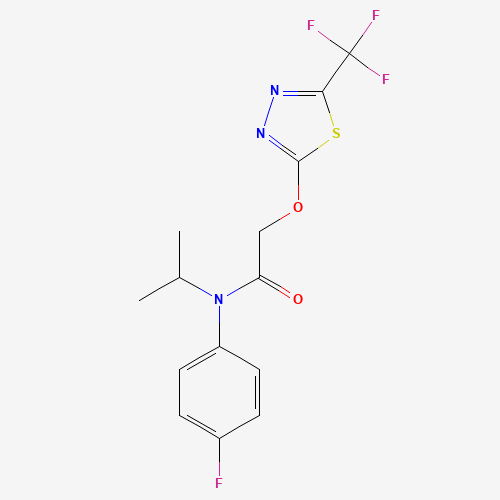
Flufenacet is an aromatic amide that is acetamide in which the amino hydrogens have been replaced by a propan-2-yl and 4-fluorophenyl groups while the methyl hydrogen is replaced by a [5-(trifluoromethyl)-1,3,4-thiadiazol-2-yl]oxy group. It has a role as a herbicide, a xenobiotic and an environmental contaminant. It is a member of thiadiazoles, an aromatic amide and a member of monofluorobenzenes.
科学粮草官-词典编辑部,修订于:2026-07-06
Toxicity
ToxicityEPA Ecotoxicity
Pesticide Ecotoxicity Data from EPA: 100
Ecotoxicity Values
LD50; Species: Apis mellifera (Honey Bee) worker; topical, general >25 ug/bee for 48 hr
Fate Summary
[Table#6614]: IkRheXMgYWZ0ZXIgYXBwbGljYXRpb24iLCJFeHRyYWN0YWJsZSBSZXNpZHVlcyAlIEFwcGxpZWQiLCJGbHVmZW5hY2V0ICUgQXBwbGllZCIsIkRlZ3JhZGF0ZXMgJSBBcHBsaWVkIiwiQm91bmQgUmVzaWR1ZXMgJSBBcHBsaWVkIgoiMCIsIjk4LjAiLCI5Ny4wIiwiMS4wIiwibm90IGRldGVjdGVkIgoiMSIsIjk0LjQiLCI5Mi45IiwiMS41IiwiNC4yIgoiNCIsIjg2LjQiLCI4NC41IiwiMS45IiwiMTEuMSIKIjciLCI4Ny4xIiwiODQuNSIsIjIuNiIsIjEzLjciCiIxMSIsIjg0LjgiLCI3OS44IiwiNS4wIiwiMTIuOSIKIjE1IiwiNjUuMSIsIjYyLjYiLCIyLjUiLCIxOS4wIgoiMTkiLCI1OS4wIiwiNTYuOCIsIjIuMiIsIjIzLjciCiIyNyIsIjY0LjUiLCI1MS41IiwiMTMuMCIsIjIyLjMiCiIzNSIsIjczLjYiLCI1MS4zIiwiMjIuMyIsIjI0LjIiCiI0NiIsIjY3LjgiLCI0Mi4zIiwiMjUuNSIsIjIyLjMiCiI4OCIsIjYyLjYiLCIyOS4wIiwiMzMuNiIsIjI1LjMiCg==
Soil Adsorption / Mobility
An outdoor soil study with [phenyl-U-14C]flufenacet was conducted in two sandy loams collected from Chualar and Fresno sites in California. Plots were treated with an equivalent rate of 0.89 lb/acre. Samples were collected up to 88 days after treatment. Soil characteristics for Chualar soil are 1.3% organic matter, 70.0% sand, 18.0% silt, 12.0% clay, pH 6.4; for Fresno soil 0.5% organic matter, 64.7% sand, 31.3% silt, 4.0% clay, pH 7.5. Bound residues at depths of 3 to 13 cm were measured in both soils starting at day 15; Fresno soil (day:% bound residue) 15:8.9, 19:6.6, 27:11.6, 35:15.6, 46:6.9, 88:22.1; Chualar soil (day:% bound residue) 15:11.1, 19:12.7, 27:6.0, 35:1.0, 46:5.1, 88:6.3(1).
Environmental Biodegradation
ANAEROBIC: Under anaerobic conditions (flooded soil) for a 6 month incubation period, flufenacet had a half-life of 240 days; however, most of the flufenacet dissipated by binding to the soil matrix(1).
Environmental Bioconcentration
An estimated BCF of 60 was calculated in fish for flufenacet(SRC), using a log Kow of 3.20(1) and a regression-derived equation(2). According to a classification scheme(3), this BCF suggests the potential for bioconcentration in aquatic organisms is moderate(SRC).
Volatilization from Water / Soil
The Henry's Law constant for flufenacet is estimated as 5.8X10⁻⁹ atm-cu m/mole(SRC) derived from its vapor pressure, 6.75X10⁻⁷ mm Hg(1), and water solubility, 56 mg/L(1). This Henry's Law constant indicates that flufenacet is expected to be essentially nonvolatile from moist soil and water surfaces(2). Flufenacet is not expected to volatilize from dry soil surfaces(SRC) based upon its vapor pressure(1).
Environmental Abiotic Degradation
The rate constant for the vapor-phase reaction of flufenacet with photochemically-produced hydroxyl radicals has been estimated as 1.7X10⁻¹¹ cu cm/molecule-sec at 25 °C(SRC) using a structure estimation method(1). This corresponds to an atmospheric half-life of about 22 hours at an atmospheric concentration of 5X10+5 hydroxyl radicals per cu cm(1). Flufenacet is not expected to undergo hydrolysis in the environment due to the lack of functional groups that hydrolyze under environmental conditions(2). Flufenacet contains chromophores that absorb at wavelengths >290 nm(2) and, therefore, may be susceptible to direct photolysis by sunlight(SRC). Flufenacet had a photodegradation half-life of >30 days in sterile water at pH 5.0 and 25 °C using artificial sunlight(3). In sandy loam soil surf...
Environmental Water Concentrations
RAIN WATER: Rainfall samples from four intensively agricultural watersheds (Maryland, Indiana, Nebraska, California) tested positive for flufenacet in 4% of the 52 samples collected in 2003 and 2004 with a maximum concentration of 0.05 ug/L measured in Nebraska on May 4, 2004(1).
Ecotoxicity Excerpts
/AQUATIC SPECIES/ Two chronic studies are available testing chronic toxicity of flufenacet to freshwater fish. The first, an early life-stage toxicity test, was conducted using rainbow trout. Delays in growth and development of fry were demonstrated to occur at concentrations of flufenacet in water as low as 0.334 ppm. The second, a full life cycle study, used fathead minnows. No treatment-related effects were observed on embryo survival, hatching success, larval, juvenile, or adult survival of the F0 generation. In addition, no significant treatment-related effects were observed on egg production at any test level. Growth was affected by treatment with flufenacet: the most sensitive endpoint was adult male weight at test termination (Day 254), with a NOAEC of 0.075 ppm a.i. Growth was...
Artificial Pollution Sources
Fulfenacet's production may result in its release to the environment through various waste streams; it's use as a herbicide(1) will result in its direct release to the environment(SRC).
Probable Routes of Human Exposure
Occupational exposure to flufenacet may occur through inhalation of dust and dermal contact with this compound at workplaces where flufenacet is produced or used. (SRC)
Environmental Fate / Exposure Summary
Fulfenacet's production may result in its release to the environment through various waste streams; it's use as a herbicide will result in its direct release to the environment. If released to air, a vapor pressure of 6.75X10⁻⁷ mm Hg at 20 °C indicates flufenacet will exist in both the vapor and particulate phases in the atmosphere. Vapor-phase flufenacet will be degraded in the atmosphere by reaction with photochemically-produced hydroxyl radicals; the half-life for this reaction in air is estimated to be 22 hours. Particulate-phase flufenacet will be removed from the atmosphere by wet or dry deposition. Flufenacet contains chromophores that absorb at wavelengths >290 nm and, therefore, may be susceptible to direct photolysis by sunlight. If released to soil, flufenacet is expected to...
Effect Level
collection=toxvaldb&kind=^EL$
Lethal Dose
collection=toxvaldb&kind=^LD$
Toxicity Data
LC50 (rat) >3740 mg/m3
Adverse Effects
Skin Sensitizer - An agent that can induce an allergic reaction in the skin.
RAIS Toxicity Values
Oral Chronic Reference Dose Reference: OPP
Carcinogen Classification
No indication of carcinogenicity to humans (not listed by IARC).
Non-Human Toxicity Values
LD50 Rabbit dermal >2000 mg/kg /Axiom DF Herbicide/
Reference and Risk Values
collection=toxvaldb&kind=^RRV$
Non-Human Toxicity Excerpts
/OTHER TOXICITY INFORMATION/ Treatment with FOE 5043 at a rate of 1000 ppm as a dietary admixture was found to significantly increase the clearance of (125I)T4 from the serum, suggesting an enhanced excretion of the hormone. In the liver, the activity of hepatic uridine glucuronosyl transferase, a major pathway of thyroid hormone biotransformation in the rat, increased in a statistically significant and dose-dependent manner; conversely, hepatic 5'-monodeiodinase activity trended downward with dose. Bile flow as well as the hepatic uptake and biliary excretion of (125I)T4 were increased following exposure to FOE 5043. Thyroidal function, as measured by the discharge of iodide ion in response to perchlorate, and pituitary function, as measured by the capacity of the pituitary to secrete...
Evidence for Carcinogenicity
Cancer Classification: Not Likely to be Carcinogenic to Humans
Antidote and Emergency Treatment
/SRP:/ Advanced treatment: Consider orotracheal or nasotracheal intubation for airway control in the patient who is unconscious, has severe pulmonary edema, or is in severe respiratory distress. Positive-pressure ventilation techniques with a bag valve mask device may be beneficial. Consider drug therapy for pulmonary edema ... . Consider administering a beta agonist such as albuterol for severe bronchospasm ... . Monitor cardiac rhythm and treat arrhythmias as necessary ... . Start IV administration of D5W /SRP: "To keep open", minimal flow rate/. Use 0.9% saline (NS) or lactated Ringer's if signs of hypovolemia are present. For hypotension with signs of hypovolemia, administer fluid cautiously. Watch for signs of fluid overload ... . Treat seizures with diazepam or lorazepam ... . Use...
USGS Health-Based Screening Levels for Evaluating Water-Quality
Reference: Smith, C.D. and Nowell, L.H., 2024. Health-Based Screening Levels for evaluating water-quality data (3rd ed.). DOI:10.5066/F71C1TWP









