


 一键配货
一键配货
化合物详情
CAS143322-58-1
分子式C22H26N2O2S
分子量382.52 g/mol g/mol
危化品
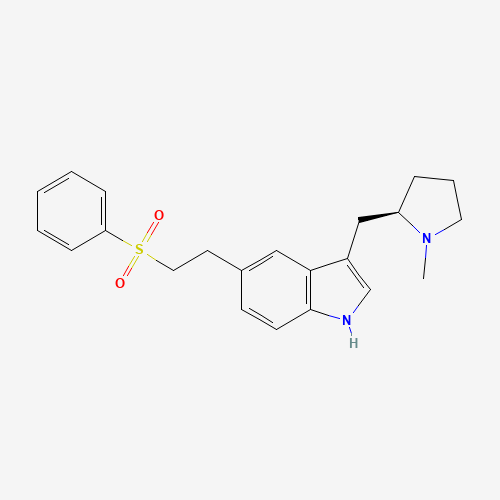
Eletriptan is an N-alkylpyrrolidine, that is N-methylpyrrolidine in which the pro-R hydrogen at position 2 is replaced by a {5-[2-(phenylsulfonyl)ethyl]-1H-indol-3-yl}methyl group. It has a role as a non-steroidal anti-inflammatory drug, a serotonergic agonist and a vasoconstrictor agent. It is a member of indoles, a sulfone and a N-alkylpyrrolidine. It is a conjugate base of an eletriptan(1+).
科学粮草官-词典编辑部,修订于:2026-07-06
Toxicity
ToxicityAdverse Effects
As eletriptan is a primary substrate of the CYP3A4 enzyme, it is advised not to administer eletriptan within at least 72 hours of a potent CYP3A4 inhibitor. Furthermore, eletriptan may interact with oral contraceptives due to its CYP3A4 metabolism. Eletriptan should not be coadministered with monoamine oxidase inhibitors, other triptans (5-HT1D receptor agonists), or nefazodone due to the high risk of an increased serotonergic effect, which could lead to serotonin syndrome. Although serotonergic agonists may be utilized concurrently with eletriptan therapy, close monitoring for signs and symptoms of serotonin syndrome is recommended, especially during initiation and dose increases.
Toxicity Summary
Although a specific antidote for triptan toxicity does not exist, it is recommended to discontinue eletriptan therapy and initiate cyproheptadine therapy, if toxicity is suspected, particularly in the case of serotonin syndrome. Notably, eletriptan toxicity is associated with a low risk of death. In managing eletriptan toxicity, the primary approaches involve decontamination, supportive care, airway management, monitoring patient vitals, and consulting with a medical toxicologist in cases of significant overdose. Due to the large volume of drug distribution, hemodialysis is unlikely to be effective.
Drug Induced Liver Injury
References: DOI:10.1016/j.drudis.2019.09.022
Effects During Pregnancy and Lactation
A review of four European adverse reaction databases found 26 reported cases of painful, burning nipples, painful breasts, breast engorgement and/or painful milk ejection in women who took a triptan while nursing. Pain was sometimes intense and occasionally led to decreased milk production. Pain generally subsided with time as the drug was eliminated. The authors proposed that triptans may cause vasoconstriction of the arteries in the breast, nipples, and the arteries surrounding the alveoli and milk ducts, causing a painful sensation and a painful milk ejection reflex.









