


 一键配货
一键配货
化合物详情
CAS144494-65-5
分子式C22H36N2O5S
分子量440.6 g/mol g/mol
危化品
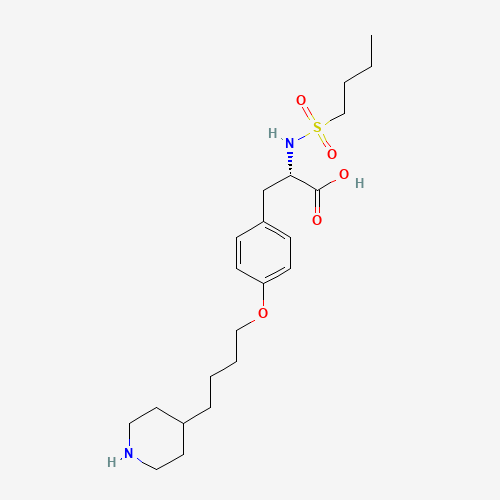
Tirofiban is a member of the class of piperidines that is L-tyrosine in which a hydrogen attached to the amino group is replaced by a butylsulfonyl group and in which the hydrogen attached to the phenolic hydroxy group is replaced by a 4-(piperidin-4-yl)butyl group. It has a role as a fibrin modulating drug, an anticoagulant and a platelet glycoprotein-IIb/IIIa receptor antagonist. It is a member of piperidines, a L-tyrosine derivative and a sulfonamide.
科学粮草官-词典编辑部,修订于:2026-07-06
Toxicity
ToxicityFate Summary
ATMOSPHERIC FATE: According to a model of gas/particle partitioning of semivolatile organic compounds in the atmosphere(1), tirofiban, which has an estimated vapor pressure of 5.2X10⁻¹⁶ mm Hg at 25 °C(SRC), determined from a fragment constant method(2), is expected to exist solely in the particulate phase in the ambient atmosphere. Particulate-phase tirofiban may be removed from the air by wet and dry deposition(SRC). Tirofiban does not contain chromophores that absorb light at wavelengths >290 nm and therefore is not be expected to be susceptible to direct photolysis by sunlight(SRC).
Soil Adsorption / Mobility
Using a structure estimation method based on molecular connectivity indices(1), the Koc for tirofiban can be estimated to be 40,000(SRC). According to a classification scheme(2), this estimated Koc value suggests that tirofiban is expected to be immobile in soil.
Environmental Bioconcentration
An estimated BCF of 3.2 was calculated for tirofiban(SRC), using an estimated log Kow of 1.4(1) and a regression-derived equation(2). According to a classification scheme(3), this BCF suggests the potential for bioconcentration in aquatic organisms is low(SRC).
Volatilization from Water / Soil
The Henry's Law constant for tirofiban is estimated as 7.4X10⁻¹⁵ atm-cu m/mole(SRC) using a fragment constant estimation method(1). This Henry's Law constant indicates that tirofiban is expected to be essentially nonvolatile from water surfaces(2). Estimated pKa values of 3.3 (carboxylic acid group) and 10.5 (amino group)(3) indicate that tirofiban will exist as a zwitterion at pH values of 5 to 9 and therefore volatilization from moist soil surfaces and water surfaces is not expected to be an important fate process. Tirofiban is not expected to volatilize from dry soil surfaces(SRC) based upon an estimated vapor pressure of 5.2X10⁻¹⁶ mm Hg(SRC), determined from a fragment constant method(4).
Environmental Abiotic Degradation
Tirofiban is not expected to undergo hydrolysis in the environment due to the lack of hydrolyzable functional groups(1). Tirofiban does not contain chromophores that absorb light at wavelengths >290 nm and therefore is not be expected to be susceptible to direct photolysis by sunlight(SRC).
Artificial Pollution Sources
Tirofiban's production and use as an antithrombotic(1) may result in its release to the environment through various waste streams(SRC).
Probable Routes of Human Exposure
Occupational exposure to tirofiban may occur through inhalation and dermal contact with this compound at workplaces where tirofiban is produced or used. Exposure to the drug among the general population exposure may be limited to those individuals being administered tirofiban (an antithrombotic). (SRC)
Environmental Fate / Exposure Summary
Tirofiban's production and use as an antithrombotic may result in its release to the environment through various waste streams. If released to air, an estimated vapor pressure of 5.2X10⁻¹⁶ mm Hg at 25 °C indicates tirofiban will exist solely in the particulate phase in the ambient atmosphere. Particulate-phase tirofiban will be removed from the atmosphere by wet and dry deposition. Tirofiban does not contain chromophores that absorb light at wavelengths >290 nm and therefore is not be expected to be susceptible to direct photolysis by sunlight. If released to soil, tirofiban is expected to have no mobility based upon an estimated Koc of 40,000. Volatilization from moist soil surfaces is not expected to be an important fate process based upon the estimated Henry's Law constant of 7.4X10-...
Interactions
Data from a large clinical study indicate that concomitant administration of tirofiban and levothyroxine or omeprazole was associated with a higher clearance of tirofiban; the clinical importance of this effect is not known.
Human Toxicity Excerpts
/SIGNS AND SYMPTOMS/ Limited information is available on the acute toxicity of tirofiban. In general, overdosage of tirofiban in humans may be expected to produce effects that are extensions of the pharmacologic and adverse effects of the drug, predominantly bleeding. The most frequently reported manifestation of overdosage was bleeding, principally minor bleeding at mucocutaneous and cardiac catheterization sites. Inadvertent overdosage with tirofiban has occurred in doses of up to twice those recommended for an IV loading infusion and up to 9.8 times higher than the recommended maintenance infusion dosage of 0.15 ug/kg per minute
Drug Induced Liver Injury
References: DOI:10.1016/j.drudis.2019.09.022
Non-Human Toxicity Excerpts
/GENOTOXICITY/ Tirofiban HCl was negative in the in vitro microbial mutagenesis and V-79 mammalian cell mutagenesis assays. In addition, there was no evidence of direct genotoxicity in the in vitro alkaline elution and in vitro chromosomal aberration assays. There was no induction of chromosomal aberrations in bone marrow cells of male mice after the administration of intravenous doses up to 5 mg tirofiban/kg. /Tirofiban hydrochloride/
Antidote and Emergency Treatment
Advanced treatment: Consider orotracheal or nasotracheal intubation for airway control in the patient who is unconscious, has severe pulmonary edema, or is in respiratory arrest. Positive pressure ventilation techniques with a bag valve mask device may be beneficial. Monitor cardiac rhythm and treat arrhythmias as necessary ... . Start an IV with D5W /SRP: "To keep open", minimal flow rate/. Use lactated Ringer's if signs of hypovolemia are present. Watch for signs of fluid overload. Consider drug therapy for pulmonary edema ... . For hypotension with signs of hypovolemia, administer fluid cautiously. Watch for signs of fluid overload ... . Treat seizures with diazepam (Valium) ... . Use proparacaine hydrochloride to assist eye irrigation ... . /Poison A and B/
Effects During Pregnancy and Lactation
◉ Effects on Lactation and Breastmilk









