


 一键配货
一键配货
化合物详情
CAS146939-27-7
分子式C21H21ClN4OS
分子量412.94 g/mol g/mol
危化品
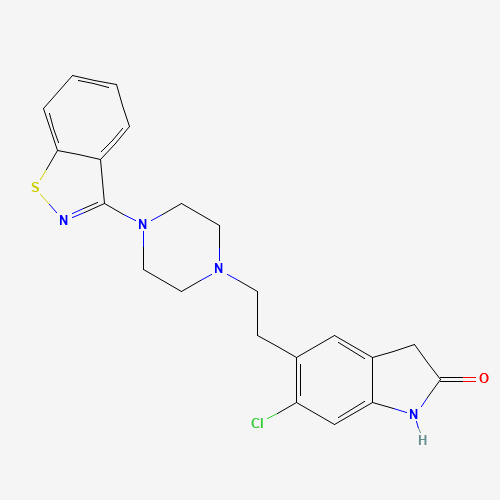
Ziprasidone is a piperazine compound having 1,2-benzothiazol-3-yl- and 2-(6-chloro-1,3-dihydro-2-oxindol-5-yl)ethyl substituents attached to the nitrogen atoms. It has a role as a psychotropic drug, an antipsychotic agent, a histamine antagonist, a serotonergic antagonist, a dopaminergic antagonist and a muscarinic antagonist. It is a member of indolones, a member of piperazines, an organochlorine compound and a 1,2-benzisothiazole.
科学粮草官-词典编辑部,修订于:2026-07-06
Toxicity
ToxicityFate Summary
ATMOSPHERIC FATE: According to a model of gas/particle partitioning of semivolatile organic compounds in the atmosphere(1), ziprasidone, which has an estimated vapor pressure of 1.0X10⁻¹³ mm at Hg 25 °C(SRC), determined from a fragment constant method(2), is expected to exist solely in the particulate phase in the ambient atmosphere. Particulate-phase ziprasidone may be removed from the air by wet and dry deposition(SRC). Ziprasidone contains chromophores that absorb at wavelengths >290 nm(4) and, therefore, may be susceptible to direct photolysis by sunlight(SRC).
Soil Adsorption / Mobility
Using a structure estimation method based on molecular connectivity indices(1), the Koc of ziprasidone can be estimated to be 1.3X10+5(SRC). According to a classification scheme(2), this estimated Koc value suggests that ziprasidone is expected to be immobile in soil. The estimated pKa value of ziprasidone is 14.89(3), indicating that this compound will exist entirely in the cation form in the environment and cations generally adsorb more strongly to soils containing organic carbon and clay than their neutral counterparts(4).
Environmental Bioconcentration
An estimated BCF of 110 was calculated in fish for ziprasidone(SRC), using n estimated log Kow of 3.60(1) and a regression-derived equation(1). According to a classification scheme(2), this BCF suggests the potential for bioconcentration in aquatic organisms is high(SRC).
Volatilization from Water / Soil
The estimated pKa of 14.89(1) indicates ziprasidone will exist entirely in the cation form at pH values of 5 to 9 and, therefore, volatilization from water surfaces is not expected to be an important fate process.Ziprasidone is not expected to volatilize from dry soil surfaces(SRC) based upon an estimated vapor pressure of 1.0X10⁻¹³ mm Hg(SRC), determined from a fragment constant method(2).
Environmental Abiotic Degradation
Ziprasidone is not expected to undergo hydrolysis in the environment due to the lack of functional groups that hydrolyze under environmental conditions(1). Ziprasidone contains chromophores that absorb at wavelengths >290 nm(1) and, therefore, may be susceptible to direct photolysis by sunlight(SRC).
Environmental Water Concentrations
While data specific to ziprasidone were not located(SRC, 2015), the literature suggests that some pharmaceutically active compounds originating from human and veterinary therapy are not eliminated completely in municipal sewage treatment plants and are, therefore, discharged into receiving waters(1). Wastewater treatment processes often were not designed to remove them from the effluent(2). Selected organic waste compounds may be degrading to new and more persistent compounds that may be released instead of or in addition to the parent compound(2).
Artificial Pollution Sources
Ziprasidone's production and adminitration as a medication(1) may result in its release to the environment through various waste streams(SRC).
Probable Routes of Human Exposure
Occupational exposure to ziprasidone may occur through inhalation and dermal contact with this compound at workplaces where ziprasidone is produced or used. Exposure to ziprasidone among the general population may be limited to those administered the drug, an antipsychotic. (SRC)
Environmental Fate / Exposure Summary
Ziprasidone's production and administration as a medication may result in its release to the environment through various waste streams. If released to air, an estimated vapor pressure of 1.0X10⁻¹³ mm Hg at 25 °C indicates ziprasidone will exist solely in the particulate phase in the atmosphere. Particulate-phase ziprasidone will be removed from the atmosphere by wet and dry deposition. Ziprasidone contains chromophores that absorb at wavelengths >290 nm and, therefore, may be susceptible to direct photolysis by sunlight. If released to soil, ziprasidone is expected to be immobile based upon an estimated Koc of 1.0X10+5. An estimated pKa of ziprasidone is 14.89, indicating that this compound will exist entirely in the cation form in the environment and cations generally adsorb more stron...
Interactions
Ziprasidone may antagonize the effects of levodopa and dopamine agonists.
Hepatotoxicity
Likelihood score: D (possible rare cause of clinically apparent liver injury).
Adverse Effects
* Concurrent administration of ziprasidone in combination with methyldopa, diuretics, calcium channel blockers, angiotensin-converting enzyme (ACE) inhibitors, angiotensin receptor blockers, and nitrates warrants caution as they may aggravate the hypotensive effects of ziprasidone and lead to orthostatic hypotension.
Toxicity Summary
According to an analysis of cumulative cases reported to US Poison Control Centers, ziprasidone overdose is associated with high mortality. Consequently, in an overdose, ensure the patient maintains ventilation, and intubation may be necessary. IV access is required with gastric lavage after intubation if the patient is unconscious. Charcoal is also an option, along with a laxative, to assist with drug clearance.
Human Toxicity Excerpts
/SIGNS AND SYMPTOMS/ Orthostatic hypotension and associated adverse effects (e.g., dizziness, tachycardia, syncope) may occur during ziprasidone therapy in some patients, particularly during the initial dosage titration period, because of the drug's alpha1-adrenergic blocking activity. Syncope was reported in 0.6% of ziprasidone-treated patients in clinical studies. Ziprasidone should be used with particular caution in patients with known cardiovascular disease (e.g., history of myocardial infarction or ischemic heart disease, heart failure, conduction abnormalities), cerebrovascular disease, and/or conditions that would predispose patients to hypotension (e.g., dehydration, hypovolemia, concomitant antihypertensive therapy).
Drug Induced Liver Injury
References: DOI:10.1016/j.drudis.2019.09.022
Non-Human Toxicity Excerpts
/LABORATORY ANIMALS: Developmental or Reproductive Toxicity/ Ziprasidone was shown to increase time to copulation in Sprague-Dawley rats in two fertility and early embryonic development studies at doses of 10 to 160 mg/kg/day. Fertility rate was reduced at 160 mg/kg/day. There was no effect on fertility at 40 mg/kg/day (2 times the MRHD on a mg/sq m basis). The effect on fertility appeared to be in the female since fertility was not impaired when males given 160 mg/kg/day were mated with untreated females.
Populations at Special Risk
The manufacturer states that ziprasidone should be avoided in patients with congenital prolongation of the QT interval or a history of cardiac arrhythmias and in those receiving concomitant therapy with other drugs that prolong the QTC interval.
Antidote and Emergency Treatment
Decontamination. Administer activated charcoal orally if conditions are appropriate. Gastric lavage is not necessary after small to moderate ingestions if activated charcoal can be given promptly. /Antipsychotic drugs/
Effects During Pregnancy and Lactation
There are no well-controlled studies in males exposed to ziprasidone. In general, exposures that fathers or sperm donors have are unlikely to increase risks to a pregnancy. For more information, please see the MotherToBaby fact sheet Paternal Exposures at https://mothertobaby.org/fact-sheets/paternal-exposures-pregnancy/.









