

 一键配货
一键配货
化合物详情
CAS154598-52-4
分子式C14H9ClF3NO2
分子量315.67 g/mol g/mol
危化品
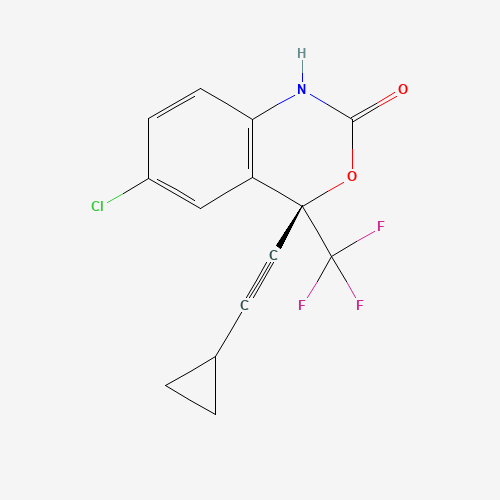
Efavirenz is 1,4-Dihydro-2H-3,1-benzoxazin-2-one substituted at the 4 position by cyclopropylethynyl and trifluoromethyl groups (S configuration) and at the 6 position by chlorine. A non-nucleoside reverse transcriptase inhibitor with activity against HIV, it is used with other antiretrovirals for combination therapy of HIV infection. It has a role as an antiviral drug and a HIV-1 reverse transcriptase inhibitor. It is an organochlorine compound, an organofluorine compound, a benzoxazine, a member of cyclopropanes and an acetylenic compound.
科学粮草官-词典编辑部,修订于:2026-07-06
Toxicity
ToxicityBody Burden
Efavirenz is distributed into human milk.
Fate Summary
ATMOSPHERIC FATE: According to a model of gas/particle partitioning of semivolatile organic compounds in the atmosphere(1), efavirenz, which has an estimated vapor pressure of 3.8X10⁻⁷ mm Hg at 25 °C(SRC), determined from a fragment constant method(2), will exist in both the vapor and particulate phases in the ambient atmosphere. Vapor-phase efavirenz is degraded in the atmosphere by reaction with photochemically-produced hydroxyl radicals(SRC); the half-life for this reaction in air is estimated to be 8 hours(SRC), calculated from its rate constant of 4.2X10⁻¹¹ cu cm/molecule-sec at 25 °C(SRC) that was derived using a structure estimation method(3). Particulate-phase efavirenz may be removed from the air by wet or dry deposition(SRC). Efavirenz contains chromophores that absorb at wave...
Soil Adsorption / Mobility
Using a structure estimation method based on molecular connectivity indices(1), the Koc of efavirenz can be estimated to be 17,000(SRC). According to a classification scheme(2), this estimated Koc value suggests that is expected to be immobile in soil.
Environmental Bioconcentration
An estimated BCF of 580 was calculated in fish for efavirenz(SRC), using an estimated log Kow of 4.69(1) and a regression-derived equation(1). According to a classification scheme(2), this BCF suggests the potential for bioconcentration in aquatic organisms is high(SRC).
Volatilization from Water / Soil
The Henry's Law constant for efavirenz is estimated as 7.0X10⁻⁹ atm-cu m/mole(SRC) using a fragment constant estimation method(1). This Henry's Law constant indicates that efavirenz is expected to be essentially nonvolatile from water and moist soil surfaces(2). Efavirenz is not expected to volatilize from dry soil surfaces(SRC) based upon an estimated vapor pressure of 3.8X10⁻⁷ mm Hg(SRC), determined from a fragment constant method(3).
Environmental Abiotic Degradation
The rate constant for the vapor-phase reaction of efavirenz with photochemically-produced hydroxyl radicals has been estimated as 4.2X10⁻¹¹ cu cm/molecule-sec at 25 °C(SRC) using a structure estimation method(1). This corresponds to an atmospheric half-life of about 8 hours at an atmospheric concentration of 5X10+5 hydroxyl radicals per cu cm(1). Efavirenz may undergo hydrolysis in the environment due to the presence of functional groups that hydrolyze under environmental conditions(2). A base-catalyzed second-order hydrolysis rate constant of 4.2X10+2 L/mole-sec(SRC) was estimated using a structure estimation method(3); this corresponds to half-lives of 6 hours and 27 minutes at pH values of 7 and 8, respectively(3). Efavirenz contains chromophores that absorb at wavelengths >290 nm(2)...
Environmental Water Concentrations
While data specific to efavirenz were not located(SRC, 2013), the literature suggests that some pharmaceutically active compounds originating from human and veterinary therapy are not eliminated completely in municipal sewage treatment plants and are therefore discharged into receiving waters(1). Wastewater treatment processes often were not designed to remove them from the effluent(2). Selected organic waste compounds may be degrading to new and more persistent compounds that may be released instead of or in addition to the parent compound(2).
Milk Concentrations
Efavirenz is distributed into human milk.
Artificial Pollution Sources
Efavirenz's production and use as an antiviral(1) may result in its release to the environment through various waste streams(SRC).
Probable Routes of Human Exposure
Occupational exposure to efavirenz may occur through inhalation and dermal contact with this compound at workplaces where efavirenz is produced or used. Use data indicate that the general population may be exposed to efavirenz via medical administration of this compound for the treatment of viral infection. (SRC)
Environmental Fate / Exposure Summary
Efavirenz's production and use as an antiviral may result in its release to the environment through various waste streams. If released to air, an estimated vapor pressure of 3.8X10⁻⁷ mm Hg at 25 °C indicates efavirenz will exist in both the vapor and particulate phases in the atmosphere. Vapor-phase efavirenz will be degraded in the atmosphere by reaction with photochemically-produced hydroxyl radicals; the half-life for this reaction in air is estimated to be 8 hours. Particulate-phase efavirenz will be removed from the atmosphere by wet or dry deposition. Efavirenz contains chromophores that absorb at wavelengths >290 nm and, therefore, may be susceptible to direct photolysis by sunlight. If released to soil, efavirenz is expected to have no mobility based upon an estimated Koc of 17,...
Interactions
Efavirenz may inhibit the metabolism of these medications /astemizole or cisapride/ through competition for the CYP3A4 isoenzyme, which may increase the potential for cardiac arrhythmias; use is contraindicated.
Hepatotoxicity
Likelihood score: A (well established cause of clinically apparent liver injury).
Adverse Effects
Like most NNRTIs, efavirenz correlates with many drug interactions due to the phase I cytochrome P450 (CYP) enzymes. Efavirenz is an in vitro inhibitor of CYP3A4, CYP2C9, and CYP2C19. The drug is a substrate, inducer, and inhibitor of CYP3A4. Medications that undergo metabolism through CYP2B6, 3A4, 2C9, and 2C19, and those that undergo glucuronidation, may also interact with efavirenz. Drugs that are contraindicated with efavirenz due to interactions include dasabuvir, grazoprevir, ritonavir, and voriconazole.
Toxicity Summary
The toxicity of this drug is generally relative to serum concentrations. Overdose is uncommon, and life-threatening sequelae from acute overdose are rare. There is no antidote available for efavirenz overdose. Short-term toxicity is usually transient and does not require treatment interruption.
Human Toxicity Excerpts
/SIGNS AND SYMPTOMS/ Rash has occurred in 26% of adults receiving efavirenz in clinical studies and in 18% of adults in control groups not receiving the drug. Although treatment-emergent rash generally manifests as mild to moderate maculopapular skin eruptions (NCI grade 1 and 2 reactions), rash associated with blistering, moist desquamation, or ulceration (NCI grade 3 reaction) has been reported in about 1% of adults receiving efavirenz in clinical studies. The incidence of grade 4 rash (e.g., erythema multiforme, Stevens-Johnson syndrome) in patients receiving efavirenz in clinical studies or in the expanded access program has been reported to be 0.1%.
Drug Induced Liver Injury
References: DOI:10.1016/j.drudis.2019.09.022
Non-Human Toxicity Excerpts
/GENOTOXICITY/ Efavirenz was not mutagenic or genotoxic in several in vitro and in vivo genotoxicity assays, including Salmonella typhimurium and Escherichia coli bacterial mutation assays, mammalian mutation assays in Chinese hamster ovary cells, chromosomal aberration assays in human peripheral blood lymphocytes or Chinese hamster ovary cells, and a mouse bone marrow micronucleus assay.
Populations at Special Risk
The US Department of Health and Human Services (HHS) Panel on Treatment of HIV-infected Pregnant Women and Prevention of Perinatal Transmission states that initiation of efavirenz should be avoided during the first trimester of pregnancy, but initiation after the first trimester can be considered if efavirenz is the best choice for a specific woman after consideration of other alternatives.
Antidote and Emergency Treatment
/SRP:/ Advanced treatment: Consider orotracheal or nasotracheal intubation for airway control in the patient who is unconscious, has severe pulmonary edema, or is in severe respiratory distress. Positive-pressure ventilation techniques with a bag valve mask device may be beneficial. Consider drug therapy for pulmonary edema ... . Consider administering a beta agonist such as albuterol for severe bronchospasm ... . Monitor cardiac rhythm and treat arrhythmias as necessary ... . Start IV administration of D5W /SRP: "To keep open", minimal flow rate/. Use 0.9% saline (NS) or lactated Ringer's if signs of hypovolemia are present. For hypotension with signs of hypovolemia, administer fluid cautiously. Watch for signs of fluid overload ... . Treat seizures with diazepam or lorazepam ... . Use...
Effects During Pregnancy and Lactation
Gynecomastia has been reported among men and at least one woman receiving efavirenz therapy. Efavirenz appears to be much more likely to cause gynecomastia than other antiretroviral agents. Gynecomastia is unilateral initially, but can progress to bilateral. Spontaneous resolution usually occurred within one year, even with continuation of the regimen. The relevance of these findings to nursing mothers is not known. The prolactin level in a mother with established lactation may not affect her ability to breastfeed.