


 一键配货
一键配货
化合物详情
CAS192725-17-0
分子式C37H48N4O5
分子量628.8 g/mol g/mol
危化品
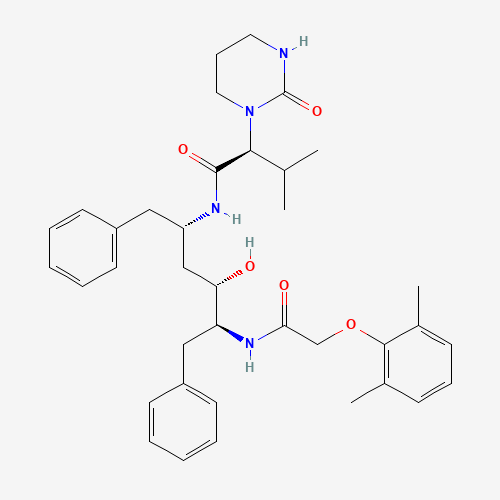
Lopinavir is a dicarboxylic acid diamide that is amphetamine is substituted on nitrogen by a (2,6-dimethylphenoxy)acetyl group and on the carbon alpha- to nitrogen by a (1S,3S)-1-hydroxy-3-{[(2S)-3-methyl-2-(2-oxotetrahydropyrimidin-1-yl)butanoyl]amino}-4-phenylbutyl group. An antiretroviral of the protease inhibitor class, it is used against HIV infections as a fixed-dose combination with another protease inhibitor, ritonavir. It has a role as an anticoronaviral agent, a HIV protease inhibitor and an antiviral drug. It is a member of amphetamines and a dicarboxylic acid diamide.
科学粮草官-词典编辑部,修订于:2026-07-06
Toxicity
ToxicityFate Summary
ATMOSPHERIC FATE: According to a model of gas/particle partitioning of semivolatile organic compounds in the atmosphere(1), lopinavir, which has an estimated vapor pressure of 3.4X10⁻²⁴ mm Hg at 25 °C(SRC), determined from a fragment constant method(2), is expected to exist solely in the particulate phase in the ambient atmosphere. Particulate-phase lopinavir may be removed from the air by wet and dry deposition(SRC). Lopinavir does not contain chromophores that absorb at wavelengths >290 nm(4) and, therefore, is not expected to be susceptible to direct photolysis by sunlight(SRC).
Soil Adsorption / Mobility
Using a structure estimation method based on molecular connectivity indices(1), the Koc of lopinavir can be estimated to be 1.0X10+6(SRC). According to a classification scheme(2), this estimated Koc value suggests that lopinavir is expected to be immobile in soil.
Environmental Bioconcentration
An estimated BCF of 2200 was calculated in fish for lopinavir(SRC), using an estimated log Kow of 5.94(1) and a regression-derived equation(1). According to a classification scheme(2), this BCF suggests the potential for bioconcentration in aquatic organisms is very high(SRC), provided the compound is not metabolized by the organism(SRC).
Volatilization from Water / Soil
The Henry's Law constant for lopinavir is estimated as 4.3X10⁻²⁸ atm-cu m/mole(SRC) using a fragment constant estimation method(1). This Henry's Law constant indicates that lopinavir is expected to be essentially nonvolatile from water and moist surfaces(2). Lopinavir is not expected to volatilize from dry soil surfaces(SRC) based upon an estimated vapor pressure of 3.4X10⁻²⁴ mm Hg(SRC), determined from a fragment constant method(3).
Environmental Abiotic Degradation
Lopinavir is not expected to undergo hydrolysis in the environment due to the lack of functional groups that hydrolyze under environmental conditions(1). Lopinavir does not contain chromophores that absorb at wavelengths >290 nm(1) and, therefore, is not expected to be susceptible to direct photolysis by sunlight(SRC).
Environmental Water Concentrations
While data specific to lopinavir were not located(SRC, 2013), the literature suggests that some pharmaceutically active compounds originating from human and veterinary therapy are not eliminated completely in municipal sewage treatment plants and are, therefore, discharged into receiving waters(1). Wastewater treatment processes often were not designed to remove them from the effluent(2). Selected organic waste compounds may be degrading to new and more persistent compounds that may be released instead of or in addition to the parent compound(2).
Artificial Pollution Sources
Lopinavir's production and administration in the antiretroviral drug Kaletra(1) may result in its release to the environment through various waste streams(SRC).
Probable Routes of Human Exposure
Occupational exposure to lopinavir may occur through inhalation and dermal contact with this compound at workplaces where lopinavir is produced or used. Exposure to lopinavir among the general population may be limited to those administered the drug Kaletra, an antiviral. (SRC)
Environmental Fate / Exposure Summary
Lopinavir's production and administration in the antiretroviral drug, Kaletra, may result in its release to the environment through various waste streams. If released to air, an estimated vapor pressure of 3.4X10⁻²⁴ mm Hg at 25 °C indicates lopinavir will exist solely in the particulate phase in the atmosphere. Particulate-phase lopinavir will be removed from the atmosphere by wet and dry deposition. Lopinavir does not contain chromophores that absorb at wavelengths >290 nm and, therefore, is not expected to be susceptible to direct photolysis by sunlight. If released to soil, lopinavir is expected to have no mobility based upon an estimated Koc of 1.0X10+6. Volatilization from moist soil surfaces is not expected to be an important fate process based upon an estimated Henry's Law consta...
Interactions
The fixed combination of lopinavir and ritonavir (lopinavir/ritonavir) inhibits the cytochrome P-450 (CYP) isoenzyme; potential pharmacokinetic interactions with drugs metabolized by CYP3A (altered metabolism of the drug metabolized by CYP3A). Concomitant use with some drugs that are CYP3A substrates is contraindicated; concomitant use with other drugs that are CYP3A substrates may require dosage adjustment or additional monitoring. Lopinavir and ritonavir are metabolized by CYP3A; potential pharmacokinetic interactions with drugs that inhibit or induce CYP3A (altered metabolism of lopinavir).
Hepatotoxicity
Likelihood score: D (possible, rare cause of clinically apparent liver injury).
Human Toxicity Excerpts
/EPIDEMIOLOGY STUDIES/ Lopinavir-ritonavir is a human immunodeficiency virus 1 (HIV-1) protease inhibitor boosted by ritonavir, a cytochrome p450 inhibitor. A warning about its tolerance in premature newborns was recently released, and transient elevation of 17-hydroxyprogesterone (17OHP) was noted in 2 newborns treated with lopinavir-ritonavir in France. To evaluate adrenal function in newborns postnatally treated with lopinavir-ritonavir, a retrospective cross-sectional analysis of the database from the national screening for congenital adrenal hyperplasia (CAH) and the French Perinatal Cohort /was performed/. Comparison of HIV-1-uninfected newborns postnatally treated with lopinavir-ritonavir and controls treated with standard zidovudine. Plasma 17OHP and dehydroepiandrosterone-sulfa...
Drug Induced Liver Injury
References: DOI:10.1016/j.drudis.2019.09.022
Non-Human Toxicity Excerpts
/LABORATORY ANIMALS: Developmental or Reproductive Toxicity/ Lopinavir (LPV) is the preferred HIV protease inhibitor in pregnancy, but it is unknown if gestational diabetes mellitus (GDM) affects its disposition. Hepatic protein expression and plasma protein binding are altered in rodent models of GDM. Because LPV is influenced by hepatic transporters and metabolic enzymes and is highly protein bound, it was hypothesized that streptozotocin-induced GDM would alter its disposition. Maternal and fetal tissues were collected from GDM rats and controls 45 min after LPV injection. In another cohort, fetuses were serially extracted 5 to 60 min after injection. LPV was quantified using liquid chromatography tandem mass spectrometry. Expression of relevant transporters, such as Multidrug resist...
Antidote and Emergency Treatment
Emergency and supportive measures: Maintain an open airway and assist ventilation if needed. Treat coma, seizures, hypotension or anaphylaxis if they occur. Replace fluid losses resulting from gastroenteritis with intravenous crystalloids. Maintain steady urine flow with intravenous fluids to alleviate crystalluria and reverse renal dysfunction. Treat lactic acidosis with judicious doses of sodium bicarbonate and by withdrawal of the offending drug. /Antiviral and antiretroviral agents/
Effects During Pregnancy and Lactation
Gynecomastia has been reported among men receiving highly active antiretroviral therapy. Gynecomastia is unilateral initially, but progresses to bilateral in about half of cases. No alterations in serum prolactin were noted and spontaneous resolution usually occurred within one year, even with continuation of the regimen. Some case reports and in vitro studies have suggested that protease inhibitors might cause hyperprolactinemia and galactorrhea in some male patients, although this has been disputed. The relevance of these findings to nursing mothers is not known. The prolactin level in a mother with established lactation may not affect her ability to breastfeed.









