

 一键配货
一键配货
化合物详情
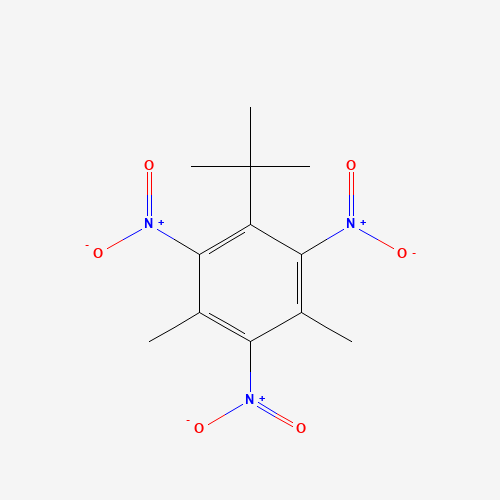
CAS81-15-2
分子式C12H15N3O6
分子量297.26 g/mol
危化品
Physical Description | 5-tert-Butyl-2,4,6-trinitro-m-xylene is a white to light-colored crystalline solid. It is insoluble in water and denser than water. Hence sinks in water. Contact may irritate skin, eyes, and mucous membranes. May be toxic by ingestion. Used to make other chemicals.
科学粮草官-词典编辑部,修订于:2026-07-06
Toxicity
ToxicityBody Burden
Musk xylene was detected at concentrations of 0.17-0.51 ug/g in maternal serum samples but not detected in any umbilical cord serum samples, all collected from 20 mothers in Seoul, Korea, sampling dates not provided(1). Musk xylene was detected in 79% of human blood plasma samples with a median concentration of 11 ng/L, collected from 100 healthy students of the Medical University of Vienna, dates not provided(2). Musk xylene was not detected in human blood samples, above the LOD (0.18 ng/L), collected from 50 hairdressers, and 10 normal adults(3).
Ecotoxicity Values
USDA APHIS Chemical Effects: collection=usda_chemeffect&query_type=synonym&query='^81-15-2$'
Fate Summary
ATMOSPHERIC FATE: According to a model of gas/particle partitioning of semivolatile organic compounds in the atmosphere(1), musk xylene, which has a vapor pressure of 2.25X10⁻⁷ mm Hg at 25 °C(2), is expected to exist in both the vapor and particulate phases in the ambient atmosphere. Vapor-phase musk xylene is degraded in the atmosphere by reaction with photochemically-produced hydroxyl radicals(SRC); the half-life for this reaction in air is estimated to be 19 days(SRC), calculated from its rate constant of 8.3X10⁻¹³ cu cm/molecule-sec at 25 °C(SRC), that was derived using a structure estimation method(3). Particulate-phase musk xylene may be removed from the air by wet and dry deposition(SRC). Musk xylene contains chromophores that absorb at wavelengths >290 nm(4) and, therefore, may...
Soil Adsorption / Mobility
The Koc of musk xylene is estimated as 1.2X10+4(SRC), using a log Kow of 4.9(1) and a regression-derived equation(2). According to a classification scheme(3), this estimated Koc value suggests that musk xylene is expected to be immobile in soil. An experimental Koc for musk xylene of 16,300 L/kg was reported from a laboratory desorption experiment utilizing 25 mg suspended matter spiked with approx 10 ug/g musk xylene(4).
Environmental Biodegradation
ANAEROBIC: In a study evaluating the removal of fragrance materials during activated sludge and trickling filter sewage treatment, anaerobic degradation was suggested. From influent and effluent measurements the total removal for musk xylene was 95-98.7% within both an activated sludge and trickling filter sewage treatment plant. This high removal rate indicates that besides adsorption, biotransformation processes may be present. An explanation suggested was that during the anaerobic phase of sewage treatment a reduction of one or more of the nitro groups occurs(1).
Environmental Bioconcentration
A BCF of 1,600 was measured in fish for musk xylene using bluegill sunfish (Lepomis macrochirus) which were exposed over a 16-day period(1) to water concentrations from 5 to 47 ug/L. Bioconcentration factors of 1,400-6,740 and 640-5,820 were measured for musk xylene in fish in flow-through tests using carp (Cyprinus carpio) with a 10 week uptake period and water concentrations of 1 ug/L and 10 ug/L respectively(2). A BCF of 3,250-6,810 was measured in fish for musk xylene using carp (Cyprinus carpio) which were exposed over a 12 week period to a water concentration of 1 ug/L(3). According to a classification scheme(4), these BCF values suggest that bioconcentration in aquatic organisms is very high, provided the compound is not metabolized by the organism(SRC).
Volatilization from Water / Soil
The Henry's Law constant for musk xylene is estimated as 5.9X10⁻⁷ atm-cu m/mole(SRC) derived from its vapor pressure, 2.25X10⁻⁷ mm Hg(1), and water solubility, 0.15 mg/L(2). This Henry's Law constant indicates that musk xylene is expected to be essentially nonvolatile from water surfaces(3). Based on this Henry's Law constant, the volatilization half-life from a model river (1 m deep, flowing 1 m/sec, wind velocity of 3 m/sec)(3) is estimated as 110 days(SRC). The volatilization half-life from a model lake (1 m deep, flowing 0.05 m/sec, wind velocity of 0.5 m/sec)(3) is estimated as greater than 1 year(SRC). Musk xylene's estimated Henry's Law constant indicates that volatilization from moist soil surfaces may occur relatively slow(SRC). Additionally, adsorption to soil is expected to a...
Environmental Abiotic Degradation
The rate constant for the vapor-phase reaction of musk xylene with photochemically-produced hydroxyl radicals has been estimated as 8.3X10⁻¹³ cu cm/molecule-sec at 25 °C(SRC) using a structure estimation method(1). This corresponds to an atmospheric half-life of about 19 days at an atmospheric concentration of 5X10+5 hydroxyl radicals per cu cm(1). Musk xylene is not expected to undergo hydrolysis in the environment due to the lack of functional groups that hydrolyze under environmental conditions(2). Musk xylene contains chromophores that absorb at wavelengths >290 nm(2) and, therefore, may be susceptible to direct photolysis by sunlight(SRC). Musk xylene had an aqueous photolysis half-life of 2.0 minutes resulting from UV irradiation (lambda >265 - 577/79) of a saturated solution in w...
Environmental Water Concentrations
SEA WATER: Musk xylene was detected in 30 of 33 water samples taken from the German Bight and the eastern part of the North Sea from July 12 to August 1, 1993 at concentrations ranging from <0.02 to 0.17 ng/L(1).
Milk Concentrations
In another study in 23 human milk samples from 1992/1993 in Northern Germany, musk xylene levels up to 190 (average 78) ug/kg milk fat were found. These milk samples showed fat contents of 0.1 - 5.1%. /Another researcher/ showed the presence of musk xylene in mother's milk of various research-centers throughout Germany between 1992-1994. The mean concentrations varied from 11-90 ug/kg milk fat (with one extreme mean value of 245 ug/kg milk fat due to an extremely high individual value of 3 mg/kg milk fat).
Ecotoxicity Excerpts
/AQUATIC SPECIES/ Musk xylene (MX) is a common synthetic nitromusk fragrance. Its high release in aquatic environments and evidence of bioaccumulation in biota suggest that it could have serious toxicological consequences for aquatic ecosystems. However, not much data is available on cellular pathways and mechanisms of toxicity in aquatic organisms. The aim of the present study was to investigate the interaction of MX with CYP1A by looking at gene transcription and EROD activity in two fish cell lines: PLHC-1 and RTG-2. Time-dependent (6 and 24 hr) exposure experiments with three doses of MX (2, 4 and 20 uM) were performed also with co-exposure to B(a)P. Low cytotoxicity was observed in both cell lines. Reduction of cyp1a gene transcription was observed after 6 h with full dose-dependen...
Effluent Concentrations
Musk xylene was detected in 18 effluent samples from three treatment plants along the river Tama (Japan) in 1981 at 0.025-0.036 ug/L, median concentration 0.035 ug/L(1). Musk xylene was detected in effluent samples collected over a 3-day period from an activated sludge wastewater treatment plant in Loveland, OH in September 1997 and from a trickling filter wastewater treatment plant in Glendale, OH in October 1997 at concentrations of 5 and 31 ng/L, respectively(2). Musk xylene was detected in the effluent from a variety of types of European and U.S. wastewater treatment plants at concentrations ranging from 10 to 95 ng/L and from <1 to 112 ng/L, respectively, depending on the type of wastewater treatment plant(3). In the City of Lubbock, TX, musk xylene was not detected in waste water...
Natural Pollution Sources
Musk xylene has not been reported to occur in nature(1).
Atmospheric Concentrations
SOURCE DOMINATED: Musk xylene was not detected in air sampled at two landfills in Northern Germany in 2009(1).
Fish/Seafood Concentrations
Musk xylene was detected in yellow eels (13 samples)in the Netherlands in lakes and rivers in 1994 at a concentration range of <0.004-0.08 mg/kg wet weight, median 0.03 mg/kg and <0.02-0.43 mg/kg fat, median 0.13 mg/kg fat. In a second sampling program in 1996, the concentrations of musk xylene in yellow eels (10 samples) ranged from <0.0005-0.045 mg/kg wet weight, median 0.014 mg/kg(1). Musk xylene was detected in trout collected from Danish fish farms at concentrations ranging from below the detection limit to 71.0 ug/kg with a mean concentration of 12.0 ug/kg in 1992; at concentrations ranging from below the detection limit to 1.59 ug/kg with a mean concentration of 0.72 ug/kg in 1999; and at concentrations ranging from below the detection limit to 0.55 ug/kg with a mean concentratio...
Artificial Pollution Sources
Musk xylene's production may result in its release to the environment through various waste streams; its use as a fragrance in cosmetic products and partly in detergents, fabric softeners, household cleaning products and other fragranced products(1,2) will result in its direct release to the environment.
Sediment/Soil Concentrations
SEDIMENT: Musk xylene was detected in San Francisco Bay sediments at a mean concentration of 0.034 ng/g and in the nearby wastewater treatment plant effluent at concentrations ranging from 0.13-0.24 ng/g(1).
Probable Routes of Human Exposure
NIOSH (NOES Survey 1981-1983) has statistically estimated that 134,413 workers (48,955 of these were female) were potentially exposed to musk xylene in the US(1). Occupational exposure to musk xylene may occur through inhalation and dermal contact with this compound at workplaces where musk xylene is produced or used(SRC). Monitoring data indicate that the general population may be exposed to musk xylene via ingestion of contaminated food or from inhalation(SRC). Dermal absorption may play a role after application of musk containing perfumes and cosmetics to the skin or from textiles containing musk fragrance residues from laundry detergents(2).
Environmental Fate / Exposure Summary
Musk xylene's production may result in its release to the environment through various waste streams; its use as a fragrance in cosmetic products and partly in detergents, fabric softeners, household cleaning products and other fragranced products will result in its direct release to the environment. If released to air, a vapor pressure of 2.25X10⁻⁷ mm Hg at 25 °C indicates musk xylene will exist in both the vapor and particulate phases in the atmosphere. Vapor-phase musk xylene will be degraded in the atmosphere by reaction with photochemically-produced hydroxyl radicals; the half-life for this reaction in air is estimated to be 40 days. Particulate-phase musk xylene will be removed from the atmosphere by wet and dry deposition. Musk xylene contains chromophores that absorb at wavelengt...
Interactions
Photosensitivity to musk ambrette was confirmed in 15 men previously photopatch tested and in a further 4 men currently attending the clinic. 6 of the recalled patients continued to react adversely to sunlight due either to unrecognised exposure to musk ambrette or to their having become persistent light reactors. Positive photopatch tests, possibly cross reactions, were seen in 3 of the 19 patients with the structurally-related nitromusks, moskene and musk xylene but not with musks ketone and tibetine. Musk ambrette elicited a positive patch test without light in 3 of the 19 patients.
Toxicity Summary
IDENTIFICATION AND USE: Musk xylene is a solid with sweet, musky odor. It is used in large quantities in inexpensive perfumes for soap and household products. HUMAN STUDIES: Some patients develop a persistent light reaction/chronic actinic dermatitis (pruritic dermatitis with lichenification on the light-exposed areas), which can persist for years, in spite of the patient having removed the exposure. The mechanism behind this reaction is not known. It can cause photoallergic contact dermatitis. Significant associations were reported between musk xylene levels in blood and the frequency of cosmetics use (especially with perfumes), the level of androstanediol-glucuronide, and obstetric history. Musk xylene did not induced sister chromatid exchanges in human lymphocytes with and without me...
Human Toxicity Excerpts
/HUMAN EXPOSURE STUDIES/ Photosensitivity to musk ambrette was confirmed in 15 men previously photopatch tested and in a further 4 men currently attending the clinic. 6 of the recalled patients continued to react adversely to sunlight due either to unrecognised exposure to musk ambrette or to their having become persistent light reactors. Positive photopatch tests, possibly cross reactions, were seen in 3 of the 19 patients with the structurally-related nitromusks, moskene and musk xylene but not with musks ketone and tibetine. Musk ambrette elicited a positive patch test without light in 3 of the 19 patients.
Carcinogen Classification
IARC Monographs: Volume 65: (1996) Printing Processes and Printing Inks, Carbon Black and Some Nitro Compounds
Non-Human Toxicity Values
LD50 Mouse oral >4 g/kg
Non-Human Toxicity Excerpts
/LABORATORY ANIMALS: Acute Exposure/ ... Each of six NZW rabbits received a dose of 0.075 g (0.1 mL weight equivalent) musk xylene in the conjunctival sac of the right eye. At 30 seconds post instillation, both eyes of three rabbits were rinsed with physiological saline. The eyes of the three remaining animals were not rinsed. The contralateral eye of each animal served as a control. Test and control eyes were examined for signs of irritation for up to 14 days following dosing. In the non-rinse group musk xylene caused iritis (score 1) in all three rabbits at 1 and 24 hours. The iridal irritation resolved completely by the 48 hour scoring interval. Conjunctivitis (redness, swelling and discharge) score 1 was also noted in all three rabbits. This irritation was completely resolved in all...
Populations at Special Risk
Musk xylene (MX), musk ketone (MK), musk ambrette, musk moskene, and musk tibetene are synthetic fragrances. Between 1994 and 1996 these five nitromusk compounds (NMCs) were tested in the blood of 152 women who consulted the Endocrinological Department of the University Hospital of Obstetrics and Gynecology, Heidelberg, Germany, because of gynecological problems. The testing was conducted by gas chromotography with mass-specific detector and mass spectrometry in a retrospective cross-sectional study. MX was detected in 95% and MK in 85% of the blood samples (>20 ng per liter whole blood). The median concentration of MX was 65.5 ng/L and the maximum level of MX was 1183 ng/L; the corresponding values for MK were respectively 55.5 and 518 ng/L. The other three NMCs were found in only a fe...
Evidence for Carcinogenicity
Evaluation: There is inadequate evidence in humans for the carcinogenicity of musk xylene. There is limited evidence in experimental animals for the carcinogenicity of musk xylene. Musk xylene is not classifiable as to its carcinogenicity to humans (Group 3).
Antidote and Emergency Treatment
Advanced treatment: Consider orotracheal or nasotracheal intubation for airway control in the patient who is unconscious, has severe pulmonary edema, or is in severe respiratory distress. Positive-pressure ventilation techniques with a bag-valve-mask device may be beneficial. Consider drug therapy for pulmonary edema ... . Consider administering a beta agonist such as albuterol for severe bronchospasm ... . Monitor cardiac rhythm and treat arrhythmias if necessary ... . Start IV administration of D5W TKO /SRP: "To keep open", minimal flow rate/. Use 0.9% saline (NS) or lactated Ringer's (LR) if signs of hypovolemia are present. For hypotension with signs of hypovolemia, administer fluid cautiously. Watch for signs of fluid overload ... . Treat seizures with diazepam (Valium) or lorazepa...