

 一键配货
一键配货
化合物详情
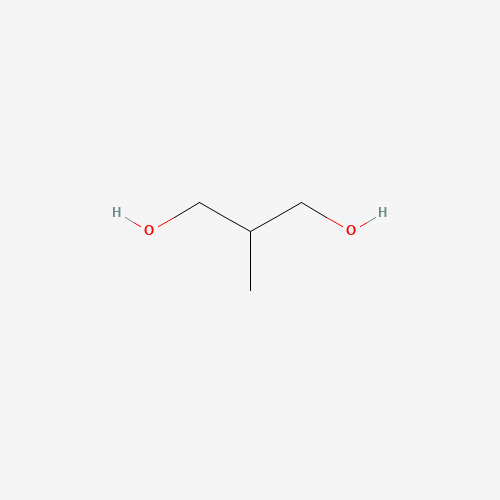
CAS2163-42-0
分子式C4H10O2
分子量90.12 g/mol g/mol
危化品
See also: Glycerin; methylpropanediol (component of).
科学粮草官-词典编辑部,修订于:2026-07-06
Toxicity
ToxicityEcotoxicity Values
EC50; Species: Scenedesmus subspicatus (Algae); Conditions: static, pH 8.5-8.6, temperature 21 °C; Concentration: >1000 mg/L for 72 hr; Effect: growth inhibition
Fate Summary
ATMOSPHERIC FATE: According to a model of gas/particle partitioning of semivolatile organic compounds in the atmosphere(1), 2-methyl-1,3-propanediol, which has a vapor pressure of 2.1X10⁻² mm Hg at 25 °C(2), is expected to exist solely as a vapor in the ambient atmosphere. Vapor-phase 2-methyl-1,3-propanediol is degraded in the atmosphere by reaction with photochemically-produced hydroxyl radicals(SRC); the half-life for this reaction in air is estimated to be 34 hours(SRC), calculated from its rate constant of 1.1X10⁻¹¹ cu cm/molecule-sec at 25 °C(SRC) that was derived using a structure estimation method(3). 2-Methyl-1,3-propanediol does not contain chromophores that absorb at wavelengths >290 nm(4) and, therefore, is not expected to be susceptible to direct photolysis by sunlight(SRC).
Soil Adsorption / Mobility
The Koc of 2-methyl-1,3-propanediol is estimated as 1.7(SRC), using a log Kow of 0.24(1) and a regression-derived equation(2). According to a classification scheme(3), this estimated Koc value suggests that 2-methyl1,3-propanediol is expected to have very high mobility in soil.
Environmental Biodegradation
AEROBIC: 2-Methyl-1,3-propanediol, present at 10 and 20 mg/L, generated 54% and 6% of theoretical carbon dioxide, respectively, in 4 weeks using a municipal treatment plant sludge inoculum in the modified Sturm test failing to meet the criteria for ready biodegradability(1). In another aerobic study, 2-methyl-1,3-propanediol, present at 1 and 3 mg/L, reached 15-26% and 59-64% degradation, respectively in 28 days using a municipal treatment plant sludge inoculum(1). Therefore this compound may biodegrade under certain environmental conditions, however, it is not expected to biodegrade rapidly(SRC).
Environmental Bioconcentration
An estimated BCF of 3 was calculated for 2-methyl-1,3-propanediol(SRC), using a log Kow of 0.24(1) and a regression-derived equation(2). According to a classification scheme(3), this BCF suggests the potential for bioconcentration in aquatic organisms is low(SRC).
Volatilization from Water / Soil
The Henry's Law constant for 2-methyl-1,3-propanediol is estimated as 2.3X10⁻⁷ atm-cu m/mole(SRC) using a fragment constant estimation method(1). This Henry's Law constant indicates that 2-methyl-1,3-propanediol is expected to be essentially nonvolatile from water surfaces(2). 2-Methyl-1,3-propanediol is not expected to volatilize from dry soil surfaces(SRC) based upon a vapor pressure of 2.1X10⁻² mm Hg(3).
Environmental Abiotic Degradation
The rate constant for the vapor-phase reaction of 2-methyl-1,3-propanediol with photochemically-produced hydroxyl radicals has been estimated as 1.1X10⁻¹¹ cu cm/molecule-sec at 25 °C(SRC) using a structure estimation method(1). This corresponds to an atmospheric half-life of about 34 hours at an atmospheric concentration of 5X10+5 hydroxyl radicals per cu cm(1). 2-Methyl-1,3-propanediol is not expected to undergo hydrolysis in the environment due to the lack of functional groups that hydrolyze under environmental conditions(3). 2-Methyl-1,3,-propanediol does not contain chromophores that absorb at wavelengths >290 nm(3) and, therefore, is not expected to be susceptible to direct photolysis by sunlight(SRC).
Environmental Water Concentrations
Water quality data compiled from the Retrieval (STORET) Data Warehouse and the USGS National Water Information System (NWIS) reports surface water and ground water monitoring data for various chemicals but does not include 2-methyl-1,3-propanediol as of 2017(1).
Ecotoxicity Excerpts
/AQUATIC SPECIES/ Green algae (Scendesmus subspicatus) were exposed to 2-methyl-1,3-propanediol at nominal concentrations of 0, 100, 180, 320, 560 or 1000 mg/L under static conditions for 72 hours. Measured concentrations for the 100, 320 and 1000 mg/L were 120, 361 and 873 mg/L at the start of the study and 100, 383 and 1023 mg/L at 72 hours. No significant inhibition of cell growth or reduction of growth rate was noted at any concentration tested.
Artificial Pollution Sources
2-Methyl-1,3-propanediol's production and use as a solvent in consumer and commercial ink, toner, and colorant products(1) may result in its release to the environment through various waste streams(SRC).
Sediment/Soil Concentrations
SEDIMENT: Water quality data compiled from the Retrieval (STORET) Data Warehouse and the USGS National Water Information System (NWIS) reports sediment monitoring data for various chemicals but does not include 2-methyl-1,3-propanediol as of 2017(1).
Probable Routes of Human Exposure
Occupational exposure to 2-methyl-1,3-propanediol may occur through inhalation and dermal contact with this compound at workplaces where 2-methyl-1,3-propanediol is produced or used. Use data indicate that the general population may be exposed to 2-methyl-1,3-propanediol via dermal contact with consumer products containing 2-methyl-1,3-propanediol. (SRC)
Environmental Fate / Exposure Summary
2-Methyl-1,3-propanediol's production and use as a solvent in consumer and commercial ink, toner, and colorant products may result in its release to the environment through various waste streams. If released to air, a vapor pressure of 2.1X10⁻² mm Hg at 25 °C indicates 2-methyl-1,3-propanediol will exist solely as a vapor in the ambient atmosphere. Vapor-phase 2-methyl-1,3-propanediol will be degraded in the atmosphere by reaction with photochemically-produced hydroxyl radicals; the half-life for this reaction in air is estimated to be 34 hours. 2-Methyl-1,3-propanediol does not contain chromophores that absorb at wavelengths >290 nm and, therefore, is not expected to be susceptible to direct photolysis by sunlight. If released to soil, 2-methyl-1,3-propanediol is expected to have very...
Effect Level
collection=toxvaldb&kind=^EL$
Lethal Dose
collection=toxvaldb&kind=^LD$
Toxicity Data
LC50 (rat) > 5,100 mg/m3/4h
Toxicity Summary
IDENTIFICATION AND USE: 2-Methyl-1,3-propanediol is a clear, colorless liquid. It is used as a solvent in personal care products (neutralizer, emollient, emulsifier, and humectant) as well as in the manufacture of resins and coatings. HUMAN STUDIES: 2-Methyl-1,3-propanediol was not irritating to human skin. Five studies evaluated the potential for dermal sensitization in humans. Mild skin irritation was observed in some subjects during the induction phase (< 10% of participants). A mild delayed reaction was seen during the challenge phase in only one study (< 5% of subjects), but it is unclear if these were irritant or allergic in nature. Human lymphocytes were exposed to 2-methyl-1,3-propanediol at concentrations of 10-5000 g/mL in the absence of metabolic activation and 333- 5000 ug/m...
Lethal Concentration
collection=toxvaldb&kind=^LC$
Human Toxicity Excerpts
/GENOTOXICITY/ In vitro Human lymphocytes were exposed to 2-methyl-1,3-propanediol at concentrations of 10-5000 ug/mL in the absence of metabolic activation and 333-5000 ug/mL in the presence of activation. Positive controls were tested concurrently and produced an appropriate response. Cytotoxicity was not observed at any dose. There was no biologically meaningful increase in chromosomal aberrations.
Non-Human Toxicity Values
LD50 Rabbit dermal >2000 mg/kg bw
Reference and Risk Values
collection=toxvaldb&kind=^RRV$
Non-Human Toxicity Excerpts
/LABORATORY ANIMALS: Acute Exposure/ New Zealand Albino rabbits (six/dose, gender not specified) were administered undiluted 2- methyl-1,3-propanediol on two intact and two abraded sites per animal under an occlusive dressing for 24 hours and observed for 72 hours post-application. No erythema or edema was noted during the observation period. No clinical signs of toxicity were observed. 2-Methyl-1,3-propanediol was not irritating to rabbit skin in this assay.
Antidote and Emergency Treatment
/SRP:/ Advanced treatment: Consider orotracheal or nasotracheal intubation for airway control in the patient who is unconscious, has severe pulmonary edema, or is in severe respiratory distress. Positive-pressure ventilation techniques with a bag-valve-mask device may be beneficial. Consider drug therapy for pulmonary edema ... . Monitor cardiac rhythm and treat arrhythmias if necessary ... . Start IV administration of D5W /SRP: "To keep open", minimal flow rate/. Use 0.9% saline (NS) lactated Ringer's (LR) if signs of hypovolemia are present. For hypotension with signs of hypovolemia, administer fluid cautiously. Consider vasopressors if patient is hypotensive with a normal fluid volume. Watch for signs of fluid overload ... . Treat seizures with diazepam or lorazepam ... . Use propara...