

 一键配货
一键配货
化合物详情
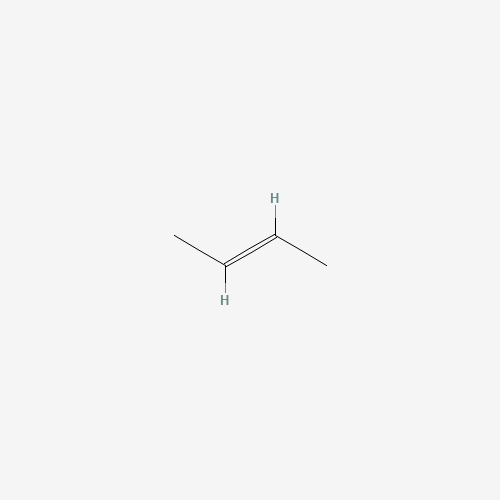
CAS624-64-6
分子式C4H8
分子量56.11 g/mol
非危品
Physical Description | 2-butene appears as a colorless liquefied petroleum gas. Asphyxiate gas. Flammability limits in air 1.8-9.7% by volume.
科学粮草官-词典编辑部,修订于:2026-07-06
Toxicity
ToxicityBody Burden
2-Butene has been detected in exhaled air; in the majority of subjects, concentrations of the cis form were greater than those for the trans isomer(1). trans-2-Butene was detected in the expired air of 6 out of 10 air samples taken from 8 smoking and non-smoking male volunteers from Texas, at concentrations ranging from 0.054 to 80.0 ug/h, averaging 14.2 ug/h for the positive samples(2).
Fate Summary
ATMOSPHERIC FATE: According to a model of gas/particle partitioning of semivolatile organic compounds in the atmosphere(1), trans-2-butene, which has a vapor pressure of 1750 mm Hg at 25 °C(2), is expected to exist solely as a gas in the ambient atmosphere. Gas-phase trans-2-butene is degraded in the atmosphere by reaction with photochemically-produced hydroxyl radicals, ozone molecules, and nitrate radicals(SRC). The half-life for the reaction with hydroxyl radicals is estimated to be 6 hours(SRC) calculated from its rate constant of 6.4X10⁻¹¹ cu cm/molecule-sec at 25 °C(3). The half-life for the reaction with ozone molecules is estimated to be 0.64 to 4.6 hours(SRC) calculated from rate constants in the range of 5.98X10⁻¹⁷ to 4.32X10⁻¹⁶ cu cm/molecule-sec at 25 °C(4). The half-life fo...
Soil Adsorption / Mobility
The Koc of trans-2-butene is estimated as 100(SRC), using a log Kow of 2.31(1) and a regression-derived equation(2). According to a classification scheme(3), this estimated Koc value suggests that trans-2-butene is expected to have high mobility in soil.
Environmental Biodegradation
PURE CULTURE: Pure cultures of methanotrophic bacteria isolated from soil and water were found to oxidize trans-2-butene to trans-2-butene-1-ol and then epoxidized to trans-2,3-epoxybutane(1-3). The rate of trans-2-butene oxidation to trans-2,3-epoxybutane was 0.22 umol/10 min-mg of protein(3). Epoxides were not further metabolized and accumulated extracelluarly(1). These data suggest that biodegradation may be an important environmental fate process(SRC).
Environmental Bioconcentration
An estimated BCF of 16 was calculated for trans-2-butene(SRC), using a log Kow of 2.31(1) and a regression-derived equation(2). According to a classification scheme(3), this BCF suggests the potential for bioconcentration in aquatic organisms is low.
Volatilization from Water / Soil
The Henry's Law constant for trans-2-butene is 0.224 atm-cu m/mole(1). This Henry's Law constant indicates that trans-2-butene is expected to volatilize rapidly from water surfaces(2). Based on this Henry's Law constant, the volatilization half-life from a model river (1 m deep, flowing 1 m/sec, wind velocity of 3 m/sec)(2) is estimated as 2 hours(SRC). The volatilization half-life from a model lake (1 m deep, flowing 0.05 m/sec, wind velocity of 0.5 m/sec)(2) is estimated as 3 days(SRC). trans-2-Butene's Henry's Law constant indicates that volatilization from moist soil surfaces may occur(SRC). trans-2-Butene may volatilize from dry soil surfaces(SRC) based upon a vapor pressure of 1750 mm Hg at 25 °C(3).
Environmental Abiotic Degradation
The rate constant for the gas-phase reaction of trans-2-butene with photochemically-produced hydroxyl radicals has been measured as 6.4X10⁻¹¹ cu cm/molecule-sec at 25 °C(1). This corresponds to an atmospheric half-life of about 6 hours at an atmospheric concentration of 5X10+5 hydroxyl radicals per cu cm(1). The rate constant for the gas-phase reaction of trans-2-butene with ozone molecules has been measured in the range of 5.98X10⁻¹⁷ to 4.32X10⁻¹⁶ cu cm/molecule-sec at 25 °C(2). This corresponds to an atmospheric half-life of about 0.64 to 4.6 hours at an atmospheric concentration of 7X10+11 ozone molecules per cu cm(2). The rate constant for the gas-phase nighttime reaction of trans-2-butene with nitrate radicals has been measured as 2.11X10⁻¹³ cu cm/molecule-sec at 25 °C(3). This cor...
Effluent Concentrations
trans-2-Butene was identified, not quantified, in automobile emissions in Canada(1) and 4-stroke lawn mowers(2). The emission of trans-2-butene from typical automobiles was reported as 37 mg/L of gasoline(3). The emission rate of trans-2-butene from ferries with diesel engines was reported as 0.3 and 0.1 mg/kWh(4). Car exhaust in London, England contained trans-2-butene at an avg concn of 822 ppb(5).
Natural Pollution Sources
trans-2-Butene is an anthropogenic compound and is not known to occur naturally(1).
Atmospheric Concentrations
URBAN/SUBURBAN: trans-2-Butene was detected in urban air in Porto Alegre, Brazil in 1996 at a mean concentration of 3.2 mg/cu m(1). trans-2-Butene was detected in 1993 at an avg concentration of 0.75 ug/cu m (not detected to 3.0 ug/cu m) in Los Angeles, CA(2). trans-2-Butene was detected in 53% of the air samples obtained in Atlanta, GA at concentrations of 0.1-0.15 ppb(3). Mean concentrations of 3-13.9 ppb trans-2-butene were reported for various sites around Vienna, Austria(4).
Artificial Pollution Sources
trans-2-Butene's production and use as a solvent, cross-linking agent, in the polymerization of gasoline, in butadiene synthesis, and in the synthesis of C4 and C5 derivatives(1) may result in its release to the environment through various waste streams(SRC). trans-2-Butene occurs in coal gas(2). trans-2-Butene is found in exhaust of diesel engine at 0.6 vol%, in evaporate from gasoline fuel tank at 4.8 vol%, and in evaporate from carburetor at 0.3-0.5 vol%(3). trans-2-Butene has expected ground level concentration in the United States urban air of 5-10 ppb(3). trans-2-Butene has been identified as a constituent of tobacco smoke(4).
Probable Routes of Human Exposure
The probable routes of exposure to trans-2-butene are by inhalation and dermal contact. Workers in the petroleum field are likely to be exposed to trans-2-butene by inhalation of gasoline fumes during the production, transport or dispensing of motor fuels(1). Workers were exposed to trans-2-butene during the loading of gasoline at bulk or marine terminals(2). Personal air samples taken from workers in the petroleum industry indicate that 2 of 56 outside operators were exposed to trans-2-butene at a mean concentration 0.370 mg/cu m, 30 of 49 transport drivers were exposed at a mean concentration of 0.169 mg/cu m and 16 of 49 service attendants were exposed at a mean concentration of 0.034 mg/cu m(1). Dermal exposure is likely to result when gasoline products are spilled on the skin(SRC)...
Other Environmental Concentrations
trans-2-Butene was detected in the gas phase of smoke emissions from a residential chimney upon combustion of pine firewood at 66.5 mg/kg of wood burned(1). trans-2-Butene was detected in 15 of 16 various fuel/stove combinations using coal, wood, residues and gas as fuel sources with emission rates ranging between 0.068-25.7 mg/kg dry fuel(2).
Environmental Fate / Exposure Summary
trans-2-Butene's production and use as a solvent, cross-linking agent, in the polymerization of gasoline, in butadiene synthesis, and in the synthesis of C4 and C5 derivatives may result in its release to the environment through various waste streams. If released to air, a vapor pressure of 1750 mm Hg at 25 °C indicates trans-2-butene will exist solely as a gas in the atmosphere. Gas-phase trans-2-butene will be degraded in the atmosphere by reaction with photochemically-produced hydroxyl radicals, ozone molecules, and nitrate radicals; the half-life for the reaction with hydroxyl radicals in air is estimated to be 6 hours; the half-life for the reaction with ozone molecules is estimated to be 0.64 to 4.6 hours; the half-life for the nighttime reaction with nitrate radicals is estimated...
Symptoms
Eye Exposure: See Skin.
Exposure Routes
Exposure mainly occurs via inhalation.
Toxicity Summary
IDENTIFICATION AND USE: trans-2-Butene is a colorless gas. It is used as a solvent, as a cross-linking agent, in the polymerization of gasoline, and in butadiene synthesis. It is also used in the synthesis of C4 and C5 derivatives. HUMAN STUDIES: trans-2-Butene is a simple asphyxiant. Rapid evaporation of liquid 2-butene (in its cis or trans form, or as a mixture of both) may cause frostbite. The substance may cause effects on the central nervous system. Exposure may result in unconsciousness. ANIMAL STUDIES: There are no data available.
Average Daily Intake
Intake: 11.5 mg/m cu: EHE max (maximum estimated human exposure) = 5 ppm or 11.5 mg/m cu equivalent to the peak concentration at working place(1). <0.23 mg/m cu TWA (time-weighted average) at working place or EHE mean <0.1ppm, (calculated)(1).
Human Toxicity Excerpts
/SIGNS AND SYMPTOMS/ Rapid evaporation of the 2-butene (in its cis or trans form, or as a mixture of both) may cause frostbite. The substance may cause effects on the central nervous system. Exposure may result in unconsciousness.
Non-Human Toxicity Values
LC50 Mice, inhalation 425 ppm /the duration of exposure is not stated/
Non-Human Toxicity Excerpts
/LABORATORY ANIMALS: Neurotoxicity/ Concentrations of 13 to 13.5% (300 or 400 mg/L) causes deep CNS depression in mice and about 19% (120 to 420 mg/L) is fatal.
Antidote and Emergency Treatment
Advanced treatment: Consider orotracheal or nasotracheal intubation for airway control in the patient who is unconscious, has severe pulmonary edema, or is in severe respiratory distress. Positive-pressure ventilation techniques with a bag-valve-mask device may be beneficial. Consider drug therapy for pulmonary edema ... . Monitor cardiac rhythm and treat arrhythmias as necessary ... . Start IV administration of D5W /SRP: "To keep open", minimal flow rate/. Use 0.9% saline (NS) or lactated Ringer's (LR) if signs of hypovolemia are present. For hypotension with signs of hypovolemia, administer fluid cautiously. Watch for signs of fluid overload ... . Treat seizures with diazepam (Valium) or lorazepam (Ativan) ... . Use proparacaine hydrochloride to assist eye irrigation ... . /Aliphatic...