


 一键配货
一键配货
化合物详情
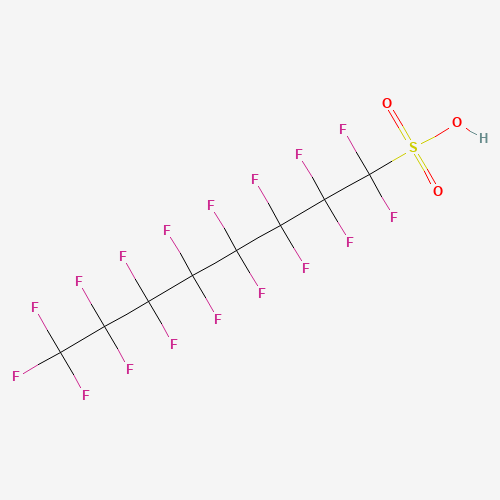
CAS1763-23-1
分子式C8HF17O3S
分子量500.13 g/mol
危化品
Perfluorooctane sulfonate (PFOS) can cause cancer according to an independent committee of scientific and health experts. It can cause developmental toxicity according to The Environmental Protection Agency (EPA).
科学粮草官-词典编辑部,修订于:2026-07-06
Toxicity
ToxicityBody Burden
Perfluorooctane sulfonic acid was measured in blood sera of employees in the fluorochemical manufacturing industry at concentrations up to 12.8 ug/L(1). The compound has been detected in samples of human sera at concentrations ranging from 6.7 to 81.5 ng/mL, an average of 28.4 ng/mL(2). Perfluorooactane sulfonic acid concentrations in serum samples ranged from 3.6 to 164.0 ng/mL from 20 adults residents of Atlanta, GA analyzed in July 2003(3). The mean concentrations in blood samples from 47 males and 36 females in Sweden were 18.4 (1.7-37) and 17.8 (4.6-33) ppb, respectively, collected in 1997-2000(4). Mean concentrations in blood plasma levels of children, women, and men in Arnsberg, Germany, were 5.4, 6.3, an 11.8 ug/L, sampled between September and November, 2006(5). The geometric m...
Ecotoxicity Values
LC50; Species: Cyprinodon variegatus (Sheepshead minnow); Conditions: semi-static (24 hr renewal); Concentration: >15 mg/L for 96 hr /Perfluorooctane sulfonate, potassium salt; 86.7% pure/
Fate Summary
ATMOSPHERIC FATE: According to a model of gas/particle partitioning of semivolatile organic compounds in the atmosphere(1), perfluorooctane sulfonic acid, which has an estimated vapor pressure of 2.0X10⁻³ mm Hg at 25 °C(2), is expected to exist solely as a vapor in the ambient atmosphere. Vapor-phase perfluorooctane sulfonic acid is degraded in the atmosphere by reaction with photochemically-produced hydroxyl radicals(SRC); the half-life for this reaction in air is estimated to be 115 days(SRC), calculated from its rate constant of 1.4X10⁻¹³ cu cm/molecule-sec at 25 °C(SRC) that was derived using a structure estimation method(2). Monitoring data has detected perfluorooctane sulfonic acid in both vapor and particulate phases in ambient air samples(3). Vapor-phase perfluorooctane sulfonic...
Soil Adsorption / Mobility
Based on 2009 field measurements of water and sediment concentrations near Toronto, Canada, a log Koc of 2.10 (Koc of 126) was derived for perfluorooctane sulfonic acid(1). Field-based sediment-water distribution measurements from The Netherlands determined a loc Koc range of 2.2-3.2 (Koc range of 160-1580)(2). A mean field-based log Koc of 3.7 (Koc of 5010) was determined for sediment from the Orge River near Paris, France(3). Field-based sediment-water distribution measurements from Haihe River and Dagu Drainage Canal, China determined a log Koc range of 4.3-4.6 (Koc range of 19900-39800)(4). The field-based Koc range of 126-39800 suggests that perfluorooctane sulfonic acid can have low to very high adsorption to sediment in the aquatic environment(SRC).
Environmental Biodegradation
ANAEROBIC: Perfluorooctane sulfonic acid was not degraded using the modified ECETOC test under anaerobic conditions which tests for carbon dioxide release and methane production by organisms from an anaerobic digester, with the compound as sole carbon source(1). Incubations of anaerobic digester sludge were carried out using serum bottles placed in the dark for 60 days at 37 °C containing 40 mL of inoculated medium and the test compound at 100 mg C/L. This compound inhibited the methane production rate of sludge from the digester(1). No biodegradation was observed over a 56 day period under anaerobic conditions using activated sludge(2).
Environmental Bioconcentration
A BCF range of 200-1500 was measured in fish for the potassium salt of perfluorooctane sulfonic acid using carp (Cyprinus carpio) which were exposed over a 58-day period at concentrations of 2 and 20 ug/L(1). Using bluegill sunfish (Lepomis macrochirus) exposed to 86 ug/L of the potassium salt of perfluorooctane sulfonic acid for a 62-day period in a flow-through test, BCF values of 484 and 856 where determined for the edible and whole tissue respectively(2). According to a classification scheme(3), these BCF values suggest the potential for bioconcentration in aquatic organisms is high to very high(SRC). Blackrock fish (Sebastes schlegeli) exposed to the potassium salt of perfluorooctane sulfonic acid for 28 days had serum and liver BCF values of 4714-6687 and 950-1475 respectively(4)....
Volatilization from Water / Soil
The pKa of perfluorooctane sulfonic acid is <1.0(1), indicating that this compound will exist almost entirely in anion form in the environment and, therefore, volatilization from water surfaces is not expected to be an important fate process since anions do not volatilize(SRC). The air-water partitioning of the potassium salt of perfluorooctane sulfonic acid (which will completely ionize in water to the anion) was measured as <2X10⁻⁶(2) which corresponds to a Henry's law constant of <4.9X10⁻⁹ atm-cu m/mole(SRC). This Henry's Law constant indicates that the anion of perfluorooctane sulfonic acid is expected to be essentially nonvolatile from water surfaces(3). Although perfluoroalkyl anions will not volatilize from water or moist soil surfaces, their unique surfactant properties may prev...
Environmental Abiotic Degradation
In laboratory studies, perfluorooctane sulfonic acid was shown to be degraded in groundwater samples by sonolysis (breaking of chemical bonds using ultrasound). A degradation rate constant of 0.0094/min was reported using landfill groundwater samples from Oakdale, MN, perfluorooctane sulfonic acid at a concentration of 100 ug/L in a 600 mL flask subjected to a frequency of 354 kHz. However, the rate of degradation is reduced by 61% in the presence of other volatile organic constituents. Further degradation by the addition of ozonation increased the degradation rate to 0.019/min(1).
Environmental Water Concentrations
SURFACE WATER: Perfluorooctane sulfonic acid was detected in 40 of 40 samples collected from November 14-16, 2000 in an 80 mile stretch of the Tennessee River near a fluorochemical manufacturing site in Decatur, AL. Concentrations ranging from 16.8 to 140 ng/L were reported; the average upstream concentration from the plant was 32 ng/L, and below the plant - 114 ng/L(1).
Food Survey Values
[Table#6718]: Ik1lYXQgc291cmNlIiwiTWluIGNvbmNuICh1ay9rZykiLCJNYXggY29uY24gKHVnL2tnKSIKIkxpdmVzdG9jayBhbmltYWxzIiwiMC4wMDMzIiwiMS43NCIKIlBvdWx0cnkiLCIwLjAwNDYiLCIyLjgiCiJHYW1lIG1hbW1hbCAod2lsZCBib2FyKSIsIjEuMSIsIjI5IgoiRWRpYmxlIG9mZmFsIGZyb20gZmFybWVkIGFuaW1hbHMiLCIwLjIwIiwiMTIuMyIKIkVkaWJsZSBvZmZhbCBvZiBnYW1lIGFuaW1hbHMgKG1vc3RseSB3aWxkIGJvYXIgbGl2ZXIpIiwiMC4wMDIiLCIzNDgwIgoiVHdvIHNhbXBsZSBvZiBwcmVzZXJ2ZWQgbWVhdCIsIjAuMDEiLCIwLjAxIgoiU2F1c2FnZXMiLCIwLjA4IiwiMTYuNSIK
Milk Concentrations
Perfluorooctane sulfonic acid was detected in 3% of 2,449 "Milk and dairy products" samples collected in 13 European countries during the period 2006 to 2012(1); concentrations measured in liquid milk ranged from 0.0009 to 0.12 ug/kg(1). Human milk samples collected in 2003-2004 in the Kingston region of Ontario Canada were found to contain average and median perfluorooctane sulfonic acid concentrations of 0.055 and 0.026 ng/mL respectively(2). Perfluorooctane sulfonic acid was not detected in 60 raw and retail cow milk samples collected from across the US(3); a concentration of 0.16 ng/g was detected in a milk sample collected at a dairy farm that had applied perfluoroalkyl compound containing biosolids to its fields(3). The mean concentrations of perfluorooctane sulfonic acid in foods...
Ecotoxicity Excerpts
/AQUATIC SPECIES/ ... The primary objective of this study was to determine whether multiple PFAAs enhance hepatic tumorigenesis in trout, an animal model that represents human insensitivity to peroxisome proliferation. A two-stage chemical carcinogenesis model was employed in trout to evaluate PFOA, perfluorononanoic acid (PFNA), perfluorodecanoic acid (PFDA), perfluorooctane sulfonate (PFOS), and 8:2 fluorotelomer alcohol (8:2FtOH) as complete carcinogens or promoters of aflatoxin B(1) (AFB(1))- and/or N-methyl-N'-nitro-N-nitrosoguanidine (MNNG)-induced liver cancer. A custom trout DNA microarray was used to assess hepatic transcriptional response to these dietary treatments in comparison with E2 and the classic peroxisome proliferator, clofibrate (CLOF). Incidence, multiplicity, and s...
Animal Concentrations
Perfluorooctane sulfonic acid has been measured in mink (Neovison vison) livers from the Midwestern United States with concentrations ranging from 40-5,140 ng/g(1). Concentrations in the river otters (Lontra canadensis) collected in Oregon ranged from 33.6 to 329 ng/g(2). Perfluorooctane sulfonic acid mean plasma concentrations in mammals were reported as follows (genus species, location, concentration in ng/mL or ng/g wet weight): Amur tiger, Panthera tigris altaica, China, 1.41; polar bear, Ursus maritimus, Svalbard,1290; bottlenose dolphin, Tursiops truncates: Bermuda, 49; Indian River Lagoon, FL, 642; New Jersey, 751; Sarasota Bay, FL 780; Charleston, SC, 1315; giant panda, Ailuropoda melanoleuca, Beijing, China, 11.10; red panda, Ailurus fulgens, 15.65(3). Concentrations in various...
Effluent Concentrations
Perfluorooctane sulfonic acid is a conversion product of incomplete oxidation during the incineration of perfluoroalkyl sulfonate-containing materials(1). Perfluorooctane sulfonic acid concentrations in effluents from four wastewater treatment plants in Northern Bavaria, Germany were 50, 195, 86 ng/L on April 6, 2005, July 6, 2005, March 15, 2006 from plant A; 9.4 ng/L on July 13, 2005 from plant B; 7.5 ng/L on July 20, 2005 from plant C; 2.4 ng/L on July 27, 2005 from plant D(2). An estimated overall aqueous emission from the European Continent was calculated to be 20 tons in 2007(3). The compound was detected at a range of 13 to 24 ng/L in effluents from waste water treatment plants in Arizona, Nevada, and Georgia, sampled in 2008(4). In 2010, effluents from 90 European wastewater tre...
Natural Pollution Sources
Perfluorooctane sulfonic acid is a human-made compound that does not occur naturally in the environment(1).
Atmospheric Concentrations
RURAL/REMOTE: Air samples collected in 2005 near Kjeller Norway, Mace Head Ireland and Hazelrigg UK contained mean perfluorooctane sulfonic acid concentrations of 1.0, <1.8 and 1.6 pg/cu m, respectively(1). Marine air samples near northwest Europe and the east coast of Africa contained mean concentrations of 1.36 and 0.544 pg/cu m, respectively(2).
Fish/Seafood Concentrations
[Table#6717]: Ik1lYXQgc291cmNlIiwiTWluIGNvbmNuICh1ay9rZykiLCJNYXggY29uY24gKHVnL2tnKSIKIkZpc2ggb2ZmYWwiLCIxLjEiLCIzMTAiCiJGaXNoIG1lYXQiLCIwLjA0IiwiMjExIgoiQ3J1c3RhY2VhbnMiLCIwLjA5IiwiNjUiCiJXYXRlciBtb2xsdXNjcyIsIjAuMDIiLCIyLjkiCg==
Artificial Pollution Sources
Perfluorooctane sulfonic acid's former production and use in the manufacture of polymers and fluorinated surfactants for application in surface treatments, paper protection and performance chemicals has resulted in its release to the environment through various waste streams(1-3). The major uses for the perfluorooctane sulfonic acid-related substances were providing grease, oil and water resistance to materials such as textiles, carpets, paper and in general coatings(4); for example, perfluorooctane sulfonic acid (PFOS) was used in the production of 3M Corporation's popular Scotchguard fabric protector through 2000(5). Through 2001, PFOS was used to manufacture Aqueous Film Forming Foam (AFFF) used to extinguish flammable liquid fires (hydrocarbon fueled), such as fires involving gas ta...
Sediment/Soil Concentrations
SOIL: Perfluoroctane sulfonic acid was detected in 95% of soil samples collected near the 3M Cottage Grove Facility, Minnesota at maximum concentration of 104,000 ng/g(1). A median soil concentration of 12.2 ng/g was detected in a US metropolitan area(2).
Probable Routes of Human Exposure
Occupational exposure to perfluorooctane sulfonic acid may occur through inhalation and dermal contact with this compound at workplaces where perfluorooctane sulfonic acid is produced or used(SRC). Monitoring data indicate that the general population may be exposed to perfluorooctane sulfonic acid via inhalation of ambient air, ingestion of food and drinking water, and dermal contact with consumer products containing perfluorooctane sulfonic acid(SRC). The mean concentration range of perfluorooctane sulfonic acid in plasma of New York State personnel responding to the World Trade Center disaster was shown to be 3.8-185 ng/mL, a 2-fold higher concentration than for the US population in general(1). Studies have found perfluorooctylsulfonate chemicals in very small quantities in the blood...
Other Environmental Concentrations
Annual geometric mean perfluorooctane sulfonic acid concentration in air dust particles in Oyamazaki (Kyoto Prefecture), Japan was 72.2 ng/g, sampled from April 2001 - March 2002(1). The mean concentration in house dust samples from 102 homes and 10 day care centers in Ohio and North Carolina surveyed in 2000-2001 was 761 ng/g with a maximum concentration of 12,100 ng/g reported; 94.6% of samples were above the detection limit of 8.93 ng/g(2). The mean and median perfluorooctane sulfonic acid concentrations detected in 102 house dust samples collected in Vancouver, Canada between 2007 and 2008 was 338 and 75 ng/g respectively, with 100% detection in all samples(3). House dusts samples collected from 42 Norwegian homes in 2008 contained a mean concentration of 11 ng/g(4).
Environmental Fate / Exposure Summary
Perfluorooctane sulfonic acid's former production and use in the manufacture of polymers and fluorinated surfactants for application in surface treatments, paper protection and performance chemicals has resulted in its release to the environment through various waste streams. Through 2001, perfluorooctane sulfonic acid (PFOS) was used to manufacture Aqueous Film Forming Foam (AFFF) used to extinguish flammable liquid fires, such as fires involving gas tankers and oil refineries, which resulted in its direct release to the environment. PFOS chemicals are no longer manufactured in the US, but specific technical applications are still permitted. Perfluorooctane sulfonic acid can be formed in the environment through microbial or abiotic degradation processes from related precursor compounds...
Effect Level
collection=toxvaldb&kind=^EL$
Interactions
... Curcumin is a natural polyphenolic compound abundant in the rhizome of the perennial herb turmeric. It is commonly used as a dietary spice and coloring agent in cooking and anecdotally as an herb in traditional Asian medicine. In this study, male rats were treated with three different PFOS doses (0.6, 1.25, and 2.5 mg/kg) and one dose of curcumin, from Curcuma longa (80 mg/kg), and combined three doses of PFOS with 80 mg/kg dose of curcumin by gavage for 30 d at 48 hr intervals. Here, we investigated the DNA damage via single-cell gel electrophoresis/comet assay and micronucleus test in rat peripheral blood in vivo. It is found that all doses of PFOS increased micronucleus frequency (p<0.05) and strongly induced DNA damage in peripheral blood in two different parameters; the damaged...
Lethal Dose
collection=toxvaldb&kind=^LD$
Toxicity Data
LC50 (rat) = 5,200 mg/m3
Adverse Effects
Reproductive Toxin - A chemical that is toxic to the reproductive system, including defects in the progeny and injury to male or female reproductive function. Reproductive toxicity includes developmental effects. See Guidelines for Reproductive Toxicity Risk Assessment.
Screening Level
collection=toxvaldb&kind=^SL$
Benchmark Values
collection=toxvaldb&kind=^BV$
Toxicity Summary
IDENTIFICATION AND USE: Perfluorooctane sulfonic acid (PFOS) is a liquid. It is used as a chemical intermediate, an acid catalyst for photoresists, a surfactant in firefighting foam, a surfactant for alkaline cleaners, an emulsifier in floor polish, a mist suppressant for metal plating baths, a surfactant for etching acids for circuit boards, a pesticide active ingredient for ant bait traps, and an agricultural chemical. HUMAN EXPOSURE AND TOXICITY: Health effects of perfluoroalkyl-compounds on humans remain controversial, in spite of a number of experimental and epidemiological studies. In one study, subjects with Polycystic Ovary Syndrome had higher serum concentrations of PFOS. Some studies of women and infants found that PFOS levels negatively correlated with birth weight only in fe...
Minimum Risk Level
collection=toxvaldb&kind=^MRL$
Average Daily Intake
Fish consumption and estimated perfluorooctane sulfonic acid intake among residents of the Lake Vattern and Baltic Seas regions, Sweden were reported as 8.3-83 g consumption/day with intake of 0.92-9.6 ng/kg body weight/day and 0-242 g consumption/day with intake of 0-4.5 ng/kg body weight/day, respectively(1). On average, the daily dietary intake of perfluorooctanesulfonic acid for a standard adult man in Tarrgona County, Spain ranged from 62.5 to 74.2 ng/day(2). Based on food monitoring in 13 European countries during the period 2006 to 2012, the dietary exposure for age groups was determined as follows (in ng/kg body wt/day): infants (0.29-11, min-max), toddlers (1.2-8.5, median), other children (1.5-7.1 median), adolescents (0.84-4.0 median), adults (0.8-3.0 median), elderly (1.0-3....
Lethal Concentration
collection=toxvaldb&kind=^LC$
RAIS Toxicity Values
Oral Slope Factor Reference: DWSHA
Other Toxicity Values
collection=toxvaldb&kind=^Other$
Human Toxicity Excerpts
/EPIDEMIOLOGY STUDIES/ Current understanding of the thyroid disruptive properties of perfluoroalkyl substances (PFASs), particularly in aging populations, is limited. The objectives of this study were to (i) assess associations between thyroid function, as measured by serum thyrotropin (thyroid stimulating hormone, TSH), free thyroxine (fT4), total thyroxine (T4), and total triiodothyronine (T3), and serum perfluorooctane sulfonate (PFOS) and perfluorooctanoic acid (PFOA) in an aging population and (ii) determine if other persistent organic pollutants with thyroid disruptive properties including polychlorinated biphenyls (PCBs) and polybrominated diphenyl ethers (PBDEs) modify such associations. We conducted a cross-sectional study of 87 men and women 55 to 74 years of age, without clin...
Carcinogen Classification
No indication of carcinogenicity to humans (not listed by IARC).
Non-Human Toxicity Values
LD50 Rat oral 154 mg/kg
Reference and Risk Values
collection=toxvaldb&kind=^RRV$
Non-Human Toxicity Excerpts
/LABORATORY ANIMALS: Subchronic or Prechronic Exposure/ ... Dietary treatment of male C57BL/6 mice with 0.002% (w/w) PFOA or 0.005% (w/w) PFOS for 10 days resulted in significant reductions in serum levels of cholesterol and triglycerides, a moderate increase in the serum activity of alkaline phosphatase (ALP) and hepatomegaly, without affecting other immune organs. This hepatomegaly was associated with marked hypertrophy of the centrilobular hepatocytes, with elevated numbers of cytoplasmic acidophilic granules and occasional mitosis. Furthermore, dietary exposure to PFOA or PFOS altered the hepatic immune status: whereas exposure to PFOA enhanced the numbers of total, as well as of phenotypically distinct subpopulations of intrahepatic immune cells (IHIC), and in particular the presum...
1 or Cancer Risk Level 1E-06
Fraction of Contaminant Absorbed Dermally from Soil: 0.1
Medium-Specific Concentration
collection=toxvaldb&kind=^MSC$
Antidote and Emergency Treatment
Advanced treatment: Consider orotracheal or nasotracheal intubation for airway control in the patient who is unconscious, has severe pulmonary edema, or is in severe respiratory distress. Positive-pressure ventilation techniques with a bag-valve-mask device may be beneficial. Consider drug therapy for pulmonary edema ... . Consider administering a beta agonist such as albuterol for severe bronchospasm ... . Monitor cardiac rhythm and treat arrhythmias as necessary ... . Start IV administration of D5W TKO /SRP: "To keep open", minimal flow rate/. Use 0.9% saline (NS) or lactated Ringer's (LR) if signs of hypovolemia are present. For hypotension with signs of hypovolemia, administer fluid cautiously. Watch for signs of fluid overload ... . Treat seizures with diazepam (Valium) or lorazepa...
Hazard Quotient Level 3 or Cancer Risk Level 1E-04
Fraction of Contaminant Absorbed Dermally from Soil: 0.1
USGS Health-Based Screening Levels for Evaluating Water-Quality
Reference: Smith, C.D. and Nowell, L.H., 2024. Health-Based Screening Levels for evaluating water-quality data (3rd ed.). DOI:10.5066/F71C1TWP









