


 一键配货
一键配货
化合物详情
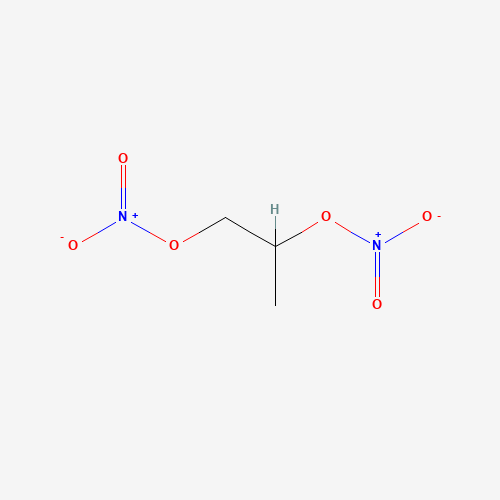
CAS6423-43-4
分子式C3H6N2O6
分子量166.09 g/mol
非危品
Physical Description | -30 °C. Density 1.37 g/cm3 at 20 °C. Slightly soluble in water (7.97 g/L H2O at 24.85 °C).
科学粮草官-词典编辑部,修订于:2026-07-06
Toxicity
ToxicityFate Summary
ATMOSPHERIC FATE: According to a model of gas/particle partitioning of semivolatile organic compounds in the atmosphere(1), 1,2-propanediol dinitrate, which has an estimated vapor pressure of 0.38 mm Hg at 25 °C (SRC), determined from a fragment constant method(2), is expected to exist solely as a vapor in the ambient atmosphere. Vapor-phase 1,2-Propanediol dinitrate is degraded in the atmosphere by reaction with photochemically-produced hydroxyl radicals(SRC); the half-life for this reaction in air is estimated to be 50 days(SRC), calculated from its rate constant of 3.2X10⁻¹³ cu cm/molecule-sec at 25 °C(3).
Soil Adsorption / Mobility
Using a structure estimation method based on molecular connectivity indices(1), the Koc for 1,2-propanediol dinitrate can be estimated to be 68(SRC). According to a classification scheme(2), this estimated Koc value suggests that 1,2-Propanediol dinitrate is expected to have high mobility in soil(SRC).
Environmental Biodegradation
Using Otto fuel II (76% 1,2-propanediol dinitrate, 22.5% dibutyl sebacate, and 1.5% 2-nitrodiphenylamine) as substrate, 1,2-propanediol dinitrate was shown to be poorly biodegraded using an activated sewage sludge, a pure culture of Pseudomonas aeruginosa, and a commercially available inoculum employed for the degradation of nitrogen containing wastes(1).
Environmental Bioconcentration
An estimated BCF of 3 was calculated for 1,2-propanediol dinitrate(SRC), using an estimated log Kow of 1.6(1) and a regression-derived equation(2). According to a classification scheme(3), this BCF suggests the potential for bioconcentration in aquatic organisms is low(SRC).
Volatilization from Water / Soil
The Henry's Law constant for 1,2-propanediol dinitrate is estimated as 9.4X10⁻⁷ atm-cu m/mole(SRC) calculated using a fragment constant estimation method(1). This Henry's Law constant indicates that 1,2-propanediol dinitrate is not expected to volatilize from moist soil or water surfaces(2). Laboratory experiments using 10 ml of Otto fuel II (76% 1,2-propanediol dinitrate, 22.5% dibutyl sebacate, and 1.5% 2-nitrodiphenylamine) added to an unspecified amount of water showed that 1,2-propanediol dinitrate in solution does not obey ideal solution behavior and there is a positive deviation in Raoult's Law due to the formation of an azeotrope with water(3). This resulted in the unexpected volatilization of 1,2-propanediol dinitrate from water under aerated laboratory conditions(3). The Henry...
Environmental Abiotic Degradation
The rate constant for the vapor-phase reaction of 1,2-propanediol dinitrate with photochemically-produced hydroxyl radicals has been measured as 3.2X10⁻¹³ cu cm/molecule-sec at 25 °C(1). This corresponds to an atmospheric half-life of about 50 days at an atmospheric concentration of 5X10+5 hydroxyl radicals per cu cm(1). 1,2-Propanediol dinitrate is not expected to undergo hydrolysis in the environment due to the lack of hydrolyzable functional groups(2). When irradiated with polychromatic light, 1,2-propanediol dinitrate was shown to decompose to lactic and pyruvic acid(3), however this reaction is not expected to be environmentally significant since this compound does not absorb light in the environmental UV (> 290 nm) spectrum(SRC).
Atmospheric Concentrations
Grab samples of air in four U.S. Navy torpedo facilities (Naval Weapons Station, Charleston, South Carolina; Naval Weapons Station, Yorktown, Virginia; Naval Submarine Support Facility, New London, Connecticut; and Naval Torpedo Station, Keyport, Washington) had levels of 1,2-propanediol dinitrate ranging from 0 to 0.22 ppm(1).
Artificial Pollution Sources
1,2-Propanediol dinitrate's production and use as a component of the naval torpedo fuel Otto II(1,2) may result in its release to the environment through various waste streams(SRC).
Probable Routes of Human Exposure
Occupational exposure to 1,2-propanediol dinitrate may occur through inhalation and dermal contact with this compound at workplaces where 1,2-propanediol dinitrate or Otto fuel II is produced or used(SRC). 1,2-Propanediol dinitrate was monitored as an indicator of exposure to Otto Fuel II at four naval facilities(1). A level of 0.001 ppm was measured in the breath of one of the workers 5 minutes after exposure to air concentrations ranging from 0.01 to 0.026 ppm ceased. No 1,2-propanediol dinitrate was detected 15 minutes after exposure ceased. In the second worker, concentrations of 0.0008 and 0.0004 ppm were measured in the expired air 5 and 15 minutes, respectively, after exposure to 0.015-0.222 ppm of Otto fuel II(1).
Environmental Fate / Exposure Summary
1,2-Propanediol dinitrate's production and use as a component of the naval torpedo fuel Otto II may result in its release to the environment through various waste streams. If released to air, an estimated vapor pressure of 0.38 mm Hg at 25 °C indicates 1,2-propanediol dinitrate will exist solely as a vapor in the ambient atmosphere. Vapor-phase 1,2-propanediol dinitrate will be degraded in the atmosphere by reaction with photochemically-produced hydroxyl radicals; the half-life for this reaction in air is estimated to be 50 days. If released to soil, 1,2-propanediol dinitrate is expected to have high mobility based upon an estimated Koc of 68. Volatilization from moist soil surfaces is not expected to be an important fate process based upon an estimated Henry's Law constant of 9.4X10⁻⁷...
Symptoms
irritation eyes; conjunctivitis; methemoglobinemia; headache, impaired balance, visual disturbance; In Animals: liver, kidney damage
Target Organs
Eyes, central nervous system, blood, liver, kidneys
Toxicity Data
LC50 (rat) > 1,350 mg/m3/4h
Adverse Effects
Methemoglobinemia - The presence of increased methemoglobin in the blood; the compound is classified as secondary toxic effect
Exposure Routes
inhalation, skin absorption, ingestion, skin and/or eye contact
RAIS Toxicity Values
Inhalation Short-term Reference Concentration Reference: ATSDR Final
1 or Cancer Risk Level 1E-06
Fraction of Contaminant Absorbed Dermally from Soil: 0.1
Hazard Quotient Level 3 or Cancer Risk Level 1E-04
Fraction of Contaminant Absorbed Dermally from Soil: 0.1









