


 一键配货
一键配货
化合物详情
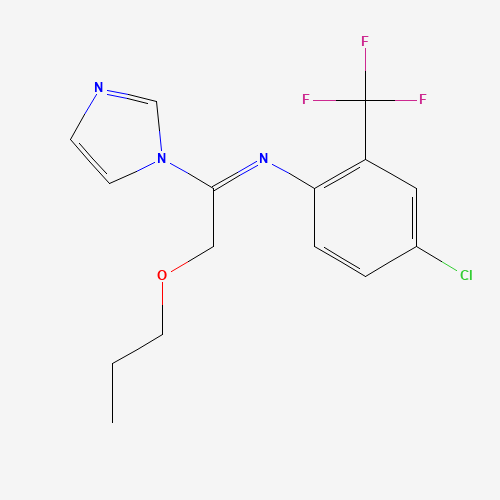
CAS68694-11-1
分子式C15H15ClF3N3O
分子量345.75 g/mol
非危品
Triflumizole is a carboxamidine resulting from the formal condensation of the amino group of 4-chloro-2-(trifluoromethyl)aniline with the oxygen of the acetyl group of N-(propoxyacetyl)imidazole. A sterol demethylation inhibitor, it is used as a fungicide for the control of powdery mildew, scab and other diseases on a variety of crops. It has a role as an EC 1.14.13.70 (sterol 14alpha-demethylase) inhibitor and an antifungal agrochemical. It is a member of imidazoles, an ether, a carboxamidine, a member of monochlorobenzenes, a member of (trifluoromethyl)benzenes, a conazole fungicide and an imidazole fungicide.
科学粮草官-词典编辑部,修订于:2026-07-06
Toxicity
ToxicityEPA Ecotoxicity
Pesticide Ecotoxicity Data from EPA: 44
Ecotoxicity Values
LD50; Species: Apis mellifera (Honey Bee) adult; topical, general >160 ug/bee[USEPA, Office of Pesticide Programs; Pesticide Ecotoxicity Database (2000) on 1-[(1E)-1-[
Fate Summary
ATMOSPHERIC FATE: According to a model of gas/particle partitioning of semivolatile organic compounds in the atmosphere(1), triflumizole, which has a vapor pressure of 1.4X10⁻⁶ mm Hg at 25 °C(2), will exist in both the vapor and particulate phases in the ambient atmosphere. Vapor-phase triflumizole is degraded in the atmosphere by reaction with photochemically-produced hydroxyl radicals(SRC); the half-life for this reaction in air is estimated to be 7 hours(SRC), calculated from its rate constant of 5.4X10⁻¹¹ cu cm/molecule-sec at 25 °C(SRC), that was derived using a structure estimation method(3). Particulate-phase triflumizole may be removed from the air by wet and dry deposition. Triflumizole contains chromophores that absorb at wavelengths >290 nm(4) and, therefore, is susceptible t...
Soil Adsorption / Mobility
The mobility of triflumizole was examined using soil thin layer chromatography with a silt loam containing 2% organic matter; results indicated that this chemical will be slightly mobile in soil(1). Triflumizole has a reported soil adsorption coefficient equal to 1400(2). According to a classification scheme(3), this Koc value suggests that triflumizole is expected to have low mobility in soil.
Environmental Biodegradation
Detailed guideline biodegradation studies for triflumizole were not available(SRC). However anaerobic metabolism in aquatic environments and aerobic soil metabolism pathways have been noted(1). In an absorption, translocation, and metabolism study, triflumizole was found to rapidly decompose with a reported half-lives of 4 to 6 days, the major metabolite (better term: degradate) noted was formed via photolysis in the presence of oxygen, however this is an abiotic process(2).
Environmental Bioconcentration
BCF values of 699 and 1417 were measured in fish for triflumizole(SRC), using carp (Cyprinus carpio) which were exposed over 60 days in the OECD 305 test(1). A whole body BCF of 390 was reported for triflumizole in bluegill fish (Lepomic macrochirus) exposed for 28 days in the 165-4/OPPTS 950.1730 EPA bioconcetration test guideline(2). According to a classification scheme(3), these BCF values suggests that bioconcentration in aquatic organisms is high to very high(SRC).
Volatilization from Water / Soil
The Henry's Law constant for triflumizole is estimated as 6.2X10⁻⁸ atm-cu m/mole(SRC) derived from its vapor pressure, 2.55X10⁻⁸ mm Hg(1), and water solubility, 10.2 mg/L(1). This Henry's Law constant indicates that triflumizole is expected to be essentially nonvolatile from water surfaces(2). Triflumizole's estimated Henry's Law constant indicates that volatilization from moist soil surfaces in not expected(SRC). Triflumizole is not expected to volatilize from dry soil surfaces(SRC) based upon its vapor pressure(1).
Environmental Abiotic Degradation
The rate constant for the vapor-phase reaction of triflumizole with photochemically-produced hydroxyl radicals has been estimated as 5.1X10⁻¹¹ cu cm/molecule-sec at 25 °C(SRC) using a structure estimation method(1). This corresponds to an atmospheric half-life of about 7 hours at an atmospheric concentration of 5X10+5 hydroxyl radicals per cu cm(1). Triflumizole is not expected to undergo rapid hydrolysis in the environment; experiments indicate that hydrolysis is pH dependent and triflumizole is most stable at neutral pH with a reported half-life of 101 days at pH 7(3). Abiotic degradation of radio-labeled triflumizole in water-sediments systems, using filtered pond water, sand, and clay loam, resulted in half-lives ranging from 48.7 to 123 days(3). Triflumizole contains chromophores t...
Food Survey Values
Results from an agricultural product monitoring effort in Japan during April 1995 through March 2000 reported triflumizole detections in 7 out of 86 samples of strawberries and grapes at concentrations between 0.5 and less than 0.01 ug/g(1). Triflumizole residues on strawberries examined in 1992 and 1993 were between 0.01 and 2.0 ug/g(2). Triflumizole was detected in 3 out of 173 agricultural product samples from a local market in Japan at concentrations of 1.9 to 494 ng/g(3).
Ecotoxicity Excerpts
/AQUATIC SPECIES/ Using rare minnow (Gobiocypris rarus) at early-life stages as experimental models, the developmental toxicity of five widely used triazole fungicides (myclobutanil, fluconazole, flusilazole, triflumizole, and epoxiconazole) were investigated following exposure to 1-15 mg/L for 72 hr. Meanwhile, morphological parameters (body length, body weight, and heart rate), enzyme activities (superoxide dismutase (SOD), glutathione S-transferase (GST), adenosine triphosphatase (ATPase), and acetyl cholinesterase (AChE)), and mRNA levels (hsp70, mstn, mt, apaf1, vezf1, and cyp1a) were also recorded following exposure to 0.2, 1.0, and 5.0 mg/L for 72 hr. Results indicated that increased malformation and mortality, decreased body length, body weight, and heart rate provide a concentr...
ICSC Environmental Data
The substance is very toxic to aquatic organisms. The substance may cause long-term effects in the aquatic environment. Avoid release to the environment in circumstances different to normal use.
Artificial Pollution Sources
Triflumizole's production may result in its release to the environment through various waste streams; its use as a fungicide(1) will result in its direct release to the environment(SRC).
Probable Routes of Human Exposure
Occupational exposure to triflumizole may occur through inhalation and dermal contact with this compound at workplaces where triflumizole is produced or used. Use data indicates that the general population may be exposed to triflumizole via ingestion of food with residues of this chemical, dermal contact with agriculture crops having residues of this chemical, and dermal contact with consumer products containing triflumizole. (SRC)
Environmental Fate / Exposure Summary
Triflumizole's production may result in its release to the environment through various waste streams; its use as a fungicide will result in its direct release to the environment. If released to air, an estimated vapor pressure of 1.4X10⁻⁶ mm Hg at 25 °C indicates triflumizole will exist in both the vapor and particulate phases in the atmosphere. Vapor-phase triflumizole will be degraded in the atmosphere by reaction with photochemically-produced hydroxyl radicals; the half-life for this reaction in air is estimated to be 7 hours. Particulate-phase triflumizole will be removed from the atmosphere by wet and dry deposition. Triflumizole contains chromophores that absorb at wavelengths >290 nm and, therefore, may be susceptible to direct photolysis by sunlight. Triflumizole has a photolysi...
Symptoms
Eye Exposure: Redness.
Effect Level
collection=toxvaldb&kind=^EL$
Lethal Dose
collection=toxvaldb&kind=^LD$
Health Effects
In human, a neuromuscular impairment and decreased locomotor activity were observed following a single exposure of 100 mg/kg/day. The liver is the primary target organ of triflumizole in the rat, mouse, and dog. It increased liver weight, hepatocyte fatty vacuolization, hypertrophy, inflammation, fatty degeneration, and caused necrosis. Chronic effects of triflumizole included hepatocyte fatty vacuolization, hepatocyte hypertrophy, focal inflammation, and necrosi, fatty degeneration, eosinophilic foci of hepatocyte alteration, hepatic nodules, bile duct hyperplasia, and hyaline degeneration/fibrosis of the bile duct. Liver effects were seen in rat and mouse subchronic and chronic/carcinogenicity studies. The fetal effects were also seen in rats. Triflumizole has a reproductive toxicity...
Adverse Effects
ACGIH Carcinogen - Not Classifiable.
Exposure Routes
The substance can be absorbed into the body by inhalation of dust and by ingestion.
Toxicity Summary
IDENTIFICATION AND USE: Triflumizole is a fungicide used for the control of powdery mildew, such as Sphaerotheca fuliginea, Sphaerotheca pannosa, Erysiphe cichoracearum, and others. HUMAN EXPOSURE AND TOXICITY: A report on the results of its yearly health examination of the personnel involved in the production of triflumizole at the Takaoka plant (Japan) during the period May 1996 to May 2002 was published. No adverse health effects attributable to chemical exposure were observed. In addition, it was reported that in the period covered, no events of acute poisoning by exposure or skin and/or eye irritation were observed. Repeated or prolonged contact may cause skin sensitization. The substance may have effects on the liver and blood. This may result in liver impairment and a decrease in...
Effect Concentration
collection=toxvaldb&kind=^EC$
Lethal Concentration
collection=toxvaldb&kind=^LC$
RAIS Toxicity Values
Oral Chronic Reference Dose Reference: OPP
Human Toxicity Excerpts
/OTHER TOXICITY INFORMATION/ Repeated or prolonged contact may cause skin sensitization. The substance may have effects on the liver and blood. This may result in liver impairment and a decrease in hemoglobin.
Carcinogen Classification
Not listed by IARC.
Non-Human Toxicity Values
LC50 Rat inhalation >3.6 mg/L/4 hr
Reference and Risk Values
collection=toxvaldb&kind=^RRV$
Non-Human Toxicity Excerpts
/LABORATORY ANIMALS: Acute Exposure/ A dermal irritation study with triflumizole (purity 98.7%; lot no. YS-200) was performed using male Angora rabbits. No signs of erythema or edema were observed after application of triflumizole on either intact or abraded skin (combined score = 0). Taking into account the absence of any skin reactions when applied to 9 sq cm, it is not expected that applying the same dose to 6 sq cm will change the classification of the test substance.
Evidence for Carcinogenicity
Triflumizole is classified as not likely to be carcinogenic to humans, based on the lack of evidence of carcinogenicity in studies in rats and mice and the absence of a mutagenicity concern.
Antidote and Emergency Treatment
Get medical aid. Eyes: Flush immediately with plenty of water. Skin: Wash thoroughly with soap and water. Remove contaminated clothing and shoes. Inhalation: Remove to fresh air.









