


 一键配货
一键配货
化合物详情
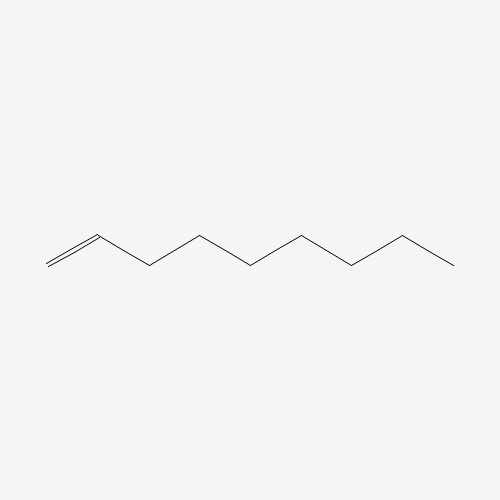
CAS124-11-8
分子式C9H18
分子量126.24 g/mol g/mol
危化品
Physical Description | 1-nonene is a colorless liquid with an odor of gasoline. Floats on water. Flammable, irritating vapor is produced.
科学粮草官-词典编辑部,修订于:2026-07-06
Toxicity
ToxicityBody Burden
In a study to detect and quantify the prevalence of chemicals found in the adipose tissue of the general population, n-nonene was found in 8 out of 46 tissue samples collected during 1982. Two samples came from the north central part of the United States, two from the north east and four from the south(1).
Fate Summary
ATMOSPHERIC FATE: According to a model of gas/particle partitioning of semivolatile organic compounds in the atmosphere(1), 1-nonene, which has a vapor pressure of 5.40 mm Hg at 25 °C(2), is expected to exist solely as a vapor in the ambient atmosphere. Vapor-phase 1-nonene is degraded in the atmosphere by reaction with photochemically-produced hydroxyl radicals(SRC); the half-life for this reaction in air is estimated to be 11 hrs(SRC), from its rate constant of 3.44X10⁻¹¹ cu cm/molecule-sec at 25 °C determined using a structure estimation method(3). Vapor-phase 1-nonene is also degraded in the atmosphere by reaction with ozone(SRC); the half-life for this reaction in air is estimated to be 23 hrs(SRC), from its rate constant of 1.20X10⁻¹⁷ cu cm/molecule-sec at 25 °C(4). Reaction of va...
Soil Adsorption / Mobility
Using a structure estimation method based on molecular connectivity indices(1), the Koc for 1-nonene can be estimated to be 935(SRC). According to a classification scheme(2), this estimated Koc value suggests that 1-nonene is expected to have low mobility in soil.
Environmental Biodegradation
Resting cells of Pseudomonas oleovorans PO-1R that had been grown on octane were able to oxidize 1-nonene to produce 1,2-epoxynonane(1). The appearance of the epoxide occurred after only a half hour exposure to 1-nonene(1). In a similar study, Corynebacterium sp (7E1C) bacteria was able to degrade 1-nonene at an optimal temperature of 30 °C and a pH range of 7.0-7.6(2). This study revealed that terminating alkenes were more recalcitrant compared to those alkenes with the double bond located elsewhere on the molecule. Researchers also noted that as the chain length of the alkene increased, so did the susceptibility to microbial attack(2). Alkenes can be utilized by a wide range of microorganisms and are catabolized via several routes(3). These include the oxidation of a terminal methyl g...
Environmental Bioconcentration
An estimated BCF of 1843 was calculated for 1-nonene(SRC), using a log Kow of 5.15(1) and a regression-derived equation(2). According to a classification scheme(3), this BCF suggests the potential for bioconcentration in aquatic organisms is very high.
Volatilization from Water / Soil
The Henry's Law constant for 1-nonene is 0.7941 atm-cu m/mole(1). This Henry's Law constant indicates that 1-nonene is expected to volatilize rapidly from water surfaces(2). Based on this Henry's Law constant, the volatilization half-life from a model river (1 m deep, flowing 1 m/sec, wind velocity of 3 m/sec)(2) is estimated as 1 hr(SRC). The volatilization half-life from a model lake (1 m deep, flowing 0.05 m/sec, wind velocity of 0.5 m/sec)(2) is estimated as 4.5 days(SRC). However, the volatilization half-life does not take into account the effects of adsorption. This is apparent from the results of two EXAMS model runs, one in which the effect of adsorption was considered, yielding an estimated half-life of 6.5 days in a model pond 2 m deep, and one in which the effect of adsorptio...
Environmental Abiotic Degradation
The rate constant for the vapor-phase reaction of 1-nonene with photochemically-produced hydroxyl radicals has been estimated as 3.44X10⁻¹¹ cu cm/molecule-sec at 25 °C(SRC) using a structure estimation method(1). This corresponds to an atmospheric half-life of about 11 hrs at an atmospheric concn of 5X10+5 hydroxyl radicals per cu cm(1). The rate constant for the vapor-phase reaction of 1-nonene with ozone has been estimated as 3.44X10⁻¹¹ cu cm/molecule-sec at 25 °C(2). This corresponds to an atmospheric half-life of about 23 hrs at an atmospheric concn of 7.0X10+11 ozone molecules per cu cm(2). Reaction of vapor-phase 1-nonene with nitrate radical may be an important night-time loss process based on its molecular structure(3). 1-Nonene is not expected to undergo hydrolysis in the envir...
Environmental Water Concentrations
SURFACE WATER: Water samples collected from fourteen heavily industrialized river basins in the United States were studied for various chemical contaminants(1). Some areas included in the study were the Hudson River, Illinois River Basin, Delaware River Basin, Mississippi River Basin, and Ohio River Basin. Of 204 water samples collected, 1-nonene was detected only once, concn not specified, between July 1, 1975 to December 31, 1976(1). 1-Nonene was detected, concn not specified, within the Lake Michigan water basin from 1975-76(2).
Food Survey Values
1-Nonene has been detected as one of several volatile hydrocarbons found in beef(1). In a study of the lipid fraction and organic volatile compounds found in raw ground beef, 1-nonene was identified as 6.08% of the lipid fraction volume but was not detected as one of the volatile organic compounds(2). The volatile vapor fraction emitted during the heating of four oils (rapeseed, Canola, peanut and soybean) was analyzed to determine its chemical composition. 1-Nonene was tentatively detected, concn not specified, in rapeseed oil(3).
Effluent Concentrations
The exhaust gas from 10 small four-stroke lawn mowers using two different gasolines was studied(1). When a 1990 national average blend of gasoline was used, 1-nonene was detected in the exhaust gas as 0.50% of the total organic gases emitted while when a California Phase 2 gasoline was used, 1-nonene was identified as 0.53% of the total organic gases emitted(1). The hydrocarbon content of the exhaust from two different turbojet engines operated at simulated supersonic flight conditions was studied. During the experiment, jet engine model YJ93-GE-3 contained 1-nonene in its exhaust gas ranging from 0.02-17.9 ppm while jet engine model J85-GE-5B contained 1-nonene in its exhaust gas ranging from 0.08-0.54 ppm(2).
Natural Pollution Sources
1-Nonene has been detected in the volatile organic fraction and lipid fraction of beef(1,2) and as a possible volatile organic compound emitted by heating rapeseed oil(3). Another biogenic source is as a volatile organic compound emitted from molds that grow on dust particles(4).
Atmospheric Concentrations
RURAL/REMOTE: Ambient air sampling performed at high ambient temperatures in Whitaker's Forest in the Sierra Nevada Mountains of California from June 20-22, 1990 contained 1-nonene, concn not specified(1).
Artificial Pollution Sources
1-Nonene's production and use in gasolines(1) may result in its release to the environment through various waste streams(SRC). Also, companies which process beef(2) and rapeseed oil(3) may be potential sources of 1-nonene contamination into the environment.
Probable Routes of Human Exposure
Occupational exposure to 1-nonene may occur through inhalation and dermal contact with this compound at workplaces where 1-nonene is produced or used(SRC). The general population may be exposed to 1-nonene via ingestion of food(1-3) and dermal contact with gasoline products(4) containing 1-nonene(SRC).
Other Environmental Concentrations
A study of volatile organic compounds released by three different molds revealed 1-nonene as a volatile constituent from Aspergillus versicolor(1). This mold is commonly found growing on dust in buildings and in the ambient atmosphere. 1-Nonene was identified as a component of three different gasolines, industry average gasoline, EPA certification gasoline, and M-85 (85% methanol, 15% gasoline), as 0.105, 0.119, and 0.016%, respectively, of the total hydrocarbon composition(2).
Environmental Fate / Exposure Summary
1-Nonene's production and use in gasoline may result in its release to the environment through various waste streams. 1-Nonene is also a naturally occurring compound found in raw beef and rapeseed oil and as a volatile organic compound emitted from molds. If released to air, a vapor pressure of 5.40 mm Hg at 25 °C indicates 1-nonene will exist solely as a vapor in the ambient atmosphere. Vapor-phase 1-nonene will be degraded in the atmosphere by reaction with photochemically-produced hydroxyl radicals and ozone; the half-life for these reaction in air is estimated to be 11 and 23 hrs, respectively. Reaction of vapor-phase 1-nonene with nitrate radical may be an important night-time loss process based on its molecular structure. If released to soil, 1-nonene is expected to have low mobil...
Adverse Effects
Neurotoxin - Acute solvent syndrome
Human Toxicity Excerpts
VAPOR: IRRITATING TO EYES, NOSE AND THROAT. IF INHALED, WILL CAUSE DIZZINESS OR LOSS OF CONSCIOUSNESS. LIQUID: IRRITATING TO SKIN & EYES. ... HIGH VAPOR CONCN ... ACT AS AN ANESTHETIC. ... IF SPILLED ON CLOTHING & ALLOWED TO REMAIN, MAY CAUSE SMARTING & REDDENING OF THE SKIN. /NONENE/
Non-Human Toxicity Excerpts
BINDING WAS INVESTIGATED OF DIFFERENT 1-ALKENES TO CYTOCHROME P450 IN MICROSOMES FROM F344 RATS.









