


 一键配货
一键配货
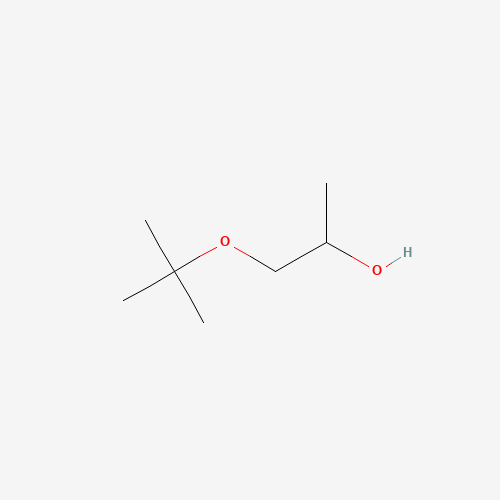
化合物详情
CAS57018-52-7
分子式C7H16O2
分子量132.2 g/mol
非危品
Physical Description | Propylene glycol t-butyl ether is a clear colorless liquid with an ethereal odor. (NTP, 1992)
科学粮草官-词典编辑部,修订于:2026-07-06
Toxicity
ToxicityFate Summary
ATMOSPHERIC FATE: According to a model of gas/particle partitioning of semivolatile organic compounds in the atmosphere(1), propylene glycol mono-t-butyl ether, which has a vapor pressure of 4.7 mm Hg at 20 °C(2), is expected to exist solely as a vapor in the ambient atmosphere. Vapor-phase propylene glycol mono-t-butyl ether is degraded in the atmosphere by reaction with photochemically-produced hydroxyl radicals(SRC); the half-life for this reaction in air is estimated to be 23 hours(SRC), calculated from its rate constant of 1.7X10⁻¹¹ cu cm/molecule-sec at 25 °C(SRC) that was derived using a structure estimation method(3).
Soil Adsorption / Mobility
The Koc of propylene glycol mono-t-butyl ether is estimated as 5(SRC), using a water solubility of 1.73X10+5 mg/L(1) and a regression-derived equation(2). According to a classification scheme(3), this estimated Koc value suggests that propylene glycol mono-t-butyl ether is expected to have very high mobility in soil.
Environmental Biodegradation
The structurally similar compound 2-tertiary butoxy ethanol was not degraded in a 16 day BOD test(1). The authors reported that tertiary and ether structures are non-biodegradable. Based on the BOD test result for 2-tertiary butoxy ethanol, propylene glycol mono-t-butyl ether is not expected to be biodegradable.
Environmental Bioconcentration
An estimated BCF of 0.8 was calculated for propylene glycol mono-t-butyl ether(SRC), using a water solubility of 1.73X10+5 mg/L(1) and a regression-derived equation(2). According to a classification scheme(3), this BCF suggests the potential for bioconcentration in aquatic organisms is low(SRC).
Volatilization from Water / Soil
The Henry's Law constant for propylene glycol mono-t-butyl ether is estimated as 4.73X10⁻⁶ atm-cu m/mole(SRC) derived from its vapor pressure, 4.7 mm Hg(1), and water solubility, 1.73X10+5 mg/L(1). This Henry's Law constant indicates that propylene glycol mono-t-butyl ether is expected to volatilize from water surfaces(2). Based on this Henry's Law constant, the volatilization half-life from a model river (1 m deep, flowing 1 m/sec, wind velocity of 3 m/sec)(2) is estimated as 6 days(SRC). The volatilization half-life from a model lake (1 m deep, flowing 0.05 m/sec, wind velocity of 0.5 m/sec)(2) is estimated as 69 days(SRC). Propylene glycol mono-t-butyl ether's estimated Henry's Law constant indicates that volatilization from moist soil surfaces may occur(SRC). The potential for volat...
Environmental Abiotic Degradation
The rate constant for the vapor-phase reaction of propylene glycol mono-t-butyl ether with photochemically-produced hydroxyl radicals has been estimated as 1.71X10⁻¹¹ cu cm/molecule-sec at 25 °C(SRC) using a structure estimation method(1). This corresponds to an atmospheric half-life of about 23 hours at an atmospheric concentration of 5X10+5 hydroxyl radicals per cu cm(1). Propylene glycol mono-t-butyl ether is not expected to undergo hydrolysis in the environment due to the lack of hydrolyzable functional groups(2) nor to directly photolyze due to the lack of absorption in the environmental UV spectrum (>290 nm).
ICSC Environmental Data
Environmental effects from the substance have not been investigated adequately.
Artificial Pollution Sources
Propylene glycol mono-t-butyl ether's production and use as a solvent for all-purpose cleaners, electronic chemicals, inks, adhesives, nail polish lacquers, and other water-reducible coatings(1) may result in its release to the environment through various waste streams(SRC).
Probable Routes of Human Exposure
Occupational exposure to propylene glycol mono-t-butyl ether may occur through inhalation and dermal contact with this compound at workplaces where propylene glycol mono-t-butyl ether is produced or used. The general population may be exposed to this compound through contact with consumer products containing propylene glycol mono-t-butyl ether. (SRC)
Environmental Fate / Exposure Summary
Propylene glycol mono-t-butyl ether's production and use as a solvent for all-purpose cleaners, electronic chemicals, inks, adhesives, nail polish lacquers, and other water-reducible coatings may result in its release to the environment through various waste streams. If released to air, a vapor pressure of 4.7 mm Hg at 20 °C indicates propylene glycol mono-t-butyl ether will exist solely as a vapor in the ambient atmosphere. Vapor-phase propylene glycol mono-t-butyl ether will be degraded in the atmosphere by reaction with photochemically-produced hydroxyl radicals; the half-life for this reaction in air is estimated to be 23 hours. If released to soil, propylene glycol mono-t-butyl ether is expected to have very high mobility based upon an estimated Koc of 5. Volatilization from moist...
Symptoms
Ingestion Exposure: Cough. Nausea. Sore throat.
Adverse Effects
IARC Carcinogen - Class 3: Chemicals are not classifiable by the International Agency for Research on Cancer.
Exposure Routes
The substance can be absorbed into the body by inhalation of its vapour.
Carcinogen Classification
Summary: Exposure of male rats to propylene glycol mono-t-butyl ether resulted in nonneoplastic lesions of the kidney characteristic of a2u-globulin accumulation. Exposure to propylene glycol mono-t-butyl ether resulted in nonneoplastic lesions of the liver and nose in male and female rats, the liver in male and female mice, and the eyes in female rats and mice. Kinetic and biomarker studies indicated that clearance was saturated at the 1,200 ppm exposure for both rats and mice.
Non-Human Toxicity Values
LD50 Rat (Sprague-Dawley) oral 3771 mg/kg
Non-Human Toxicity Excerpts
/LABORATORY ANIMALS: Acute Exposure/ All rabbits survived a 24 hr application of 2 g propylene glycol mono-tert-butyl ether (PGTBE)/kg bw. PGTBE was applied to the abraded, clipped skin of rabbits and held in contact for a period of 24 hr by use of an occlusive wrap that prevented removal by evaporation or other means. After 24 hr, the test material was removed from the skin and subjects were observed for 14 days. No deaths resulted from treatment and no adverse clinical signs were observed. No effects were noted on body weights. Examination of the skin at the site of application revealed transient erythema as well as persistent desquamation, atonia, erythema, fissures, discoloration, and thickened skin of some of the treated animals.
Antidote and Emergency Treatment
Advanced treatment: Consider orotracheal or nasotracheal intubation for airway control in the patient who is unconscious, has severe pulmonary edema, or is in respiratory arrest. Positive pressure ventilation techniques with a bag valve mask device may be beneficial. Monitor cardiac rhythm and treat arrhythmias as necessary ... . Start an IV with D5W /SRP: "To keep open", minimal flow rate/. Use lactated Ringer's if signs of hypovolemia are present. Watch for signs of fluid overload. Consider drug therapy for pulmonary edema ... . For hypotension with signs of hypovolemia, administer fluid cautiously. Watch for signs of fluid overload ... . Treat seizures with diazepam (Valium) ... . Use proparacaine hydrochloride to assist eye irrigation ... . /Poison A and B/









