


 一键配货
一键配货
化合物详情
CAS13654-09-6
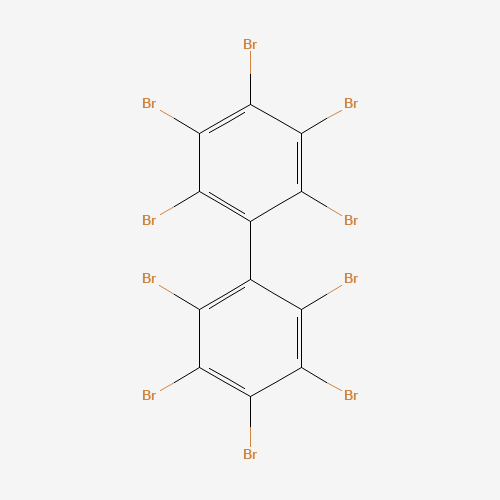
分子式C12Br10
分子量943.17 g/mol
危化品
2,2',3,3',4,4',5,5',6,6'-Decabromobiphenyl is a polybrominated biphenyl. Polybrominated biphenyls (PBBs) are a group of 209 synthetic organic compounds with 1-10 bromine atoms attached to biphenyl. They can be used as flame retardants and may be added to the plastics used to make products like computer monitors, televisions, textiles, and plastic foams to make them difficult to burn. However, the use of PBBs is banned or restricted in most areas due to their toxicity and persistence in the environment. (L628, L629)
科学粮草官-词典编辑部,修订于:2026-07-06
Toxicity
ToxicityEcotoxicity Values
EC50 Daphnia magna (immobilization) >66 mg/L/24 hr
Fate Summary
ATMOSPHERIC FATE: According to a model of gas/particle partitioning of semivolatile organic compounds in the atmosphere(1), decabromobiphenyl, which has a vapor pressure of 3.98X10⁻¹⁰ mm Hg at 25 °C(2), is expected to exist solely in the particulate phase in the ambient atmosphere. Particulate-phase decabromobiphenyl may be removed from the air by wet and dry deposition(SRC). Brominated biphenyls have been shown to undergo direct photolysis in solutions(3); however, it is unclear whether direct photolysis will occur for particulate phase decabromobiphenyl in the atmosphere.
Soil Adsorption / Mobility
Using a structure estimation method based on molecular connectivity indices(1), the Koc for decabromobiphenyl can be estimated to be 994,000(SRC). According to a classification scheme(2), this estimated Koc value suggests that decabromobiphenyl is expected to be immobile in soil(SRC).
Environmental Biodegradation
ANAEROBIC: Polybrominated biphenyls such as decabromobiphenyl may degrade slowly under anaerobic conditions(1).
Environmental Bioconcentration
A BCF range of 0.6-5.4 was measured for carp exposed to 0.15 mg/L of decabromobiphenyl over a 6 week incubation period and a BCF of <4 was measured for carp exposed to 0.015 mg/L over a 6 week incubation period(1) According to a classification scheme(2), these BCF values suggests bioconcentration in aquatic organisms is low(SRC).
Volatilization from Water / Soil
The Henry's Law constant for decabromobiphenyl is estimated as 4.2X10⁻⁸ atm-cu m/mole(SRC) using a fragment constant estimation method(1). This Henry's Law constant indicates that decabromobiphenyl is expected to be essentially non-volatile from water and moist soil surfaces (3). Decabromobiphenyl is not expected to volatilize from dry soil surfaces(SRC) based upon a vapor pressure of 3.98X10⁻¹⁰ mm Hg(3).
Environmental Abiotic Degradation
Decabromobiphenyl is subject to direct photolysis in the environment with the subsequent formation of lower brominated biphenyls as degradation products(1). In the atmosphere, decabromobiphenyl will exist primarily in the particulate-phase, thus reaction with photochemically produced hydroxyl radicals is expected to be a slow abiotic degradation process(1). Decabromobiphenyl is not expected to undergo hydrolysis in the environment due to the lack of hydrolyzable functional groups(1).
Ecotoxicity Excerpts
/AQUATIC SPECIES/ In a short-term test (according to the ISO standard 6341) the immobilization of Daphnia magna (Crustacea) by technical decabromobiphenyl (Adine 0102) has been investigated. The following results were obtained after dissolution of the test material in DMSO because of its weak solubility in water. The maximum concentration resulting in 0% immobilization (24 hr): <2 mg/liter.
Animal Concentrations
The concentration of decabromobiphenyl was <1 ug/kg wet weight from harbor seals collected from the North Sea(1). In whitebeaked dolphins from the North Sea, the concentration of decabromobiphenyl was <0.9 ug/kg wet weight(1). Decabromobiphenyl concentration was <0.5 ug/kg wet weight in sperm whales from the Atlantic Ocean(1).
Artificial Pollution Sources
Decabromobiphenyl's former production and use as an additive in flame retardant materials(1), may have resulted in its release to the environment through various waste streams(SRC). Most decabromobiphenyl produced in the US was exported and US production was discontinued in 1979(2).
Sediment/Soil Concentrations
Decabromobiphenyl was detected in New Jersey soil and sludge samples at 2,100 and 390,000 ppb, respectively(1).
Probable Routes of Human Exposure
Decabromobiphenyl is no longer produced or used in the United States(1,2); therefore, the potential for occupational exposure and exposure to the general public is considered low(SRC).
Environmental Fate / Exposure Summary
Decabromobiphenyl's former production and use as an additive in flame retardants, may have resulted in its release to the environment through various waste streams. The majority of US produced decabromobiphenyl was exported to other countries before its production was discontinued in 1979. If released to air, a vapor pressure of 3.98X10⁻¹⁰ mm Hg at 25 °C indicates decabromobiphenyl will exist solely in the particulate phase in the ambient atmosphere. Particulate-phase decabromobiphenyl will be removed from the atmosphere by wet and dry deposition. Polybrominated biphenyls have been shown to undergo direct photolysis in solution, resulting in lower brominated biphenyls as photodegradation products; however, it is unclear whether direct photolysis will occur for particulate phase decabrom...
Symptoms
Symptoms of PBB exposure may include nausea, abdominal pain, loss of appetite, joint pain, fatigue, and weakness. (L629)
Treatment
EYES: irrigate opened eyes for several minutes under running water. INGESTION: do not induce vomiting. Rinse mouth with water (never give anything by mouth to an unconscious person). Seek immediate medical advice. SKIN: should be treated immediately by rinsing the affected parts in cold running water for at least 15 minutes, followed by thorough washing with soap and water. If necessary, the person should shower and change contaminated clothing and shoes, and then must seek medical attention. INHALATION: supply fresh air. If required provide artificial respiration.
Health Effects
PBB exposure may cause weight loss, skin disorders (such as acne), nervous and immune systems effects, and effects on the liver, kidneys, and thyroid gland. (L628)
Adverse Effects
IARC Carcinogen - Class 3: Chemicals are not classifiable by the International Agency for Research on Cancer.
Exposure Routes
Oral (L628); inhalation (L628); dermal (L628)
Toxicity Summary
The exact mechanism of toxicty of PBBs varies depending on the specific congener. The predominant interaction is believed to involve the aryl hydrocarbon receptor (AhR). PBBs bind to and activate the AhR, which in turn initiates the transcriptional upregulation of a number of genes, affecting biochemical and endocrine pathways, cell cycle regulation, morphogenesis, oxidative stress response, and various other processes. This results in the numerous toxic responses characteristic of PBBs. Some of the known induced genes include the cytochrome P-450-dependent monooxygenases CYP1A1 and CYP1A2. (L628)
Minimum Risk Level
Acute Oral: 0.01 mg/kg/day (L134)
Human Toxicity Excerpts
/BIOMONITORING/ Effects in workers exposed to unspecified PBBs and/or decabromobiphenyl included increased serum thyrotropin, low or borderline low serum T4, and increased thyroid antimicrosomal antibody titers. A spectrum of thyroid effects has been observed in exposed rats, ranging from decreases in serum levels of serum T4 and T3 to histological and ultrastructural changes. Therefore, serum levels of T4 and/or other thyroid hormones are potential biomarkers of effects for PBBs. /Commercial mixture/
Carcinogen Classification
2A, probably carcinogenic to humans. (L135)
Non-Human Toxicity Values
LD50 Rabbit dermal >8 g/kg bw /from table/









