


 一键配货
一键配货
化合物详情
CAS6846-50-0
分子式C16H30O4
分子量286.41 g/mol g/mol
危化品
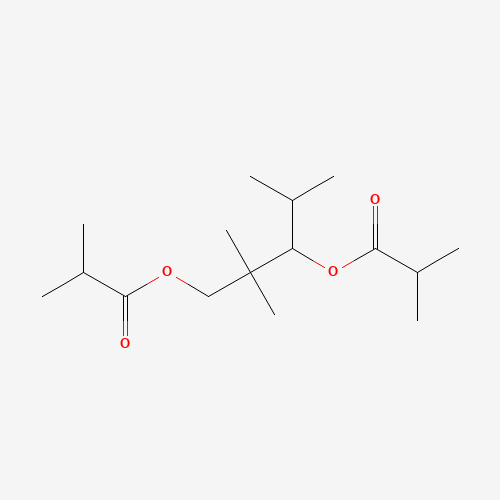
2,2,4-Trimethyl-1,3-pentadienol diisobutyrate is a diester.
科学粮草官-词典编辑部,修订于:2026-07-06
Toxicity
ToxicityFate Summary
ATMOSPHERIC FATE: According to a model of gas/particle partitioning of semivolatile organic compounds in the atmosphere(1), 2,2,4-trimethyl-1,3-pentanediol diisobutyrate, which has an estimated vapor pressure of 8.5X10⁻³ mm Hg at 25 °C(SRC), determined from a fragment constant method(2), is expected to exist solely as a vapor in the ambient atmosphere. Vapor-phase 2,2,4-trimethyl-1,3-pentanediol diisobutyrate is degraded in the atmosphere by reaction with photochemically-produced hydroxyl radicals(SRC); the half-life for this reaction in air is estimated to be one day(SRC), calculated from its rate constant of 1.1X10⁻¹¹ cu cm/molecule-sec at 25 °C(SRC) that was derived using a structure estimation method(3). 2,2,4-Trimethyl-1,3-pentanediol diisobutyrate does not contain chromophores tha...
Soil Adsorption / Mobility
Using a structure estimation method based on molecular connectivity indices(1), the Koc of 2,2,4-trimethyl-1,3-pentanediol diisobutyrate can be estimated to be 490(SRC). According to a classification scheme(2), this estimated Koc value suggests that 2,2,4-trimethyl-1,3-pentanediol diisobutyrate is expected to have low mobility in soil. 2,2,4-Trimethyl-1,3-pentanediol diisobutyrate concentrations were 500 and 120 ng/L in influent and effluent, respectively, using a soil column test and secondary treated City of Phoenix, AZ wastewater; the decrease in effluent was attributed mainly to adsorption(3).
Environmental Biodegradation
Biodegradation data for 2,2,4-trimethyl-1,3-pentanediol in soil or water were not available. (SRC, 2012)
Environmental Bioconcentration
An estimated BCF of 800 was calculated in fish for 2,2,4-trimethyl-1,3-pentanediol diisobutyrate(SRC), using an estimated log Kow of 4.91(1) and a regression-derived equation(2). According to a classification scheme(3), this BCF suggests the potential for bioconcentration in aquatic organisms is high(SRC), provided the compound is not metabolized by the organism(SRC).
Volatilization from Water / Soil
The Henry's Law constant for 2,2,4-trimethyl-1,3-pentanediol diisobutyrate is estimated as 1.1X10⁻⁵ atm-cu m/mole(SRC) using a fragment constant estimation method(1). This Henry's Law constant indicates that 2,2,4-trimethyl-1,3-pentanediol diisobutyrate is expected to volatilize from water surfaces(2). Based on this Henry's Law constant, the volatilization half-life from a model river (1 m deep, flowing 1 m/sec, wind velocity of 3 m/sec)(2) is estimated as 4 days(SRC). The volatilization half-life from a model lake (1 m deep, flowing 0.05 m/sec, wind velocity of 0.5 m/sec)(2) is estimated as 49 days(SRC). 2,2,4-Trimethyl-1,3-pentanediol diisobutyrate's Henry's Law constant indicates that volatilization from moist soil surfaces may occur(SRC). 2,2,4-Trimethyl-1,3-pentanediol diisobutyrat...
Environmental Abiotic Degradation
The rate constant for the vapor-phase reaction of 2,2,4-trimethyl-1,3-pentanediol diisobutyrate with photochemically-produced hydroxyl radicals has been estimated as 1.1X10⁻¹¹ cu cm/molecule-sec at 25 °C(SRC) using a structure estimation method(1). This corresponds to an atmospheric half-life of about one day at an atmospheric concentration of 5X10+5 hydroxyl radicals per cu cm(1). A base-catalyzed second-order hydrolysis rate constant of 1.5X10⁻² L/mole-sec(SRC) was estimated using a structure estimation method(2); this corresponds to half-lives of 15 and 1.5 years at pH values of 7 and 8, respectively(2). 2,2,4-Trimethyl-1,3-pentanediol diisobutyrate is expected to undergo hydrolysis in the environment due to the presence of functional groups that hydrolyze under environmental conditi...
Environmental Water Concentrations
SURFACE WATER: 2,2,4-Trimethyl-1.3-pentanediol diisobutyrate was present at 1-6 ppb in samples from the Delaware River collected in March 1977 between Marcus Hook, PA at river mile 78 (1-6 ppb) and Trenton, NJ at river mile 132. It was not detected in samples collected in August 1976(1).
Artificial Pollution Sources
2,2,4-Trimethyl-1,3-pentanediol diisobutyrate's production and use as a plasticizer in vinyl flooring(1-3) and coalescing aid in latex paints(3) may result in its release to the environment through various waste streams(SRC).
Probable Routes of Human Exposure
2,2,4-Trimethyl-1,3-pentanediol diisobutyrate was present at mean concentrations of 0.4, 7.7, and 11.4 ug/cu m in 50 telecommunications offices (sparsely populated), 9 data centers (variably occupied), and 11 administrative offices (densely occupied), respectively, located throughout the US. Sampling was conducted from March 18 through April 29, 1991 . Typically, the telecommunication and administrative offices were better ventilated. The immediate outdoor air concentration mean was 0.03 ppb(1).
Environmental Fate / Exposure Summary
2,2,4-Trimethyl-1,3-pentanediol diisobutyrate's production and use as a plasticizer in rolled sheet vinyl flooring and coalescing aid in latex paints in may result in its release to the environment through various waste streams. If released to air, an estimated vapor pressure of 8.5X10⁻³ mm Hg at 25 °C indicates 2,2,4-trimethyl-1,3-pentanediol diisobutyrate will exist solely as a vapor in the atmosphere. Vapor-phase 2,2,4-trimethyl-1,3-pentanediol diisobutyrate will be degraded in the atmosphere by reaction with photochemically-produced hydroxyl radicals; the half-life for this reaction in air is estimated to be one day. 2,2,4-Trimethyl-1,3-pentanediol diisobutyrate does not contain chromophores that absorb at wavelengths >290 nm and, therefore, is not expected to be susceptible to dire...
Interactions
To investigate the effect of volatile organic compounds (VOCs) exposure on the development of allergic airway inflammation Balb/c mice were exposed to VOCs emitted by new polyvinylchloride (PVC) flooring, sensitized with ovalbumin (OVA) and characterized in acute and chronic murine asthma models... VOCs with the highest concentrations emitted by new PVC flooring were N-methyl-2-pyrrolidone (NMP) and 2,2,4-trimethyl-1,3-pentanediol diisobutyrate (TXIB)... Treatment of PVC flooring-exposed mice with N-acetylcysteine prevented the VOC-induced increase of airway inflammation.
Toxicity Summary
Cosmetic Ingredient Review Finding(s): Safe in the present practices of use and concentration. Ingredient, concentration, and use information are available in documents discoverable at https://cir-reports.cir-safety.org
Human Toxicity Excerpts
/HUMAN EXPOSURE STUDIES/ An experiment explored ability of subjects to detect vapors of the plasticizer TXIB (2,2,4-trimethyl-1,3-pentanediol diisobutyrate) and ethanol via olfaction and via ocular and nasal chemesthesis, i.e. chemically stimulated feel. Testing, tailored to the sensitivity of each subject, produced psychometric functions for individuals. Olfactory detection of TXIB began at concentrations below 1 ppb (v/v), with 50% correct detection at 1.2 ppb. (Comparable detection for ethanol occurred almost two orders of magnitude higher.) Chemesthetic detection of TXIB began at about 500 ppb, with 50% correct detection at 2.1 ppm for the eye and 4.6 ppm for the nose, both close to saturated vapor concentration. (Comparable detection for ethanol occurred essentially three orders of...
Carcinogen Classification
No indication of carcinogenicity to humans (not listed by IARC).
Non-Human Toxicity Values
LD50 Rat oral >3200 mg/kg bw
Non-Human Toxicity Excerpts
TXIB (2,2,4-trimethyl-1,3-pentanediol diisobutyrate), a common plasticizer, inhibits the peach fruit moth, Carposina sasakii from ovipositing on young apple fruits. Using an insect assay and gas chromatography with an electroantennographic detector (GC-EAD) analysis, the stereochemistry of the bioactive compound was identified to be 3R, whereas (3S)-TXIB showed no activity. The inactive enantiomer did not inhibit the activity of commercially available TXIB, which was a racemic mixture. When the female moth was placed on the TXIB-treated fruits in the oviposition assay, she repeated grooming antennae. The reason why the moth detects this artificial compound is unknown, although the stereochemical structure of TXIB could have given an abnormality to the moth's antennae.
Antidote and Emergency Treatment
/SRP:/ Advanced treatment: Consider orotracheal or nasotracheal intubation for airway control in the patient who is unconscious, has severe pulmonary edema, or is in severe respiratory distress. Positive pressure ventilation techniques with a bag valve mask device may be beneficial. Consider drug therapy for pulmonary edema ... . Monitor cardiac rhythm and treat arrhythmias if necessary ... . Start IV administration of D5W /SRP: "To keep open", minimal flow rate/. Use 0.9% saline (NS) or lactated Ringer's (LR) if signs of hypovolemia are present. For hypotension with signs of hypovolemia, administer fluid cautiously. Consider vasopressors if patient is hypotensive with a normal fluid volume. Watch for signs of fluid overload ... . Administer 1% solution methylene blue if patient is symp...









