


 一键配货
一键配货
化合物详情
CAS6386-73-8
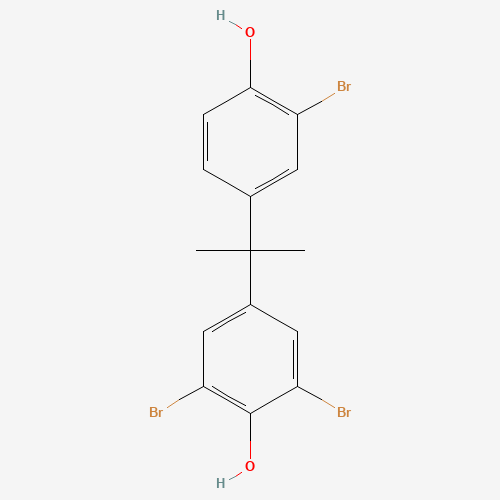
分子式C15H13Br3O2
分子量464.97 g/mol
非危品
3,3',5-tribromobisphenol A is a bromobisphenol.
科学粮草官-词典编辑部,修订于:2026-07-06
Toxicity
ToxicityFate Summary
ATMOSPHERIC FATE: According to a model of gas/particle partitioning of semivolatile organic compounds in the atmosphere(1), tribromobisphenol A, which has an estimated vapor pressure of 7.5X10⁻⁸ mm Hg at 25 °C(SRC), determined from a fragment constant method(2), will exist in both the vapor and particulate phases in the ambient atmosphere. Vapor-phase tribromobisphenol A is degraded in the atmosphere by reaction with photochemically-produced hydroxyl radicals(SRC); the half-life for this reaction in air is estimated to be 10 hours(SRC), calculated from its rate constant of 1.3X10⁻¹¹ cu cm/molecule-sec at 25 °C(SRC) that was derived using a structure estimation method(2). Particulate-phase tribromobisphenol A may be removed from the air by wet and dry deposition(SRC). Aqueous photolysis...
Soil Adsorption / Mobility
Using a structure estimation method based on molecular connectivity indices(1), the Koc of tribromobisphenol A can be estimated to be 1.7X10+5(SRC). According to a classification scheme(2), this estimated Koc value suggests that tribromobisphenol A is expected to be immobile in soil. The pKa of tribromobisphenol A is 7.80(3), indicating that this compound will exist partially in anion form in the environment and anions generally do not adsorb more strongly to soils containing organic carbon and clay than their neutral counterparts(4).
Environmental Biodegradation
ANAEROBIC: The structurally similar tetrabromobisphenol A has been shown to biodegrade anaerobically in soil and sediment studies (near complete degradation within 64 days or less) with an intermediate formation of tri- and dibrominated bisphenol A and a final formation of only bisphenol A(1-3); therefore, tribromobisphenol A is expected to biodegrade via dehalogenation to bisphenol A(SRC).
Environmental Bioconcentration
An estimated BCF of 2,000 was calculated in fish for tribromobisphenol A(SRC), using an estimated log Kow of 5.51 derived from an experimental value adjustment method(1) and a regression-derived equation(1). According to a classification scheme(2), this BCF suggests the potential for bioconcentration in aquatic organisms is very high(SRC), provided the compound is not metabolized by the organism(SRC).
Volatilization from Water / Soil
The Henry's Law constant for tribromobisphenol A is estimated as 9.0X10⁻⁸ atm-cu m/mole(SRC) using a fragment constant estimation method(1). This Henry's Law constant indicates that tribromobisphenol A is expected to be essentially nonvolatile from water surfaces(2). Tribromobisphenol A's Henry's Law constant indicates that volatilization from moist soil surfaces is not expected to occur(SRC). Tribromobisphenol A is not expected to volatilize from dry soil surfaces(SRC) based upon an estimated vapor pressure of 7.5X10⁻⁸ mm Hg(SRC), determined from a fragment constant method(1).
Environmental Abiotic Degradation
The rate constant for the vapor-phase reaction of tribromobisphenol A with photochemically-produced hydroxyl radicals has been estimated as 1.3X10⁻¹¹ cu cm/molecule-sec at 25 °C(SRC) using a structure estimation method(1). This corresponds to an atmospheric half-life of about 10 hours at an atmospheric concentration of 5X10+5 hydroxyl radicals per cu cm(1). Phototransformation studies of tribromobisphenol A in aqueous solution determined a UV absorption maximum at 306 nm, a quantum yield of 0.083 and decomposition rates ranging from 1.6X10⁻⁴ (at pH 6.6) to 7.5X10⁻⁴ (at pH 9.5) per second which correspond to a half-life range 15 minutes to 69 minutes(2). Tribromobisphenol A is not expected to undergo hydrolysis in the environment due to the lack of functional groups that hydrolyze under...
Artificial Pollution Sources
Tribromobisphenol A's production as a by-product impurity in the commercially important tetrabromobisphenol A, which is used as a reactive intermediate in the manufacture of flame-retardant epoxy and polycarbonate resins and as an additive flame in the manufacture of acrylonitrile-butadiene-styrene (ABS) resins(1) may result in its release to the environment through various waste streams(SRC). Tribromobisphenol A has been identified as a direct photolysis product of tetrabromobisphenol A(2).
Probable Routes of Human Exposure
Occupational exposure to tribromobisphenol A may occur through dermal contact with this compound at workplaces where tribromobisphenol A is produced or used. The general population may be exposed to tribromobisphenol A via dermal contact with consumer products containing brominated flame retardants (tetrabromobisphenol A) that contain this compound as an impurity. (SRC)
Environmental Fate / Exposure Summary
Tribromobisphenol A's production as a by-product impurity in the commercially important tetrabromobisphenol A, which is used as a reactive intermediate in the manufacture of flame-retardant epoxy and polycarbonate resins and as an additive flame in the manufacture of acrylonitrile-butadiene-styrene (ABS) resins, may result in its release to the environment through various waste streams. Tribromobisphenol A has been identified as a direct photolysis product of tetrabromobisphenol A. If released to air, an estimated vapor pressure of 7.5X10⁻⁸ mm Hg at 25 °C indicates tribromobisphenol A will exist in both the vapor and particulate phases in the atmosphere. Vapor-phase tribromobisphenol A will be degraded in the atmosphere by reaction with photochemically-produced hydroxyl radicals; the ha...
Human Toxicity Excerpts
/ENDOCRINE MODULATION/ Tetrabromobisphenol A (TeBBPA) is a four-meta-brominated variant of bisphenol A (BPA) and is one of the most commonly used brominated flame retardants worldwide. /The authors/ compared the estrogenic potency of TeBBPA, BPA and the brominated analogs mono- (MBBPA), di- (DBBPA), and tribromobisphenol A (TrBBPA) in the estrogen-dependent human breast cancer cell line MCF-7. All of the compounds competed with 17beta-estradiol for binding to the estrogen receptor, although the affinity of the test chemicals to the estrogen receptor was much lower than that of 17beta-estradiol. TrBBPA and TeBBPA showed a considerably lower access to the estrogen receptors within intact MCF-7 cells incubated in 100% serum compared to incubation in serum-free medium, indicating a strong b...
Non-Human Toxicity Excerpts
/ENDOCRINE MODULATION/ /The authors/ investigated the effects of the brominated phenolic and phenol compounds, some of which are brominated flame retardants, on the binding of (125)I-3,3',5-L-triiodothyronine ((125)I-T(3)) to purified Xenopus laevis transthyretin (xTTR) and to the ligand-binding domain of X. laevis thyroid hormone receptor beta (xTR LBD), on the induction of a T(3)-responsive reporter gene in a recombinant X. laevis cell line (XL58-TRE-Luc) and on T(3)-induced or spontaneous metamorphosis in X. laevis tadpoles. Of the brominated phenolic and phenol compounds tested, 3,3',5-tribromobisphenol A and 3,3'-dibromobisphenol A were the most potent competitors of (125)I-T(3) binding to xTTR and the xTR LBD, respectively. Structures with a bromine in either ortho positions with...
Antidote and Emergency Treatment
/SRP:/ Advanced treatment: Consider orotracheal or nasotracheal intubation for airway control in the patient who is unconscious, has severe pulmonary edema, or is in severe respiratory distress. Positive-pressure ventilation techniques with a bag valve mask device may be beneficial. Consider drug therapy for pulmonary edema ... . Consider administering a beta agonist such as albuterol for severe bronchospasm ... . Monitor cardiac rhythm and treat arrhythmias as necessary ... . Start IV administration of D5W /SRP: "To keep open", minimal flow rate/. Use 0.9% saline (NS) or lactated Ringer's if signs of hypovolemia are present. For hypotension with signs of hypovolemia, administer fluid cautiously. Watch for signs of fluid overload ... . Treat seizures with diazepam or lorazepam ... . Use...









