


 一键配货
一键配货
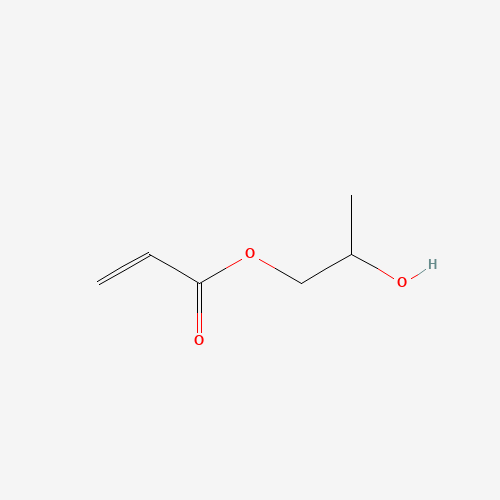
化合物详情
CAS999-61-1
分子式C6H10O3
分子量130.14 g/mol
非危品
structure in first source
科学粮草官-词典编辑部,修订于:2026-07-06
Toxicity
ToxicityEcotoxicity Values
LC50; Species: Pimephales promelas (Fathead minnow) juvenile age 28-34 days, weight 0.134 g, length 20.9 mm; Conditions: freshwater, flow through, hardness 45.3 mg/L CaCO3, alkalinity 47.0 mg/L CaCO3; Concentration: 3100 ug/L for 96 hr />97% purity/
Fate Summary
ATMOSPHERIC FATE: According to a model of gas/particle partitioning of semivolatile organic compounds in the atmosphere(1), 2-hydroxypropyl acrylate, which has an estimated vapor pressure of 0.17 mm Hg at 25 °C(SRC), determined from a fragment constant method(2), is expected to exist solely as a vapor in the ambient atmosphere. Vapor-phase 2-hydroxypropyl acrylate is degraded in the atmosphere by reaction with photochemically-produced hydroxyl radicals and ozone(SRC); the half-lives for these reactions in air are estimated to be 19 hours and 6.5 days(SRC), calculated from its respective rate constants of 2.0X10⁻¹¹ and 1.7X10⁻¹⁸ cu cm/molecule-sec at 25 °C(SRC) that were derived using a structure estimation method(2). 2-Hydroxypropyl acrylate contains chromophores that absorb at waveleng...
Soil Adsorption / Mobility
Using a structure estimation method based on molecular connectivity indices(1), the Koc of 2-hydroxypropyl acrylate can be estimated to be 1.4(SRC). According to a classification scheme(2), this estimated Koc value suggests that 2-hydroxypropyl acrylate is expected to have very high mobility in soil.
Environmental Biodegradation
AEROBIC: Biodegradation data specific to 2-hydroxypropyl acrylate were not located; however, results from ready biodegradation studies are available for the commercial hydroxypropyl acrylate isomer mixture which contains 75-80% 2-hydroxypropyl acrylate and 25-30% 1-methyl-2-hydroxyethyl acrylate(1-2). Hydroxypropyl acrylate, present at 100 mg/L, reached 83% of its Theoretical BOD in 4 weeks using an activated sludge inoculum at 30 mg/L in the Japanese MITI test(1). Hydroxypropyl acrylate, present at 3 mg/L, reached 34.9% of its Theoretical OD after 4 weeks using a domestic activated sludge inoculum in the closed bottle test for ready biodegradability(2). In a similar test, hydroxypropyl acrylate was biodegraded 73% after 20 days(2).
Environmental Bioconcentration
An estimated BCF of 3 was calculated in fish for 2-hydroxypropyl acrylate(SRC), using a log Kow of 0.35(1) and a regression-derived equation(2). According to a classification scheme(3), this BCF suggests the potential for bioconcentration in aquatic organisms is low.
Volatilization from Water / Soil
The Henry's Law constant for 2-hydroxypropyl acrylate is estimated as 1.7X10⁻⁹ atm-cu m/mole(SRC) using a fragment constant estimation method(1). This Henry's Law constant indicates that 2-hydroxypropyl acrylate is expected to be essentially nonvolatile from water and moist soil surfaces(2). 2-Hydroxypropyl acrylate is not expected to volatilize from dry soil surfaces(SRC) based upon an estimated vapor pressure of 0.17 mm Hg(SRC), determined from a fragment constant method(1).
Environmental Abiotic Degradation
The rate constant for the vapor-phase reaction of 2-hydroxypropyl acrylate with photochemically-produced hydroxyl radicals has been estimated as 2.0X10⁻¹¹ cu cm/molecule-sec at 25 °C(SRC) using a structure estimation method(1). This corresponds to an atmospheric half-life of about 20 hours at an atmospheric concentration of 5X10+5 hydroxyl radicals per cu cm(1). The rate constant for the vapor-phase reaction of 2-hydroxypropyl acrylate with ozone has been estimated as 1.7X10⁻¹⁸ cu cm/molecule-sec at 25 °C(SRC) that was derived using a structure estimation method(1). This corresponds to an atmospheric half-life of about 6.5 days at an atmospheric concentration of 7X10+11 ozone molecules per cu cm(2). A base-catalyzed second-order hydrolysis rate constant of 0.024 L/mole-sec(SRC) was esti...
ICSC Environmental Data
The substance is toxic to aquatic organisms. It is strongly advised not to let the chemical enter into the environment.
Artificial Pollution Sources
2-Hydroxypropyl acrylate's production and use in the manufacture of polymers and chemical intermediates(1) may result in its release to the environment through various waste streams(SRC).
Probable Routes of Human Exposure
Occupational exposure to 2-hydroxypropyl acrylate may occur through inhalation and dermal contact with this compound at workplaces where 2-hydroxypropyl acrylate is produced or used. The general population is not likely to be exposed to 2-hydroxypropyl acrylate. (SRC)
Environmental Fate / Exposure Summary
2-Hydroxypropyl acrylate's production and use in the manufacture of polymers and chemical intermediates may result in its release to the environment through various waste streams. If released to air, an estimated vapor pressure of 0.17 mm Hg at 25 °C indicates 2-hydroxypropyl acrylate will exist solely as a vapor in the atmosphere. Vapor-phase 2-hydroxypropyl acrylate will be degraded in the atmosphere by reaction with photochemically-produced hydroxyl radicals and ozone; the half-lives for these reactions in air are estimated to be 20 hours and 6.5 days, respectively. 2-Hydroxypropyl acrylate contains chromophores that absorb at wavelengths >290 nm and, therefore, may be susceptible to direct photolysis by sunlight. If released to soil, 2-hydroxypropyl acrylate is expected to have very...
Symptoms
irritation eyes, skin, respiratory system; eye, skin burns; cough, dyspnea (breathing difficulty)
Target Organs
Eyes, skin, respiratory system
Adverse Effects
Toxic Pneumonitis - Inflammation of the lungs induced by inhalation of metal fumes or toxic gases and vapors.
Exposure Routes
inhalation, skin absorption, ingestion, skin and/or eye contact
Toxicity Summary
IDENTIFICATION AND USE: 2-Hydroxypropyl acrylate (HPA) is a colorless liquid. It is used in manufacture of thermosetting resins for surface coatings. HUMAN STUDIES: There are no data available. ANIMAL STUDIES: Instillation of 0.1 mL in rabbit eye produced prompt, severe ocular irritation and corneal injury. In rabbits topical HPA application causes moderate burns (even when contacted as a 10% aqueous solution). Rats inhaling saturated HPA vapor generated at room temperature for 7 to 8 hours survived, but those exposed for 4 hours at approximately 650 ppm HPA vapor (generated at 100 °C) died either during exposure or within 1 hour after cessation of exposure. Marked signs of eye, nasal, and respiratory irritation were noted during the exposure period. When dogs were repeatedly exposed by...
Non-Human Toxicity Values
LD50 Rabbit subcutaneous 160 mg/kg
Non-Human Toxicity Excerpts
/LABORATORY ANIMALS: Acute Exposure/ Propylene glycol monoacrylate is markedly injurious to the eye. The application of approximately 0.1 mL to the eyes of rabbits caused marked to severe irritation and corneal injury sufficient to cause impairment of vision. In one report, the impairment was of such a nature that it could possibly be permanent.
Antidote and Emergency Treatment
/SRP:/ Advanced treatment: Consider orotracheal or nasotracheal intubation for airway control in the patient who is unconscious, has severe pulmonary edema, or is in severe respiratory distress. Early intubation, at the first sign of upper airway obstruction, may be necessary. Positive-pressure ventilation techniques with a bag-valve-mask device may be beneficial. Consider drug therapy for pulmonary edema ... . Consider administering a beta agonist such as albuterol for severe bronchospasm ... . Monitor cardiac rhythm and treat arrhythmias as necessary ... . Start IV administration of D5W /SRP: "To keep open", minimal flow rate/. Use 0.9% saline (NS) or lactated Ringer's (LR) if signs of hypovolemia are present. For hypotension with signs of hypovolemia, administer fluid cautiously. Con...









