


 一键配货
一键配货
化合物详情
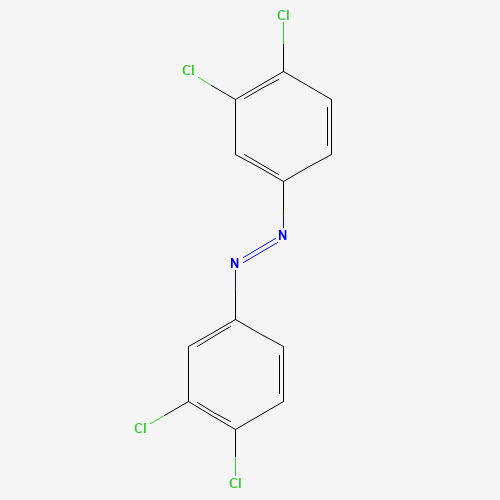
CAS14047-09-7
分子式C12H6Cl4N2
分子量320 g/mol g/mol
非危品
科学粮草官-词典编辑部,修订于:2026-07-06
Toxicity
ToxicityFate Summary
ATMOSPHERIC FATE: According to a model of gas/particle partitioning of semivolatile organic compounds in the atmosphere(1), 3,4,3',4'-tetrachloroazobenzene, which has an estimated vapor pressure of 1.56X10⁻⁷ mm Hg at 25 °C(SRC), determined from a fragment constant method(2), will exist in both the vapor and particulate phases in the ambient atmosphere. Vapor-phase 3,4,3',4'-tetrachloroazobenzene is degraded in the atmosphere by reaction with photochemically-produced hydroxyl radicals(SRC); the half-life for this reaction in air is estimated to be 50 days(SRC), calculated from its rate constant of 3.2X10⁻¹³ cu cm/molecule-sec at 25 °C(SRC) that was derived using a structure estimation method(2). Particulate-phase 3,4,3',4'-tetrachloroazobenzene may be removed from the air by wet or dry d...
Soil Adsorption / Mobility
Using a structure estimation method based on molecular connectivity indices(1), the Koc of 3,4,3',4'-tetrachloroazobenzene can be estimated to be 57,000(SRC). According to a classification scheme(2), this estimated Koc value suggests that 3,4,3',4'-tetrachloroazobenzene is expected to be immobile in soil. Residues of 3,4,3',4'-tetrachloroazobenzene in Arkansas rice soils remained primarily in the upper 0-10.1 cm soil layer(3).
Environmental Biodegradation
AEROBIC: In rice soil studies, 14-CO2 evolution during 3 and 6-month aging periods was only 0.04 and 0.13%, respectively, of applied radio-labeled 3,4,3',4'-tetrachloroazobenzene(1); mineralization of 3,4,3',4'-tetrachloroazobenzene to 14-CO2 during a 42-day growth period of rice plants was only 0.04-0.07%(1). Incubation of radio-labeled 3,4,3',4'-tetrachloroazobenzene for 6-months in French soils with different pHs and organic matter content evolved only 0.05-0.20% as 14-CO2(2); more than 93% was recovered intact in all soils(2) indicating microbiological and chemical stability(1,2).
Environmental Bioconcentration
An estimated BCF of 10 was calculated in fish for 3,4,3',4'-tetrachloroazobenzene(SRC), using a log Kow of 5.53(1) and a regression-derived equation(2). According to a classification scheme(3), this BCF suggests the potential for bioconcentration in aquatic organisms is low (SRC). In a 28-day aquarium study using snails, 3,4,3',4'-tetrachloroazobenzene bioaccumulated only to maximum level of 287 ppb (whole body basis)(4).
Volatilization from Water / Soil
The Henry's Law constant for 3,4,3',4'-tetrachloroazobenzene is estimated as 4.4X10⁻⁶ atm-cu m/mole(SRC) using a fragment constant estimation method(1). This Henry's Law constant indicates that 3,4,3',4'-tetrachloroazobenzene is expected to volatilize from water surfaces(2). Based on this Henry's Law constant, the volatilization half-life from a model river (1 m deep, flowing 1 m/sec, wind velocity of 3 m/sec)(2) is estimated as 8 days(SRC). The volatilization half-life from a model lake (1 m deep, flowing 0.05 m/sec, wind velocity of 0.5 m/sec)(2) is estimated as 66 days(SRC). However, volatilization from water surfaces is expected to be attenuated by adsorption to suspended solids and sediment in the water column. The estimated volatilization half-life from a model pond 2 meter deep i...
Environmental Abiotic Degradation
The rate constant for the vapor-phase reaction of 3,4,3',4'-tetrachloroazobenzene with photochemically-produced hydroxyl radicals has been estimated as 3.2X10⁻¹³ cu cm/molecule-sec at 25 °C(SRC) using a structure estimation method(1). This corresponds to an atmospheric half-life of about 50 days at an atmospheric concentration of 5X10+5 hydroxyl radicals per cu cm(1). 3,4,3',4'-Tetrachloroazobenzene contains the azo chromophore that absorbs at wavelengths >290 nm(2) and, therefore, may be susceptible to direct photolysis by sunlight(SRC). Laboratory irradiation of azobenzene in cyclohexane solution (via mercury vapor lamps, >290 nm) required about 100 hr of irradiation to achieve complete decomposition(3); initial photodecomposition products were identified as phenylazo, phenylazomethyl...
Artificial Pollution Sources
3,4,3',4'-Tetrachloroazobenzene is not commercially manufactured but is formed as an unwanted byproduct in the manufacture of 3,4-dichloroaniline and its herbicidal derivatives propanil, linuron, and diuron. In addition, environmental contamination by 3,4,3',4'-tetrachloroazobenzene occurs from the degradation of chloranilide herbicides and the photolysis and biolysis of 3,4-dichloroaniline(1).
Sediment/Soil Concentrations
SOIL: Analysis of rice soils in Arkansas treated with the herbicide propanil (3.4 to 13.5 kg/ha) detected 3,4,3',4'-tetrachloroazobenzene residue concentrations of <0.01 to 0.18 ppm(1).
Probable Routes of Human Exposure
Occupational exposure to 3,4,3',4'-tetrachloroazobenzene may occur through dermal contact with this compound at workplaces where 3,4,3',4'-tetrachloroazobenzene is produced or used(SRC). Occupational exposure to 3,3',4,4'-tetrachloroazobenzene has been reported in various manufacturing plants producing 3,4-dichloroaniline or herbicides derived from 3,4-dichloroaniline(1). Monitoring data indicate that human exposure to 3,4,3',4'-tetrachloroazobenzene may occur in rice fields and other locations treated with herbicides containing 3,4,3',4'-tetrachloroazobenzene as an impurity(1,2). Because 3,4-dichloroaniline is used as a precursor to dyes and, to a limited extent, as a heat transfer fluid in addition to its use in the manufacture of herbicides, 3,4,3',4'-tetrachloroazobenzene might be p...
Other Environmental Concentrations
3,4,3',4'-Tetrachloroazobenzene was detected as an impurity in commercial herbicides (diuron, propanil, linuron, neburon) at a concentration range of 0.00071 to 2.8 ppm and bulk reagents (e.g. 3,4-dichloroaniline, 3,4-dichloronitrobenzene) at a concentration range of 0.085 to 14 ppm(1). Twenty-three samples of propanil herbicide obtained from the Canadian marketplace were found to contain 3,4,3',4'-tetrachloroazobenzene levels of 1.1 to 30 ppm(2).
Environmental Fate / Exposure Summary
3,4,3',4'-Tetrachloroazobenzene is not commercially manufactured but is formed as an unwanted byproduct in the manufacture of 3,4-dichloroaniline and 3,4-dichloroaniline herbicidal derivatives propanil, linuron, and diuron. In addition, environmental contamination by 3,4,3',4'-tetrachloroazobenzene occurs from the degradation of chloranilide herbicides and the photolysis and biolysis of 3,4-dichloroaniline. If released to air, an estimated vapor pressure of 1.56X10⁻⁷ mm Hg at 25 °C indicates 3,4,3',4'-tetrachloroazobenzene will exist in both the vapor and particulate phases in the atmosphere. Vapor-phase 3,4,3',4'-tetrachloroazobenzene will be degraded in the atmosphere by reaction with photochemically-produced hydroxyl radicals; the half-life for this reaction in air is estimated to be...
Carcinogen Classification
Additional information: NB Overall evaluation upgraded to Group 2A
Non-Human Toxicity Values
LD50 Rat oral 5 g/kg
Non-Human Toxicity Excerpts
/ALTERNATIVE and IN VITRO TESTS/ 3,3',4,4'-Tetrachloroazobenzene (TCAB) and 3,3',4, 4'-tetrachloroazoxybenzene (TCAOB) are dioxin-like chemicals that were investigated for toxicity. ... As part of the comprehensive toxicological investigation of these chemicals, peripheral blood smears from mice treated 5 days per week for 13 weeks with 0.1-30mg/kg/day TCAB or TCAOB were analyzed for the frequency of micronucleated (MN) normochromatic erythrocytes (NCE). Both chemicals produced significant increases in MN-NCE in male and female mice. In contrast to these positive results in subchronic exposure studies, no significant increases were seen in acute bone marrow MN tests in male mice administered three daily injections of 50-200mg/kg/day TCAB and TCAOB. ...
Antidote and Emergency Treatment
/SRP:/ Advanced treatment: Consider orotracheal or nasotracheal intubation for airway control in the patient who is unconscious, has severe pulmonary edema, or is in severe respiratory distress. Positive-pressure ventilation techniques with a bag valve mask device may be beneficial. Consider drug therapy for pulmonary edema ... . Consider administering a beta agonist such as albuterol for severe bronchospasm ... . Monitor cardiac rhythm and treat arrhythmias as necessary ... . Start IV administration of D5W /SRP: "To keep open", minimal flow rate/. Use 0.9% saline (NS) or lactated Ringer's if signs of hypovolemia are present. For hypotension with signs of hypovolemia, administer fluid cautiously. Watch for signs of fluid overload ... . Treat seizures with diazepam or lorazepam ... . Use...









