


 一键配货
一键配货
化合物详情
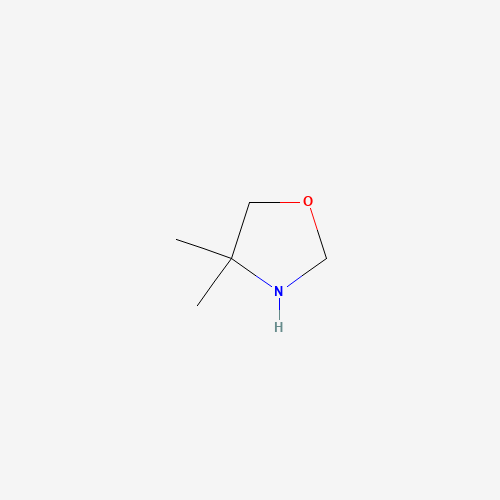
CAS51200-87-4
分子式C5H11NO
分子量101.147 g/mol g/mol
危化品
科学粮草官-词典编辑部,修订于:2026-07-06
Toxicity
ToxicityEPA Ecotoxicity
Pesticide Ecotoxicity Data from EPA: 12
Ecotoxicity Values
LC50; Species: /Cyprinodon variegatus/ (Sheepshead minnow); Conditions: saltwater, static; Concentration: 218 (171-248) ppm for 96 hr /82% purity/ /from table/
Fate Summary
ATMOSPHERIC FATE: According to a model of gas/particle partitioning of semivolatile organic compounds in the atmosphere(1), 4,4-dimethyl oxazolidine, which has an estimated vapor pressure of 7.58 mm Hg at 25 °C(SRC), determined from a fragment constant method(2), is expected to exist solely as a vapor in the ambient atmosphere. Vapor-phase 4,4-dimethyl oxazolidine is degraded in the atmosphere by reaction with photochemically-produced hydroxyl radicals(SRC); the half-life for this reaction in air is estimated to be 1.3 hrs(SRC), calculated from its rate constant of 1.0X10⁻¹⁰ cu cm/molecule-sec at 25 °C(SRC) that was derived using a structure estimation method(3). 4,4-Dimethyl oxazolidine does not contain chromophores that absorb at wavelengths >290 nm(4) and, therefore, is not expected...
Soil Adsorption / Mobility
Using a structure estimation method based on molecular connectivity indices(1), the Koc of 4,4-dimethyl oxazolidine can be estimated to be 9(SRC). According to a classification scheme(2), this estimated Koc value suggests that 4,4-dimethyl oxazolidine is expected to have very high mobility in soil. The pKa of 4,4-dimethyl oxazolidine is 9.35(3), indicating that this compound will exist almost entirely in the cation form in the environment and cations generally adsorb more strongly to soils containing organic carbon and clay than their neutral counterparts(4). However, adsorption is affected by the acidity of the soil/substrate(SRC).
Environmental Bioconcentration
4,4-Dimethyl oxazolidine hydrolyzes extremely rapidly in water(1). Therefore, bioconcentation is not expected to be an important environmental fate process(SRC).
Volatilization from Water / Soil
4,4-Dimethyl oxazolidine hydrolyzes extremely rapidly in water such that a half-life could not be determined(1). A pKa of 9.35(1) indicates 4,4-dimethyl oxazolidine will exist almost entirely in the cation form at pH values of 5 to 9(SRC). Therefore, volatilization from water and moist soil surfaces is not expected to be an important fate process(SRC). 4,4-Dimethyl oxazolidine is expected to volatilize from dry soil surfaces(SRC) based upon an estimated vapor pressure of 7.58 mm Hg(SRC), determined from a fragment constant method(2).
Environmental Abiotic Degradation
The rate constant for the vapor-phase reaction of 4,4-dimethyl oxazolidine with photochemically-produced hydroxyl radicals has been estimated as 1.0X10⁻¹⁰ cu cm/molecule-sec at 25 °C(SRC) using a structure estimation method(1). This corresponds to an atmospheric half-life of about 1.3 hours at an atmospheric concentration of 5X10+5 hydroxyl radicals per cu cm(1). 4,4-Dimethyl oxazolidine hydrolyzes rapidly to formaldehyde and 2-amino-2-methyl-1-propanol(2). 4,4-Dimethyl oxazolidine does not contain chromophores that absorb at wavelengths >290 nm(3) and, therefore, is not expected to be susceptible to direct photolysis by sunlight(SRC).
Artificial Pollution Sources
4,4-Dimethyl oxazolidine's production and use in some floor wax(1) and latex paint(2) products may result in its release to the environment through various waste streams; its use as an antimicrobial in industrial processes and water systems(3) will result in its direct release to the environment(SRC). Products containing this compound include oil recovery drilling muds, packer fluids, secondary oil recovery injection water, adhesives, metalworking cutting fluids, latex paints, resin emulsions and wet-end additives(2).
Probable Routes of Human Exposure
NIOSH (NOES Survey 1981-1983) has statistically estimated that 72,070 workers (9.363 of these are female) were potentially exposed to 4,4-dimethyl oxazolidine in the US(1). Occupational exposure to 4,4-dimethyl oxazolidine may occur through inhalation and dermal contact with this compound at workplaces where 4,4-dimethyl oxazolidine is produced or used(SRC).
Environmental Fate / Exposure Summary
4,4-Dimethyl oxazolidine's production and use as a preservative in some floor wax and paint products may result in its release to the environment through various waste streams; its use as an antimicrobial in water systems and industrial processes such as drilling muds will result in its direct release to the environment. If released to air, an estimated vapor pressure of 7.58 mm Hg at 25 °C indicates 4,4-dimethyl oxazolidine will exist solely as a vapor in the atmosphere. Vapor-phase 4,4-dimethyl oxazolidine will be degraded in the atmosphere by reaction with photochemically-produced hydroxyl radicals; the half-life for this reaction in air is estimated to be 1.3 hours. 4,4-Dimethyl oxazolidine does not contain chromophores that absorb at wavelengths >290 nm and, therefore, is not expec...
Toxicity Data
LC50 (rat) = 1,100 mg/m3
Toxicity Summary
IDENTIFICATION AND USE: 4,4-Dimethyl oxazolidine is a colorless to slightly yellow liquid. It is registered for pesticide use in the USA but approved pesticide uses may change periodically and so federal, state and local authorities must be consulted for currently approved uses. 4,4-Dimethyl oxazolidine is used as an antimicrobial to control bacteria and fungi in oil recovery drilling muds, packer fluids, secondary oil recovery injection water, adhesives, metalworking cutting fluids, latex paints, resin emulsions, wet-end additives and industrial processing chemicals or in specialty industrial products. HUMAN EXPOSURE AND TOXICITY: There are no data available. ANIMAL STUDIES: In rats and rabbits it produced skin irritation, combined with reduced bodyweight gain in rats. In rats microsco...
Non-Human Toxicity Values
LD50 Rat dermal >2000 mg/kg
Non-Human Toxicity Excerpts
/LABORATORY ANIMALS: Developmental or Reproductive Toxicity/ Oxaban-A, purity not stated but assumed 78%, specific gravity 0.9832, was administered neat to the skin (shaven backs) of 16 mated New Zealand White female rabbits/group at doses of 0 (deionized water), 30, 100, and 300 mg/kg/day for 6 hours/day on gestation days 7 through 19. Volumes were 0.0305, 0.1017 and 0.3051 mL/kg of undiluted material as supplied. Thrashing in the cage immediately after dosing occurred in 1, 5 and 4 does treated with 30, 100 and 300 mg/kg, respectively, on days 18 and/or 19 of gestation. Maternal NOEL < 30 mg/kg/day (skin irritation). Developmental NOEL >300 mg/kg/day.
Antidote and Emergency Treatment
/SRP:/ Advanced treatment: Consider orotracheal or nasotracheal intubation for airway control in the patient who is unconscious, has severe pulmonary edema, or is in severe respiratory distress. Positive-pressure ventilation techniques with a bag valve mask device may be beneficial. Consider drug therapy for pulmonary edema ... . Consider administering a beta agonist such as albuterol for severe bronchospasm ... . Monitor cardiac rhythm and treat arrhythmias as necessary ... . Start IV administration of D5W TKO /SRP: "To keep open", minimal flow rate/. Use 0.9% saline (NS) or lactated Ringer's (LR) if signs of hypovolemia are present. For hypotension with signs of hypovolemia, administer fluid cautiously. Watch for signs of fluid overload ... . Treat seizures with diazepam or lorazepam...









