


 一键配货
一键配货
化合物详情
CAS16219-75-3
分子式C9H12
分子量120.19 g/mol
非危品
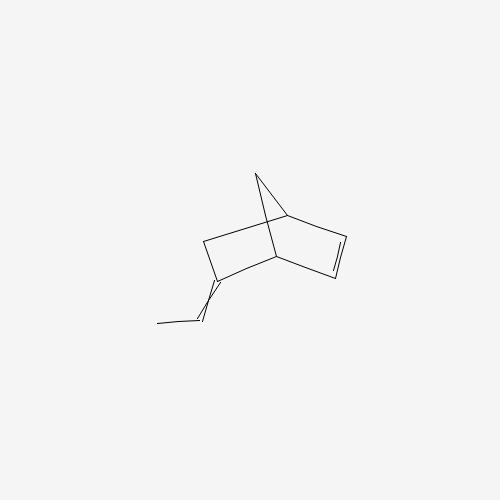
Physical Description | Ethylidene norbornene is a colorless liquid with an odor of turpentine. Floats on water.
科学粮草官-词典编辑部,修订于:2026-07-06
Toxicity
ToxicityFate Summary
ATMOSPHERIC FATE: According to a model of gas/particle partitioning of semivolatile organic compounds in the atmosphere(1), 5-ethylidene-2-norbornene, which has an estimated vapor pressure of 3.6 mm Hg at 25 °C(2), is expected to exist solely in the gas phase in the ambient atmosphere. Vapor-phase 5-ethylidene-2-norbornene is degraded in the atmosphere by reaction with photochemically-produced hydroxyl radicals(SRC); the half-life for this reaction in air is estimated to be 3 hours from its estimated rate constant of 1.5X10⁻¹⁰ cu cm/molecule-sec at 25 °C(3). The half-life for the reaction with ozone molecules is estimated to be 26 minutes(SRC) calculated from its rate constant of 6.3X10⁻¹⁶ cu cm/molecule-sec at 25 °C(4).
Soil Adsorption / Mobility
Using a structure estimation method based on molecular connectivity indices(1), the Koc for 5-ethylidene-2-norbornene is estimated to be 900(SRC). According to a classification scheme(2), this estimated Koc value suggests that 5-ethylidene-2-norbornene is expected to have low mobility in soil.
Environmental Biodegradation
AEROBIC: 5-Ethylidene-2-norbornene, at a concentration of 100 mg/l, reached 0% of its theoretical BOD over 4 weeks using a mixed inoculum of sludge, soil, and sediment in the Japanese MITI test(1).
Environmental Bioconcentration
BCFs of 70-160 were obtained in Carp for 5-ethylidene-2-norbornene in an eight-week screening test. According to a classification scheme(2), these BCFs suggest the potential for bioconcentration in aquatic organisms is moderate to high.
Volatilization from Water / Soil
The Henry's Law constant for 5-ethylidene-2-norbornene is estimated as 0.13 atm-cu m/mole(SRC) using a fragment constant estimation method(1). This Henry's Law constant indicates that 5-ethylidene-2-norbornene is expected to volatilize rapidly from water surfaces(2). Based on this Henry's Law constant, the volatilization half-life from a model river (1 m deep, flowing 1 m/sec, wind velocity of 3 m/sec)(2) is estimated as 3 hours(SRC). The volatilization half-life from a model lake (1 m deep, flowing 0.05 m/sec, wind velocity of 0.5 m/sec)(2) is estimated as 4 days(SRC). 5-Ethylidene-2-norbornene's Henry's Law constant(1) indicates that volatilization from moist soil surfaces may occur(SRC). The volatilization half-life from a model pond 2 m deep is estimated to be 38 hrs ignoring adsorp...
Environmental Abiotic Degradation
The rate constant for the vapor-phase reaction of 5-ethylidene-2-norbornene with photochemically-produced hydroxyl radicals has been estimated as 1.5X10⁻¹⁰ cu cm/molecule-sec at 25 °C(SRC) using a structure estimation method(1). This corresponds to an atmospheric half-life of about 3 hours at an atmospheric concentration of 5X10+5 hydroxyl radicals per cu cm(1). The half-life for the reaction with ozone molecules is estimated to be 26 minutes(SRC) calculated from its rate constant of 6.3X10⁻¹⁶ cu cm/molecule-sec at 25 °C and an atmospheric concentration of 7X10+11 ozone molecules per cu cm(4). 5-Ethylidene-2-norbornene is not expected to undergo hydrolysis in the environment due to the lack of hydrolyzable functional groups(3) nor to directly photolyze due to the lack of absorption in t...
Artificial Pollution Sources
5-Ethylidene-2-norbornene's production and use as a monomer(1,2) may result in its release to the environment through various waste streams(SRC).
Probable Routes of Human Exposure
Occupational exposure to 5-ethylidene-2-norbornene may occur through inhalation and dermal contact with this compound at workplaces where 5-ethylidene-2-norbornene is produced or used. (SRC)
Environmental Fate / Exposure Summary
5-Ethylidene-2-norbornene's production and use as a monomer may result in its release to the environment through various waste streams. If released to air, an estimated vapor pressure of 3.6 mm Hg at 25 °C indicates 5-ethylidene-2-norbornene will exist solely in the vapor phase in the ambient atmosphere. Vapor-phase 5-ethylidene-2-norbornene will be degraded in the atmosphere by reaction with photochemically-produced hydroxyl radicals and ozone molecules; the half-life for these reactions in air is estimated to be 3 and 0.4 hrs, respectively. If released to soil, 5-ethylidene-2-norbornene is expected to have slight mobility based upon an estimated Koc of 900. Volatilization from moist soil surfaces is expected to be an important fate process based upon an estimated Henry's Law constant...
Symptoms
irritation eyes, skin, nose, throat; headache; cough, dyspnea (breathing difficulty); nausea, vomiting; olfactory, taste changes; chemical pneumonitis (aspiration liquid); In Animals: liver, kidney, urogenital injury; bone marrow effects
Target Organs
Eyes, skin, respiratory system, central nervous system, liver, kidneys, urogenital system, bone marrow
Toxicity Data
LC50 (rat) = 1,246 ppm/4h
Adverse Effects
Occupational hepatotoxin - Secondary hepatotoxins: the potential for toxic effect in the occupational setting is based on cases of poisoning by human ingestion or animal experimentation.
Exposure Routes
inhalation, skin absorption, ingestion, skin and/or eye contact
Human Toxicity Excerpts
IF SPILLED ON CLOTHING & ALLOWED TO REMAIN, MAY CAUSE SMARTING & REDDENING OF SKIN.









