


 一键配货
一键配货
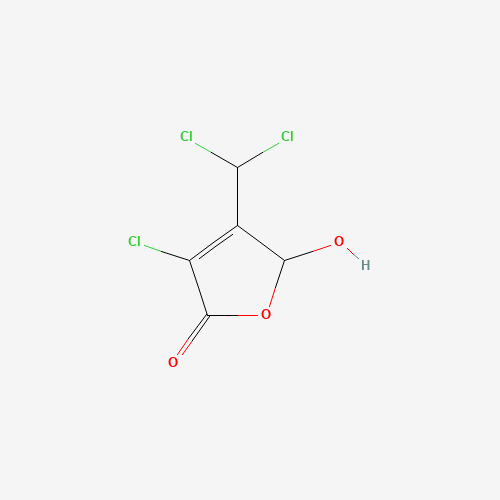
化合物详情
CAS77439-76-0
分子式C5H3Cl3O3
分子量217.435 g/mol
非危品
MX (3-chloro-4-dichloromethyl-5-hydroxy-2(5H)-furanone) can cause cancer according to an independent committee of scientific and health experts.
科学粮草官-词典编辑部,修订于:2026-07-06
Toxicity
ToxicityFate Summary
ATMOSPHERIC FATE: According to a model of gas/particle partitioning of semivolatile organic compounds in the atmosphere(1), 3-chloro-4-(dichloromethyl)-5-hydroxy-2(5H)-furanone, which has an estimated vapor pressure of 1.6X10⁻⁶ mm Hg at 25 °C(SRC), determined from a fragment constant method(2), will exist in both the vapor and particulate phases in the ambient atmosphere. Vapor-phase 3-chloro-4-(dichloromethyl)-5-hydroxy-2(5H)-furanone is degraded in the atmosphere by reaction with photochemically-produced hydroxyl radicals(SRC); the half-life for this reaction in air is estimated to be 1.2 days(SRC), calculated from its rate constant of 1.4X10⁻¹¹ cu cm/molecule-sec at 25 °C(SRC)that was derived using a structure estimation method(3). Particulate-phase 3-chloro-4-(dichloromethyl)-5-hydr...
Soil Adsorption / Mobility
The Koc of 3-chloro-4-(dichloromethyl)-5-hydroxy-2(5H)-furanone is estimated as 98(SRC), using a log Kow of 1.13(1)and a regression-derived equation(2). According to a classification scheme(3), this estimated Koc value suggests that 3-chloro-4-(dichloromethyl)-5-hydroxy-2(5H)-furanone is expected to have high mobility in soil.
Environmental Biodegradation
AEROBIC: Microbial and biological degradation of 3-chloro-4-(dichloromethyl)-5-hydroxy-2(5H)-furanone in drinking and surface water samples were studied using 14C- labeled 3-chloro-4-(dichloromethyl)-5-hydroxy-2(5H)-furanone. Samples collected from a humus-rich lake in Finland and drinking water processed from this lake were incubated at atmospheric conditions for two days in order to evaporate any free chlorine. 10-20 ug of the 14C-labeled 3-chloro-4-(dichloromethyl)-5-hydroxy-2(5H)-furanone were added to the water samples at concentrations of 0.5-1.0 ug/mL and incubated at 20 °C in the dark for 14 days at pH values of 5.5 and 8. At pH 5.5, 9.4% 14C reduction was observed in drinking water and 13.1% was observed in surface water. At pH 8, 25.0% 14C reduction was observed in drinking wa...
Environmental Bioconcentration
An estimated BCF of 1.5 was calculated for 3-chloro-4-(dichloromethyl)-5-hydroxy-2(5H)-furanone(SRC), using a log Kow of 1.13(1) and a regression-derived equation(2). According to a classification scheme(3), this BCF suggests the potential for bioconcentration in aquatic organisms is low (SRC).
Volatilization from Water / Soil
The Henry's Law constant for 3-chloro-4-(dichloromethyl)-5-hydroxy-2(5H)-furanone is estimated as 2.5X10⁻¹⁰ atm-cu m/mole(SRC) using a fragment constant estimation method(1). This Henry's Law constant indicates that 3-chloro-4-(dichloromethyl)-5-hydroxy-2(5H)-furanone is expected to be essentially nonvolatile from water surfaces(2). 3-Chloro-4-(dichloromethyl)-5-hydroxy-2(5H)-furanone's Henry's Law constant indicates that volatilization from moist soil surfaces is not expected to occur(SRC). 3-Chloro-4-(dichloromethyl)-5-hydroxy-2(5H)-furanone is not expected to volatilize from dry soil surfaces(SRC) based upon an estimated vapor pressure of 1.6X10⁻⁶ mm Hg(SRC), determined from a fragment constant method(3).
Environmental Abiotic Degradation
The rate constant for the vapor-phase reaction of 3-chloro-4-(dichloromethyl)-5-hydroxy-2(5H)-furanone with photochemically-produced hydroxyl radicals has been estimated as 1.4X10⁻¹¹ cu cm/molecule-sec at 25 °C(SRC) using a structure estimation method(1). This corresponds to an atmospheric half-life of about 1.2 days at an atmospheric concentration of 5X10+5 hydroxyl radicals per cu cm(1). The rate constant for the vapor-phase reaction of 3-chloro-4-(dichloromethyl)-5-hydroxy-2(5H)-furanone with ozone has been estimated as 1.06X10⁻¹⁷ cu cm/molecule-sec at 25 °C(SRC) that was derived using a structure estimation method(1). This corresponds to an atmospheric half-life of about 1.1 days at an atmospheric concentration of 7X10+11 ozone molecules per cu cm(2). 3-Chloro-4-(dichloromethyl)-5-h...
Environmental Water Concentrations
SURFACE WATER: Natural freshwater samples with high humic content (TOC = 25 mg/L) were collected from a lake in southwest Finland. The water was chlorinated at a 1:1 chlorine ratio at ambient temperature under darkness until a residual chlorine concentration of 0.1 mg/L was achieved. The samples were acidified to pH 2.0 with 4 molar hydrochloric acid. The concentrations of 3-chloro-4-(dichloromethyl)-5-hydroxy-2(5H)-furanone in the two samples were 380 and 190 ng/L(1).
Ecotoxicity Excerpts
/AQUATIC SPECIES/ ...Two species of shellfish, Patunopecten yessoensis and Tapes japonica, /were exposed/ for 4 hr to artificial sea water in which ... 3-chloro-4-dichloromethyl-5-hydroxy-2(H)-furanone (MX) ... /was/ dissolved. ... DNA damage /was assessed/ in cells isolated from the gills using the alkaline single-cell gel electrophoresis (SCG) assay. A statistically significant increase in DNA damage was observed for all exposures ... T. japonica was exposed to sea water sampled from two Pacific Ocean coasts of Japanese local cities--Hachinohe (Aomori Prefecture, Tohoku) and Nakatsu (Oita Prefecture, Kyushu)--and three bay coasts of the industrial megalopolises--Tokyo, Osaka, and Kobe. A significant increase in DNA damage was observed after the exposure to sea water from Tokyo, Osaka,...
Effluent Concentrations
The most potent bacterial mutagen in pulp mill effluents was identified as 3-chloro-4-(dichloromethyl)-5-hydroxy-2(5H)-furanone (MX). ... Research has shown that MX stability decreases with increasing pH in the range of pH 2 - 6. Most waste water treatment facilities operate at a pH of 6 - 7. Accordingly, MX should be deactivated and destroyed at pulp mills where the bleach plant effluent goes directly for conventional waste water treatment. However MX could pose a serious risk if mill effluents were discharged directly to receiving waters. This is particularly so in Canada and Northern Europe where lake and river waters may be slightly acidic due to poor buffering capacity, high humic acid content, and acid rain.
Artificial Pollution Sources
3-Chloro-4-(dichloromethyl)-5-hydroxy-2(5H)-furanone's formation is a result of addition of chlorine or other disinfectants used to control contaminants in drinking water reacting with naturally occurring organic and inorganic matter present in raw water(1,2); this may result in its release to the environment(SRC).
Probable Routes of Human Exposure
The most likely pathway by which the general public is exposed to this compound is by ingestion of and dermal contact with treated drinking water. (SRC)
Environmental Fate / Exposure Summary
3-Chloro-4-(dichloromethyl)-5-hydroxy-2(5H)-furanone's formation is a result of addition of chlorine or other disinfectants used to control contaminants in drinking water reacting with naturally occurring organic and inorganic matter present in water; this may result in its release to the environment. If released to air, an estimated vapor pressure of 1.64X10⁻⁶ mm Hg at 25 °C indicates 3-chloro-4-(dichloromethyl)-5-hydroxy-2(5H)-furanone will exist in both the vapor and particulate phases in the atmosphere. Vapor-phase 3-chloro-4-(dichloromethyl)-5-hydroxy-2(5H)-furanone will be degraded in the atmosphere by reaction with photochemically-produced hydroxyl radicals; the half-life for this reaction in air is estimated to be 1.2 days. Particulate-phase 3-chloro-4-(dichloromethyl)-5-hydroxy...
Interactions
The genotoxic responses of mixtures of four chlorohydroxyfuranones (CHFs), 3-chloro-4-(dichloromethyl)-5-hydroxy-2(5H)-furanone (MX), 3,4-dichloro-5-hydroxy-2(5H)-furanone (MCA), 3-chloro- 4-(chloromethyl)-5-hydroxy-2(5H)-furanone (CMCF) and 3-chloro-4-methyl-5-hydroxy-2(5H)-furanone (MCF), were compared with the genotoxicity of the individual compounds. Genotoxicity was evaluated in the Salmonella reversion assay (Ames test), the in vitro Chinese hamster ovary (CHO) cell Hprt mutation assay, and in the CHO chromosome aberration test. When tested individually, the concentrations of the chemicals that were chosen for the mixtures induced no or only a modest increase in the genotoxic effects, and caused little or no cytotoxicity. In the Ames test, the genotoxic responses caused by the mix...
Human Toxicity Excerpts
/GENOTOXICITY/ ... Single cell gel electrophoresis (SCGE) and flow cytometry were used to detect DNA damage and apoptosis in human fetal hepatocytes (L-02) treated with MX. ... DNA damage was found to increase in L-02 cells treated with MX in a dose-response manner. On treatment levels of 100 and 300 umol/L, MX led to significant increase of DNA damage in comparison to the solvent controls (DMSO) (P < 0.05, and P < 0.01 respectively). Statistically significant increases of L-02 cell apoptosis were observed in all MX treated groups in comparison to the solvent controls (DMSO) (P < 0.001)...
Carcinogen Classification
IARC Monographs: Volume 84: (2004) Some Drinking-water Disinfectants and Contaminants, including Arsenic
Non-Human Toxicity Values
LD50 Rat (SD, male & female) oral (gavage) 128 mg/kg
Non-Human Toxicity Excerpts
/LABORATORY ANIMALS: Acute Exposure/ Very limited mortality was observed in weanling CD-1 mice administered a single dose of 144 mg/kg of body weight. In this study, focal epithelial hyperplasia was observed in the stomach, and some vacuolation of the superficial villus epithelium was observed in the duodenum and jejunum. Evidence of increased numbers of mitotic figures was observed in the liver, and the possibility of some cytotoxicity was identified in the urinary bladder.
Evidence for Carcinogenicity
There is inadequate evidence in humans for the carcinogenicity of MX. There is limited evidence in experimental animals for the carcinogenicity of MX. MX is a potent, direct-acting mutagen that induces primarily GC to TA transversions in both bacterial and mammalian cells. It induces DNA damage in bacterial and mammalian cells as well as in rodents in vivo. MX is a chromosomal mutagen in mammalian cells and in rats, and it induces mammalian cell transformation in vitro. The MX-associated thyroid gland tumors in rats are caused by mechanisms other than TSH-mediated hormonal promotion. Overall evaluation 3-Chloro-4-(dichloromethyl)-5-hydroxy-2(5H)-furanone (MX) is possibly carcinogenic to humans (Group 2B).









